
Tesla’s redesigned Roadster has revived a long-running question about the company’s product strategy: how far can ambitious demonstrations advance a vehicle’s commercial appeal when production, affordability and everyday usability remain unresolved? The electric sports car’s latest presentation combined a high-performance concept with SpaceX-associated propulsion technology, including demonstrations involving controlled movement above the ground. Production is targeted for 2028, extending a programme first announced in 2017. The unveiling has renewed attention on Tesla’s engineering ambitions, but it has also made the distinction between a dramatic prototype and a commercially viable vehicle more important.
The Roadster occupies an unusual position in Tesla’s portfolio. Unlike mass-market electric cars, which compete on price, range, charging convenience and operating costs, a high-performance sports car can function as a technology showcase. Its purpose may include demonstrating acceleration, battery performance and advanced engineering rather than generating the largest possible sales volume. Yet the vehicle’s long development history means that expectations now extend beyond the spectacle of a presentation. Potential buyers and investors will eventually need evidence that the technology can be manufactured, certified and delivered at a price customers are prepared to pay.
A Long Development Cycle Raises Expectations
Tesla first presented the second-generation Roadster in 2017, with production originally expected much earlier than the latest target. The prolonged delay has increased the significance of the new unveiling because the vehicle is no longer simply an ambitious concept awaiting refinement. It is a product whose credibility depends on whether the company can convert years of promises into a functioning commercial programme.
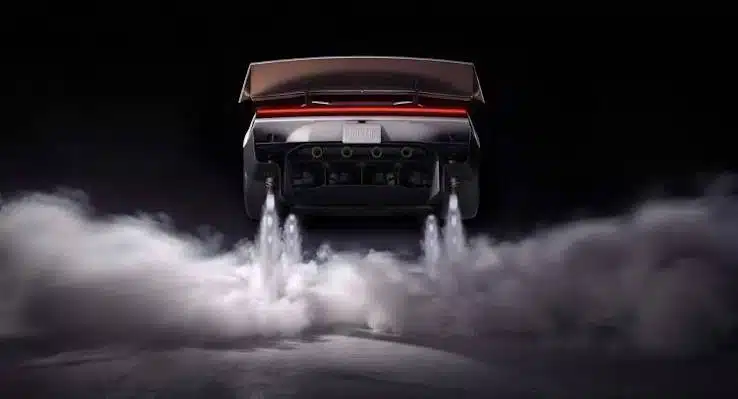
The latest demonstration featured a vehicle using a combination of propulsion and airflow technologies to perform unusual manoeuvres, including moving along an inverted structure and lifting above other vehicles. Company chief executive Elon Musk has also promoted an acceleration target of zero to 60 miles per hour in about one second. Such claims would place the Roadster in an exceptional performance category, but the commercial meaning depends on the conditions under which they can be achieved, repeated and verified.
A demonstration can establish that a particular prototype is capable of performing a manoeuvre under controlled conditions. It does not automatically establish the performance, safety or reliability of a production vehicle across different weather conditions, road surfaces and operating environments. Customers also need to understand the trade-offs involved in achieving extreme acceleration, including tyre performance, braking requirements, thermal management and the effect of repeated high-power operation on the vehicle’s systems.
Rocket Technology Creates Engineering Trade-Offs
The proposed integration of SpaceX-related thrusters is the most unusual aspect of the Roadster’s presentation. Rocket-style propulsion could, in principle, produce forces that conventional road-car systems cannot easily replicate. However, incorporating such technology into a consumer vehicle introduces challenges that extend beyond raw thrust. Engineers must consider how propulsion hardware is packaged, how its operation is controlled and what safeguards are required to prevent injury or damage.
A vehicle that briefly lifts off the ground occupies a different engineering category from one that accelerates rapidly while maintaining contact with the road. Normal road cars depend on tyres for traction, steering and braking. Once a vehicle leaves the road surface, those systems cannot perform their ordinary functions until contact is restored. Managing the transition between ground movement and airborne motion would therefore require precise control and a clear understanding of how the vehicle responds to changing forces.
The legal and practical requirements are equally important. A demonstration performed at a controlled test facility does not establish that the same manoeuvre would be permitted on public roads. Road certification, pedestrian safety, crash protection, visibility, braking performance and compliance with vehicle regulations remain essential considerations. A version intended for road use may need substantially different capabilities or restrictions from a specialised version designed primarily for demonstrations.
The distinction between a technologically possible feature and a commercially useful one is central to the Roadster’s prospects. Customers purchasing a sports car may value acceleration and distinctive engineering, but they also expect predictable handling, dependable performance and a clear maintenance regime. Any propulsion system that adds complexity, operating restrictions or significant cost must provide a corresponding benefit that customers can understand.
The Business Case Extends Beyond Performance
For Tesla, the Roadster offers an opportunity to demonstrate technical ambition at a time when the electric-vehicle industry faces intensifying competition. Established manufacturers and newer entrants are developing electric performance cars, improving battery systems and competing on software and charging infrastructure. A distinctive product can help a company attract attention, reinforce its technological identity and generate interest beyond the immediate market for the vehicle.
However, the Roadster’s financial contribution cannot be assessed solely through publicity. Production requires supply-chain planning, component validation, manufacturing capacity and quality control. A specialised vehicle with unusual engineering may be expensive to manufacture in small quantities, while the absence of a confirmed price makes it difficult to assess its potential market. Tesla has also not established through the demonstration alone how the final production model will compare with competing vehicles in range, durability and real-world performance.
There is a strategic question about resource allocation as well. Engineering teams working on a highly specialised sports car must balance the demands of a complex product against other corporate priorities. The Roadster could support wider technological development if its innovations prove adaptable to other vehicles. But that benefit should not be assumed before the company demonstrates which components can be transferred economically and which are specific to the sports car.
A premium product can still make commercial sense without mass-market volumes, particularly if customers are willing to pay for exceptional performance or exclusivity. Yet the longer development takes, the greater the importance of controlling costs and maintaining buyer confidence. The company will need to demonstrate that its ambitions are supported by a credible production schedule rather than relying indefinitely on the attraction of future capabilities.
Delivery Will Matter More Than the Demonstration
The Roadster’s unveiling has generated attention by combining electric performance with aerospace-inspired technology. Its longer-term significance, however, will depend on what Tesla delivers before the 2028 production target. Independent performance testing, technical specifications, regulatory clarity and evidence of manufacturing readiness will be more useful measures of progress than the spectacle of a prototype performing extraordinary manoeuvres.
Potential buyers will also need clear information about the different versions, their intended use and the limitations attached to any specialised propulsion system. A vehicle designed for public roads must meet requirements that do not necessarily apply to a demonstration model. Transparent explanations of those distinctions would help customers assess the product on practical grounds rather than treating every feature shown during a presentation as a standard production capability.
The Roadster illustrates both the promise and the difficulty of using an ambitious product to define a company’s technological identity. Extreme performance can attract attention and encourage engineering innovation, but it cannot substitute for reliable manufacturing, regulatory compliance and customer value. Tesla’s next challenge is to show that its latest vision can move from a controlled demonstration to a vehicle that fulfils its claims under real-world conditions.
(Source:www.businessinsider.com)