

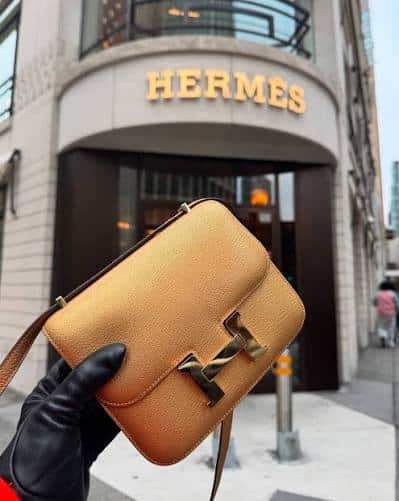
Hermes’ latest quarterly results expose a growing divide within the luxury goods market: demand for the most recognisable and tightly controlled products remains comparatively resilient, while broader categories are showing signs of strain. The French luxury group recorded slower-than-expected revenue growth as sales of clothing and accessories weakened, raising questions about how far its reputation for exclusivity can protect it from deteriorating consumer confidence.
The figures are particularly significant because Hermes has traditionally been regarded as one of the industry’s strongest performers. Its ability to sustain demand for highly desirable leather goods has helped distinguish it from competitors during periods of economic uncertainty. Yet the latest results suggest that even a powerful brand cannot entirely escape changes in spending patterns, particularly in China, a crucial market for luxury companies.
A widening gap between product categories
Hermes reported third-quarter revenue of approximately 4.10 billion euros, representing growth of 4.3% at constant exchange rates. The increase fell short of analyst expectations and marked the company’s weakest quarterly growth rate in six years. The slowdown followed stronger growth in the previous quarter, indicating that momentum had weakened as the year progressed.
The most striking difference was between leather goods and ready-to-wear clothing and accessories. Sales of leather goods, including the company’s best-known handbags, rose by 10.8%, while the clothing and accessories division recorded a 2% decline. The contrast suggests that consumer demand is becoming more selective, with some buyers continuing to prioritise signature products while reducing spending on other luxury purchases.
This divergence matters because a luxury house cannot rely indefinitely on the performance of a narrow group of highly sought-after items. Clothing, footwear, jewellery and accessories help broaden customer relationships and encourage repeat purchases. Weakness in these categories can therefore reveal changes in the wider business that strong handbag sales may temporarily conceal.
However, the figures do not establish that the brand’s appeal is declining across the board. Leather goods continued to expand, and the performance of individual categories can be influenced by product launches, supply availability and the timing of purchases. The more important question is whether the weakness outside the core handbag business persists.
China’s importance becomes harder to ignore
China’s luxury market has become a central concern for European brands as consumers respond to economic uncertainty and adjust discretionary spending. Hermes’ management described the market as particularly difficult, while revenue across Asia excluding Japan was flat at constant exchange rates during the quarter.
The slowdown presents a challenge for companies that have benefited from Chinese demand both at home and through international shopping destinations. Luxury purchases are especially sensitive to confidence because many products are discretionary rather than essential. Even wealthy consumers can become more cautious when they face uncertainty about investments, property values or future economic conditions.
A weaker Chinese market also affects how luxury groups plan store expansion, marketing and inventory. Companies must decide whether to maintain investment in anticipation of a recovery or adapt more quickly to current demand. Hermes has indicated that it remains confident about its longer-term prospects in China, but that position does not remove the need to respond to short-term changes in consumer behaviour.
The difficulty is that a recovery cannot be assumed simply because the market was previously an important source of growth. Luxury companies must demonstrate that customers are willing to spend again and that their products remain competitive in a changing environment.
Exclusivity is an advantage, but not an absolute shield
Hermes’ carefully managed distribution and reputation for craftsmanship have supported its pricing power. The appeal of its most desirable products depends partly on their perceived rarity, quality and status. These characteristics can make demand more resilient than it is for brands competing primarily through discounts or broad product availability.
Yet exclusivity also creates a strategic balancing act. A company must maintain enough availability to serve customers and grow revenue without weakening the perception that its products are difficult to obtain. Questions about the availability of iconic handbags on resale platforms have added another dimension to this challenge, although resale activity alone does not establish that the brand has lost its appeal.
The broader issue is whether exclusivity can sustain growth across a sufficiently wide product range. Strong demand for signature handbags does not automatically translate into equivalent demand for clothing, shoes or accessories. If customers increasingly concentrate spending on a small number of prestigious items, the company’s wider business may face pressure even while its most famous products remain popular.
That makes product development and customer engagement important. Hermes must preserve its established identity while offering compelling reasons for consumers to buy beyond its best-known products.
The slowdown has implications beyond Hermes itself. Luxury companies have often commanded premium valuations because investors expect strong brands to sustain pricing power and generate attractive margins. When growth slows, markets must reconsider whether those valuations adequately reflect changing demand and the risks facing the sector.
Hermes’ share price has faced substantial pressure during 2026, adding to concerns about the outlook for luxury stocks. The decline reflects a broader reassessment of expectations, rather than definitive proof that the company’s long-term business model has failed. Market prices respond not only to current results but also to how those results compare with what investors had anticipated.
The challenge for management is to show that slower growth is manageable and that the company’s investment decisions remain justified. Maintaining craftsmanship, controlling costs and developing products that appeal to customers will matter more than attempting to restore growth through indiscriminate expansion.
Hermes remains supported by its established brand and the continued strength of its leather goods business. But the latest quarter demonstrates that premium positioning cannot entirely insulate a company from economic conditions. Its next phase of growth will depend on whether it can broaden demand while preserving the exclusivity that underpins its reputation.
(Source:www.morningstar.com)