

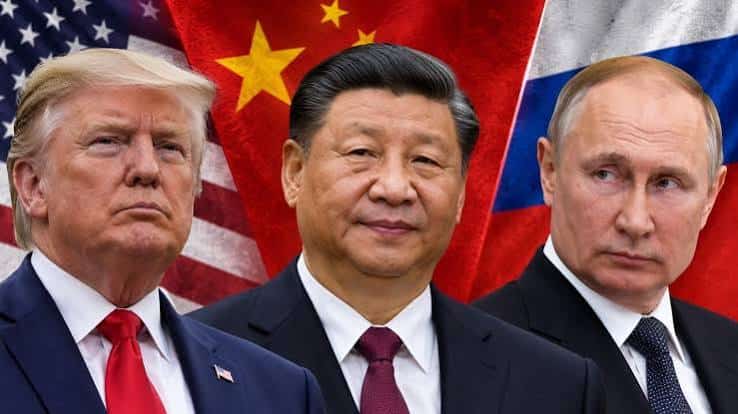
The planned meeting between Donald Trump, Xi Jinping and Vladimir Putin in Shenzhen presents an unusual diplomatic opportunity at a time when relations among the world’s three most powerful nuclear states remain complicated by strategic rivalry, military competition and disagreements over international security. China’s description of the gathering as having groundbreaking significance reflects its interest in presenting itself as a central force in global diplomacy. However, the importance of the meeting will depend less on its symbolism and more on whether the three leaders can address the differences that have weakened international cooperation.
The meeting, scheduled for November 19 alongside the Asia-Pacific Economic Cooperation summit, will bring together the leaders of the United States, China and Russia for their first face-to-face trilateral gathering at the level of heads of state. Chinese Foreign Ministry spokesperson Mao Ning has said that the discussions will focus on safeguarding world peace and strengthening strategic stability. The White House has indicated that Trump intends to raise the issue of nuclear arms reduction.
The timing is significant. The international arms control framework has weakened considerably, while tensions between Washington, Moscow and Beijing have made negotiations increasingly difficult. The three countries possess the largest nuclear arsenals, although their military capabilities and nuclear strategies are not identical. Bringing their leaders together could create an opening for dialogue, but it would be premature to assume that the meeting will produce an agreement.
The diplomatic challenge is complicated by the fact that each country has different priorities. Washington wants to address the growing nuclear capabilities of China while managing its confrontation with Russia. Moscow wants recognition of its strategic position and relief from international isolation. Beijing, meanwhile, is seeking greater international influence without accepting arrangements that it believes would place restrictions on its military development.
China Sees an Opportunity to Strengthen Its Diplomatic Position
Hosting the meeting gives China an opportunity to present itself as an indispensable participant in international security discussions. Beijing has repeatedly emphasised the importance of dialogue between major powers and has sought to position itself as a supporter of stability in a world increasingly affected by geopolitical competition.
The presence of Trump and Putin in Shenzhen would provide considerable diplomatic visibility for Xi Jinping. It would also allow China to demonstrate that it can maintain working relationships with two countries whose interests frequently conflict with each other. This is particularly relevant as Washington continues to regard Beijing as its principal strategic competitor, while Russia has become increasingly dependent on its economic and political relationship with China.
However, China’s diplomatic ambitions involve a difficult contradiction. Beijing wants to be recognised as a responsible global power, but it remains reluctant to participate in nuclear arms negotiations with Washington and Moscow. Its position has been influenced partly by the difference in the size of the respective nuclear arsenals. China argues that its stockpile remains considerably smaller than those of the United States and Russia and that it should not be expected to accept identical restrictions.
From Beijing’s perspective, entering negotiations without addressing this imbalance could place it at a disadvantage. Washington, on the other hand, believes that China’s expanding military capabilities make its participation increasingly important. This disagreement is likely to remain one of the central obstacles to any meaningful nuclear agreement.
The summit therefore offers China an opportunity to shape the diplomatic narrative, but it does not automatically provide a solution to the disagreements that have prevented progress in arms control.
The Nuclear Arms Control Framework Has Weakened
The meeting comes against the background of a serious deterioration in the international nuclear arms control system. The expiration of the New Strategic Arms Reduction Treaty in February 2026 removed the last legally binding agreement limiting the strategic nuclear arsenals of the United States and Russia.
The treaty had restricted each country to 1,550 deployed strategic nuclear warheads and 700 deployed delivery systems. Its expiration means that the two countries no longer have the same legally enforceable limits governing their deployed strategic forces. Although both governments have previously expressed interest in maintaining certain restrictions, no replacement agreement has been established.
The absence of a functioning agreement creates uncertainty about future military planning. Nuclear arms control is not only about reducing the number of weapons. It also involves verification, transparency, communication and procedures that reduce the possibility of miscalculation during periods of tension.
Without reliable information about military developments, countries may become more suspicious of each other’s intentions. This can encourage additional spending on nuclear modernisation and create pressure to respond to perceived threats, even when the other side has not necessarily decided to expand its arsenal.
China’s position makes the negotiations more complicated. Washington wants any future framework to take account of Beijing’s growing nuclear capabilities, while China has consistently resisted joining negotiations designed around the existing US-Russia balance.
The three-power meeting could help establish a political basis for further discussions, but negotiating a detailed agreement would require considerably more work. Questions involving verification, missile defence, weapons deployment and the different strategic priorities of the three countries cannot be resolved through a single leaders’ meeting.
Trump’s Approach Faces a Difficult Strategic Calculation
For Trump, the summit provides an opportunity to demonstrate that direct engagement with rival leaders can produce diplomatic results. His administration has indicated an interest in nuclear arms reduction and has previously argued that any future arrangement should include China alongside Russia.
However, bringing China into a nuclear agreement is not simply a matter of securing agreement from Xi. Beijing has little incentive to accept restrictions that it believes could limit its ability to maintain a credible deterrent against two countries with substantially larger arsenals.
Washington also faces the problem of dealing with Russia while continuing to manage broader disagreements over the war in Ukraine and European security. Moscow may be willing to discuss nuclear stability, but its expectations are unlikely to be limited to the size of its strategic arsenal. Russia has repeatedly argued that wider military and security developments must also be considered.
For Putin, the meeting offers an opportunity to demonstrate that Russia remains an important participant in global decision-making despite its strained relations with Western governments. Sitting alongside the American and Chinese presidents would provide diplomatic recognition of its continuing strategic importance.
Yet the interests of Moscow and Beijing are not completely identical. Their relationship has strengthened considerably, particularly in trade and strategic cooperation, but Russia also has reasons to maintain an independent position in discussions involving Washington. A three-way meeting could reveal areas of cooperation, but it could also expose differences that are less visible in bilateral diplomacy.
The absence of clear commitments on Ukraine would also limit the summit’s wider diplomatic significance. Any discussion involving European security could have consequences for countries that are not represented at the meeting. This raises the question of how major powers can address international conflicts without excluding those directly affected by their decisions.
Symbolic Diplomacy Needs a Practical Outcome
The Shenzhen meeting is important because the three countries have limited opportunities for direct communication at the highest political level. Even when disagreements remain unresolved, discussions between national leaders can help establish boundaries, clarify intentions and reduce the risk of misunderstanding.
However, diplomatic visibility should not be confused with progress. A joint statement about peace and stability would have limited practical value unless it is followed by concrete steps. These could include renewed nuclear communication channels, technical discussions on arms control, greater transparency about military developments and an agreed process for further negotiations.
The United Nations has indicated its readiness to support denuclearisation efforts emerging from the meeting. Such involvement could provide an institutional framework for discussions, although the willingness of the three governments to accept external oversight remains uncertain.
There is also a wider regional dimension. The Asia-Pacific region has become an increasingly important arena for military and economic competition. China’s relations with neighbouring countries, American security partnerships and Russia’s growing strategic engagement with Beijing all influence the regional balance. Any improvement in communication among the three major powers could therefore have implications beyond their bilateral relationships.
But the summit also risks reinforcing the perception that global security is primarily determined by a small group of powerful states. Smaller countries and regional organisations have legitimate interests in nuclear stability, trade and international security. Their concerns cannot simply be set aside because the three largest nuclear powers have chosen to negotiate directly.
The meeting will consequently test whether personal diplomacy can make progress where established international arrangements have struggled. Xi, Trump and Putin have an opportunity to establish a more reliable basis for communication, but their competing objectives remain substantial. The significance of the gathering will ultimately depend on whether it creates a process capable of producing practical security commitments rather than another high-profile display of geopolitical influence.
(Source:www.dw.com)