
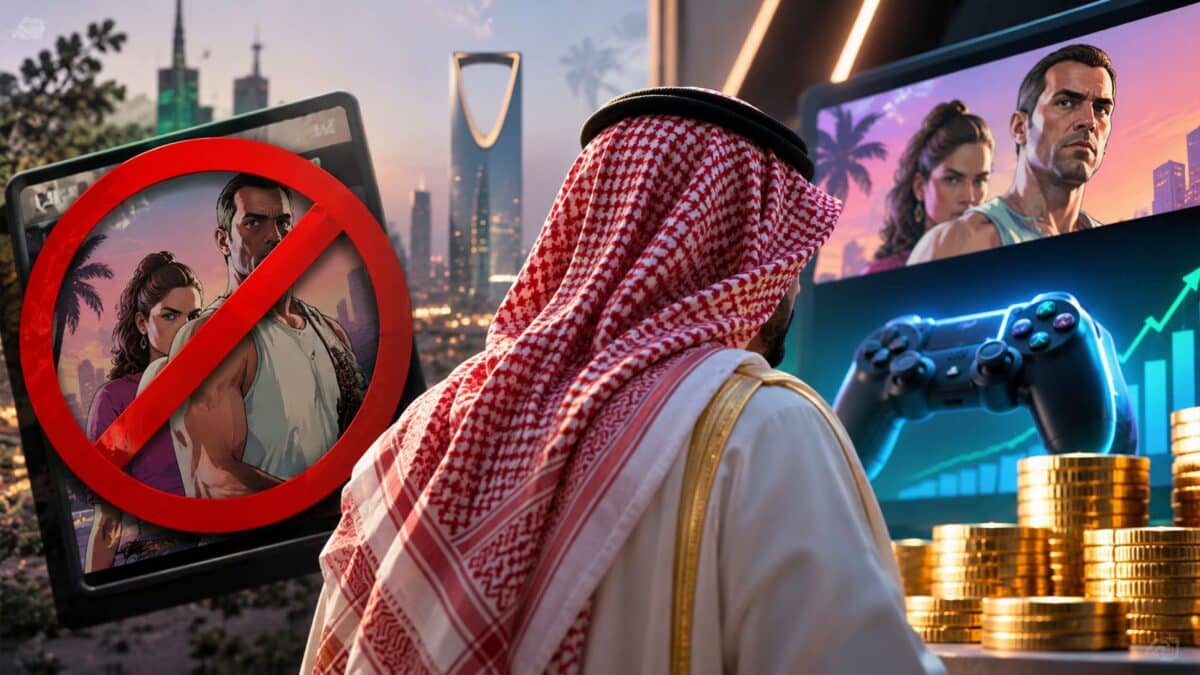
Saudi Arabia’s changing relationship with the Grand Theft Auto franchise reflects a much larger transformation in the kingdom’s approach to entertainment, investment and economic diversification. A country that restricted the popular video game series until 2025 is now allowing its latest release to reach domestic players while its sovereign wealth fund holds a substantial investment in the company behind it.
The development is particularly significant because the Public Investment Fund, chaired by Crown Prince Mohammed bin Salman, has become an increasingly influential investor in the global gaming industry. Its investment in Take-Two Interactive, the American company that owns Rockstar Games, is worth more than $2 billion, according to reported market data.
The timing of the latest release has brought this relationship into public attention. Saudi gamers have been able to purchase and play the new Grand Theft Auto VI legally, marking a major departure from the restrictions that previously applied to the franchise.
However, the significance of the development extends beyond the removal of a gaming restriction. It reflects the kingdom’s attempt to establish itself as an important international player in an industry that combines entertainment, technology, intellectual property and digital services.
From Cultural Restrictions to Commercial Opportunity
Grand Theft Auto has historically attracted controversy because of its depictions of crime, violence, drugs and sexual content. Its themes have made the franchise one of the most commercially successful but socially debated products in the global video game industry.
Saudi Arabia’s earlier restrictions reflected the country’s conservative social and cultural environment. The removal of the ban in 2025 represents a wider shift in how the kingdom approaches entertainment consumption.
Under Crown Prince Mohammed bin Salman, Saudi Arabia has introduced a series of social and economic reforms designed to diversify the economy and attract international investment. Entertainment has become an important part of this programme, alongside tourism, sports, technology and infrastructure.
The gaming industry offers an attractive opportunity because it generates revenue through multiple channels. These include game development, publishing, digital distribution, advertising, competitive gaming, merchandise and intellectual property licensing.
Unlike traditional industries that depend heavily on physical production, successful gaming businesses can reach international customers through digital platforms. Their intellectual property can also generate revenue over many years through sequels, subscriptions and additional content.
For Saudi Arabia, investing in this sector offers a way to participate in a rapidly expanding global entertainment market.
Sovereign Wealth Fund Builds a Global Gaming Portfolio
The Public Investment Fund’s investment strategy illustrates the scale of Saudi ambitions. Its holding in Take-Two Interactive gives the kingdom financial exposure to the company responsible for Grand Theft Auto and other established gaming franchises.
The investment is part of a broader effort to build a substantial presence across the gaming industry. In August 2026, a consortium including the Saudi fund acquired Electronic Arts in a transaction valued at $55 billion.
The fund has also been involved in discussions concerning a possible acquisition of Unity Software, a company whose technology is widely used by developers to create interactive games and digital experiences.
These investments cover different parts of the industry. Take-Two provides exposure to major gaming intellectual property, Electronic Arts has a large publishing and development business, while Unity supplies technology used to create games.
This approach is commercially significant because controlling or investing across several layers of an industry can provide greater strategic influence than simply holding shares in one company.
Saudi Arabia has also been consolidating its gaming investments through Savvy Games Group, a subsidiary established to strengthen the country’s position in the global gaming market.
The long-term ambition is to develop domestic capabilities rather than remain solely a financial investor in international companies.
Gaming Supports the Wider Vision 2030 Strategy
Saudi Arabia’s gaming investments form part of its broader Vision 2030 programme, which aims to reduce the country’s dependence on oil revenues.
The strategy recognises that future economic growth will require new industries capable of attracting private investment, creating employment and developing internationally competitive businesses.
Gaming has several characteristics that make it attractive for this purpose. It requires software developers, designers, engineers, digital artists, marketing specialists and production professionals. It can also encourage investment in education, digital infrastructure and technology services.
The industry has the potential to create opportunities for younger Saudi citizens, particularly as the country attempts to expand its private-sector employment base.
However, building a sustainable gaming industry is more complicated than acquiring stakes in successful foreign companies. Developing globally competitive games requires experienced creative teams, technical expertise and an understanding of international audiences.
Saudi Arabia will need to establish an ecosystem in which local developers can produce original intellectual property rather than depend entirely on international partnerships.
The distinction is important because the long-term economic value of gaming comes from creating products and technologies that can compete internationally.
Commercial Ambitions May Create Cultural Contradictions
The kingdom’s growing involvement in gaming also raises questions about the relationship between commercial priorities and cultural policy.
Grand Theft Auto is particularly controversial because its fictional world includes activities and social behaviour that may conflict with conservative cultural expectations. Its legal availability therefore represents a noticeable change in the kingdom’s approach to entertainment.
The government has been attempting to attract international visitors, investors and entertainment businesses while gradually relaxing restrictions that previously limited cultural activities.
This transformation does not necessarily mean that every form of entertainment will receive unrestricted approval. Saudi Arabia continues to operate within its own regulatory and cultural framework.
Nevertheless, the decision to welcome a franchise previously considered unacceptable demonstrates how commercial interests and changing consumer expectations are influencing policy.
The challenge for Saudi Arabia will be to maintain a consistent regulatory environment that attracts international businesses while managing domestic cultural sensitivities.
The gaming sector could become a valuable component of the country’s economic diversification programme, but its success will depend on more than investment capital. It will require skilled workers, original creative output, stable regulations and a sustainable domestic market.
The kingdom’s involvement with Grand Theft Auto therefore represents a significant change in both economic priorities and entertainment policy. What was previously treated as a restricted cultural product has become part of a much larger international investment strategy.
(Source:www.brecorder.com)