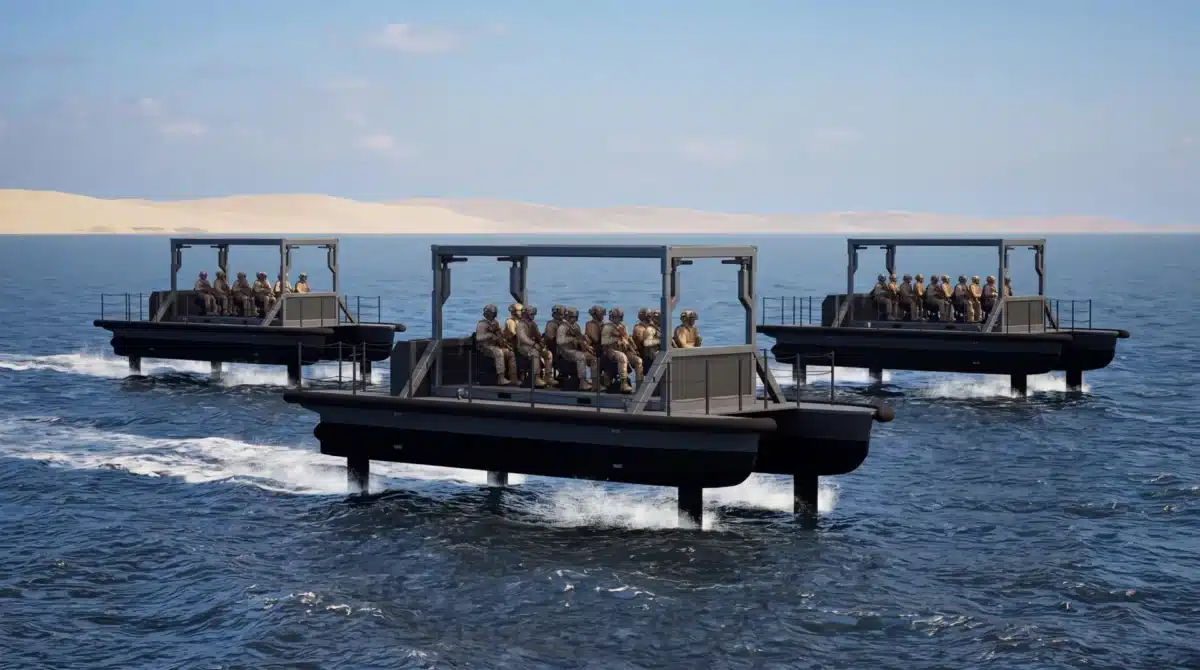
A French engineering company aims to turn a container-based maritime invention into a scalable industrial business. Unveiled at Euronaval 2026, BOAXT shows how intellectual property, modular manufacturing and national licensing could create new opportunities.
Defense technology is drawing investor attention, yet innovation alone rarely makes a sustainable business: manufacturing, customer adoption, financing, intellectual property and controlled international expansion decide the outcome.
Brest-based LE QUÉRÉ SAS has built an unconventional model around BOAXT, a modular system that transforms from a structure dimensioned like a 20-foot High Cube shipping container into a floating platform or vessel. After more than five years of investment in patents, engineering and prototyping, the project rests on four patents filed in France and internationally, three covering BOAXT, one its launch and recovery system (LARS), all invented by the company’s president, Eric Le Quéré.
Unveiled as a world premiere at Euronaval 2026, the BOAXT Defense & Offshore concept targets naval drones, defense, maritime security and offshore operations. Discussions on the stand opened highly promising avenues, notably with Scandinavian countries, Turkey and India.
One technology, multiple addressable markets
Folded, it fits standard container handling; deployed, it becomes a floating structure for varied equipment. A mothership with a highly innovative LARS deploys and recovers several units at sea, operating them as a fleet.
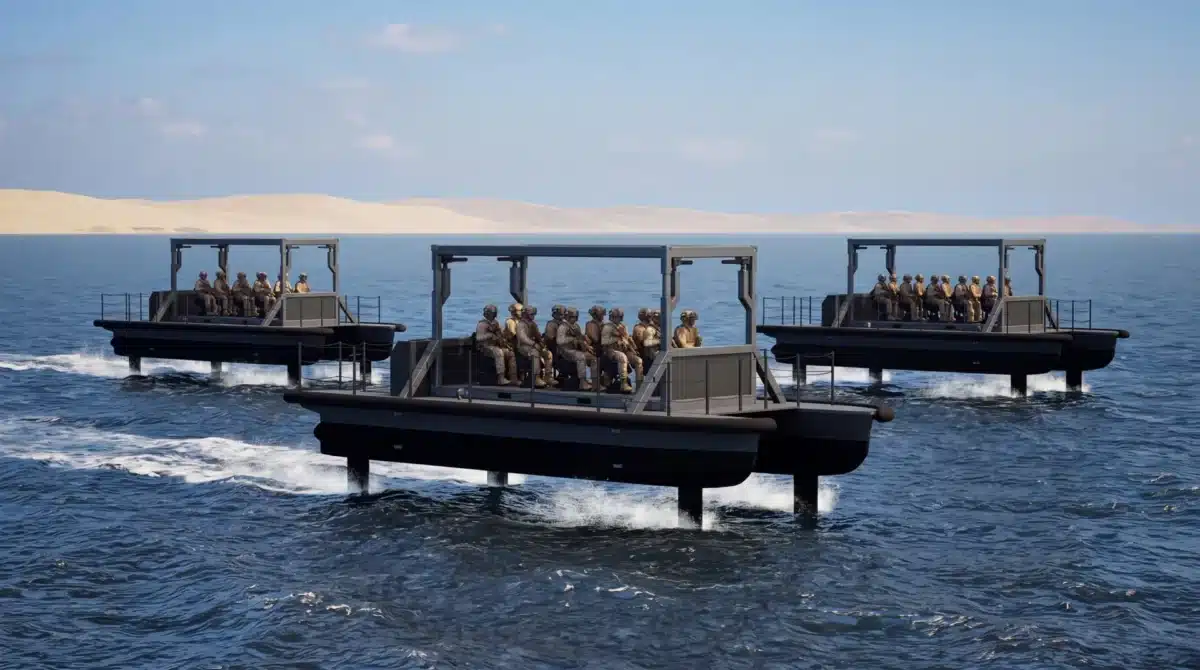
Beyond defense and maritime security, applications include offshore inspection, port operations, environmental recovery, emergency response and temporary floating infrastructure. A common architecture could diversify revenue, though each market needs its own validation and commercial strategy.
Moving from prototypes to production
Two first-generation units have been built, one afloat in Dubai. Early development took place in the United Arab Emirates; industrialization will begin in France through BOAXT Systems, a French and sovereign company created by Eric Le Quéré, whose capital will be opened to industrial and financial partners from Q1 2027, anchoring in Brittany a defense- and export-oriented industrial project.
The roadmap foresees the first fast Defense & Offshore unit in Q3 2027, testing and certification of the drone version in Q4, and series production from early 2028, rising to one unit per week per line – some fifty a year, a deliberately conservative target. Operating in nodal mode with its AI layer, BOAXT is likely to be sold as flotillas; with assembly in user countries, output could exceed one hundred units a year by 2030. These remain ambitions, dependent on validation, suppliers and confirmed demand.
A licensing model designed for international expansion
Beyond France, LE QUÉRÉ SAS plans exclusive licences with partner and allied countries, with technology transfer for local assembly. The model has begun in Japan, where the multinational SARAYA signed an exclusive licence and will manufacture locally; relatively advanced discussions are under way with the United Arab Emirates.
This meets governments’ demand for industrial capability, local jobs and supply-chain control, and could bring the technology owner licensing income and stakes in national ventures, on terms still to be negotiated.
What investors should evaluate
The proposition combines intellectual property, a modular architecture, multi-market exposure and a replicable industrial model – with real execution risk. Investors will assess the patents’ scope, the configuration’s maturity, unit costs, market size and capital needs, and distinguish expressions of interest from funded orders. Partners ÆGIR (autonomy) and H2X-Ecosystems (hydrogen) must deliver integrated, qualified solutions; AGEOSCO, chaired by retired French General Frédéric Beth, provides strategic advice.
At the intersection of defense and maritime infrastructure
BOAXT illustrates an emerging thesis: maritime value may increasingly combine reusable technology, software, modular hardware and distributed manufacturing. Success will depend less on the invention than on disciplined execution, financing and converting interest into confirmed business.