
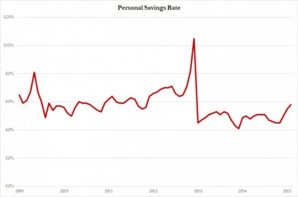
It would seem that both of these factors were to be an excellent occasion for millions of Americans to spend more, at least in any case, economists and analysts diligently tried to convince us in that for several months. But what happened, is exactly the opposite. On Monday, the published data showed that the savings rate jumped in February to 5.8% – the highest since December 2012.
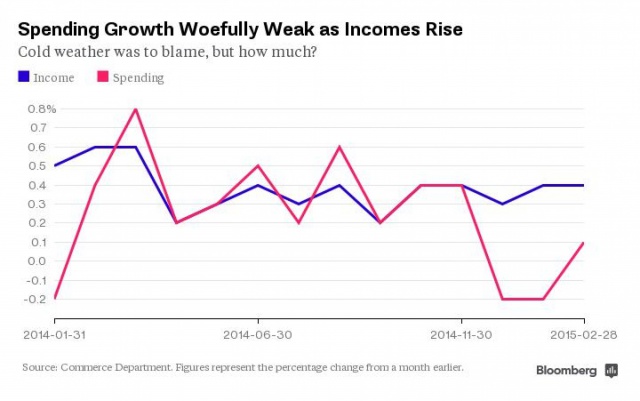 Now it has become fashionable to blame weather conditions of bad US data, and this time there was no exception. Experts from financial institutions believe that the weather caused the growth of savings, because in cold conditions the Americans do not get enough pleasure of dining out. However, it is not so important.
 The fact remains that, as recently as a few years ago, the growth rate of savings would be good news. Therefore, before the crisis fell to 1.9%, that is, Americans lived beyond their means. How it ended, not necessarily to remind how.
Later comes a sobering, and people began to bring their finances in order: in 2012 the savings rate jumped to 10.5%, mainly due to the earlier payment of dividends to higher taxes. Once again, people felt safe and were ready to start spending with renewed vigor, at least so thought many economists, and the savings rate has been gradually decreasing. However, a couple of months ago, people started to save again.
It makes you wonder about the reasons. Maybe it is too slow wage growth, and perhaps the reality is not so optimistic, as it presented by the US government.
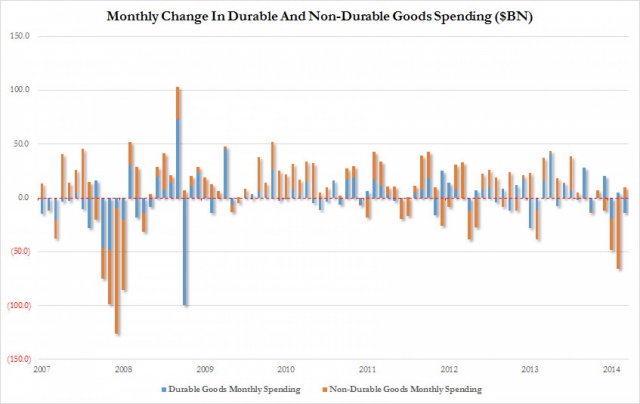
For clarity, take a look at a few charts. For example, the following is a schedule of expenditures on consumer durables and other goods.
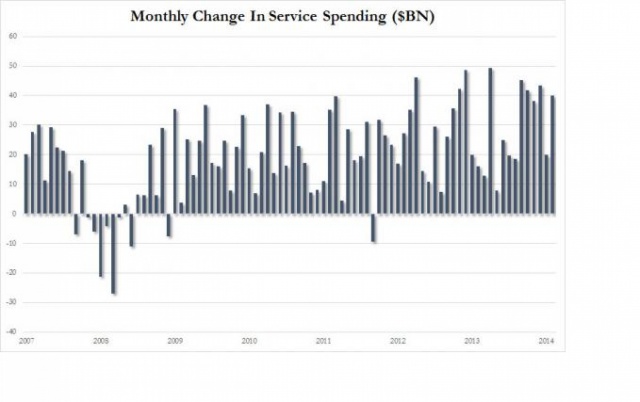 And the following graph indicates that most of their disposable income Americans spend on services.
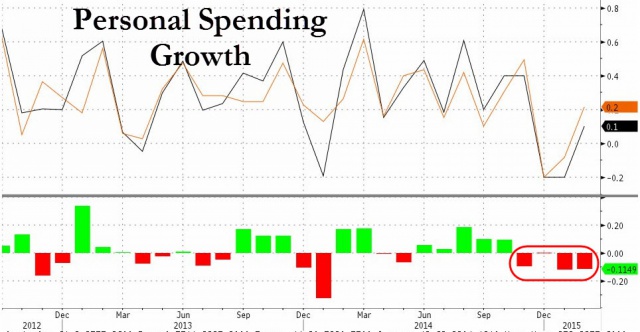 As for the costs, in February 2015, they increased by 0.1% compared with January. It would seem, there is nothing wrong, but the expenses in the fourth month in a row does not meet the expectations of analysts. Moreover, the current growth rate is lower than during the past year.
  The income of Americans last month rose 0.4%, with the expected increase of 0.3%. In January 2015, the expenditures of US citizens decreased by 0.2%, and revenue, according to revised data, increased by 0.4%.
Index PCE Core (Personal Consumption Expenditures, Excluding Food & Energy), which the Federal Reserve uses in the risk assessment of inflation, in February rose by 0.1% compared to January and by 1.4% in annual terms. The increase in the first indicator coincided with analysts’ expectations; the consensus forecast for the second was 1.3%.
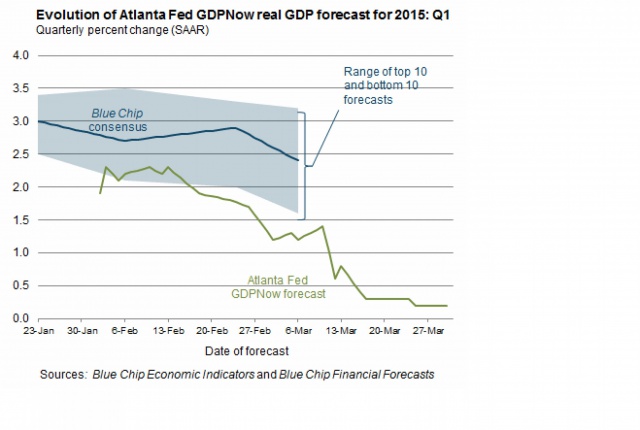
To summarize, it is necessary once again to recall that US GDP is 70% dependent on consumption, and the current dynamics expect some impressive results not worth it. In this regard, let us once again turn to the model predicting GDP growth rates of the US Federal Reserve Bank of Atlanta. According to this model the growth of the US economy in the first quarter will be 0.2%. Not impressive, indeed.
source: vestifinance