
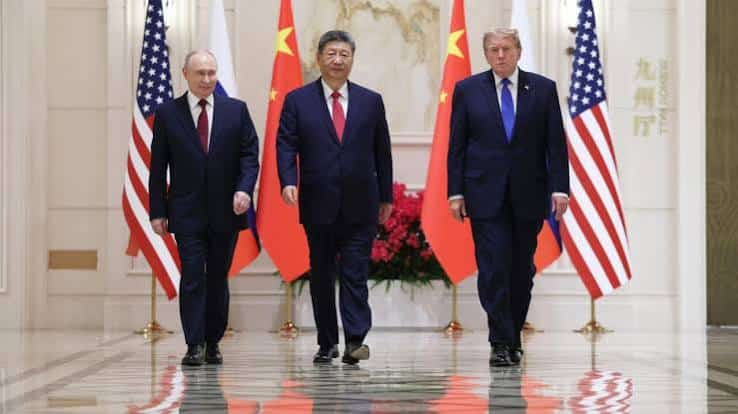
The meeting between US President Donald Trump, Chinese President Xi Jinping and Russian President Vladimir Putin in China’s southern city of Shenzhen has brought the leaders of the world’s three largest nuclear powers together for an unprecedented diplomatic encounter. Although the gathering offered an opportunity to discuss the Ukraine war, nuclear arms control and international security, the competing interests of the three governments make any substantial breakthrough difficult. The meeting also carries implications for countries outside the immediate circle of the three powers, particularly those concerned that decisions affecting their security could increasingly be made without their participation.
Trump told Xi before the trilateral meeting that the United States and China should work together to help end the war between Russia and Ukraine. The American president had already held separate discussions with Putin, describing the Russian leader as a friend. The Kremlin said the Ukraine conflict dominated their bilateral meeting and that Putin emerged in an excellent mood. Trump subsequently expressed hope that the three-way discussions would be successful, presenting direct engagement between the leaders as an opportunity that should not be dismissed.
The gathering took place alongside the Asia-Pacific Economic Cooperation (APEC) summit, giving the three governments an additional platform to discuss economic and geopolitical tensions. However, the diplomatic significance of bringing Washington, Beijing and Moscow together should not be confused with agreement on the issues dividing them. Ukraine, Iran, nuclear weapons, trade restrictions and China’s military expansion remain areas of substantial disagreement. For the smaller countries watching the encounter, the central concern is whether the three powers are beginning to establish a framework for managing global disputes without adequately considering the interests of those directly affected.
Ukraine Remains the Most Difficult Test of Cooperation
Trump’s appeal to Xi to help end the Ukraine war reflects Washington’s interest in using China’s relationship with Moscow as a diplomatic channel. Beijing maintains substantial economic and political influence in Russia, making its position relevant to any international effort to bring the conflict towards a negotiated settlement. However, China’s willingness to use that influence remains uncertain, particularly when the proposed discussions do not include Ukraine or European governments.
Xi did not directly address the Ukraine conflict during his opening remarks with Trump. Instead, he spoke about the broader importance of stable relations between major powers, suggesting that cooperation between Washington and Beijing could contribute to international peace. His position reflects China’s longstanding argument that the conflict should not be treated simply as an issue between Moscow and Western governments. Beijing has generally characterised it as a European security problem, a position that makes direct involvement in negotiations without Kyiv politically complicated.
Patricia Kim, a foreign policy fellow at the Brookings Institution, has pointed to the difficulty China would face in presenting itself as a mediator when Ukraine and European leaders are absent. Such an arrangement could create the impression that the future of a country engaged in a war is being discussed by external powers without its direct participation. For Beijing, assuming responsibility for negotiating an outcome could also expose it to diplomatic pressure from both Russia and Western governments.
The conflict has also become an important element of the relationship between Trump and Putin. The Russian president arrived in Shenzhen following a military setback involving a key bridge connecting Crimea with Russia. Putin nevertheless used his remarks at the summit to emphasise Russia’s role in regional security and its contribution to Asia-Pacific energy and food supplies. His reference to shared interests in resolving regional conflicts indicated an interest in keeping diplomatic channels open, but it did not establish that Moscow was prepared to make concessions over Ukraine.
Nuclear Arms Control Exposes the Limits of Great-Power Diplomacy
Nuclear security was another major issue surrounding the meeting, with Trump insisting that arms control should feature prominently in the discussions. The three countries possess the world’s largest nuclear arsenals, but their positions on the structure and scope of future negotiations are considerably different. Washington and Moscow have historically been central participants in nuclear arms agreements, while Beijing has resisted joining comparable negotiations on the grounds that its arsenal is substantially smaller.
China’s reluctance to enter a three-country arms control framework has complicated Trump’s proposal. Beijing has argued that Washington and Moscow should take responsibility for negotiations between themselves because their nuclear stockpiles are significantly larger. The American president, however, wants China included in discussions about future nuclear security arrangements, reflecting concerns that any meaningful long-term framework must account for the expansion of China’s military capabilities.
The United Nations has already indicated that it would support any denuclearisation initiative emerging from the discussions. Secretary-General Antonio Guterres said the organisation was prepared to contribute to such an effort, while acknowledging that an agreement was far from guaranteed. His position highlights the difference between expressing support for nuclear disarmament and establishing practical commitments covering weapons development, deployment and verification.
The meeting therefore presents an opportunity to reopen discussions on strategic stability, but the difficult questions remain unresolved. Any future arrangement would need to address the different sizes of the three countries’ arsenals, their security doctrines and their concerns about military competition. Without a shared understanding of these issues, a declaration supporting peace would have limited practical value.
Iran, Trade and Technology Add to the Strategic Rivalry
The Iran conflict and disruptions to oil supplies through the Strait of Hormuz also featured in Trump’s discussions with Xi. The American president said both countries wanted oil to continue flowing through the strategically important waterway. Its disruption has demonstrated how a regional conflict can affect international energy markets and create economic pressures well beyond the Middle East.
China’s energy interests make the issue particularly important. Its industrial economy depends on reliable supplies of imported energy, while the United States has its own strategic interest in maintaining the security of international shipping routes. However, agreement on the importance of uninterrupted oil supplies does not necessarily translate into a common approach towards Iran or the wider conflict.
Trade and advanced technology remain another source of tension. Trump and Xi have extended their trade truce, but concerns over the diversion of Nvidia chips to China through Southeast Asian countries have raised questions about the effectiveness of American export restrictions. Washington is attempting to prevent sensitive semiconductor technology from strengthening China’s military and artificial intelligence capabilities, while Beijing continues to seek access to advanced computing resources.
These disagreements illustrate why the summit’s diplomatic symbolism may prove more significant than its immediate policy outcomes. All three leaders have reasons to appear willing to cooperate, but their national priorities often point in different directions. Trump can present direct engagement as evidence of American diplomatic influence, Xi can demonstrate China’s growing international role, and Putin can use the meeting to reinforce Russia’s position as a major global power.
The encounter has consequently placed the relationship between the three countries at the centre of international attention. Whether it produces lasting cooperation will depend on what follows the diplomatic spectacle, particularly on Ukraine, nuclear security and trade. A meeting involving the world’s three largest nuclear powers is inherently significant, but the absence of agreement on the underlying disputes means that its consequences remain uncertain.
(Source:www.theguardian.com)