

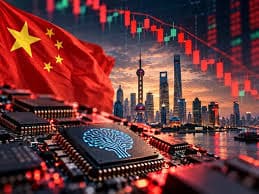
China’s technology stock market has suffered a sharp reversal after a rally built on expectations that artificial intelligence and domestic semiconductor production would deliver years of rapid growth. The mainland STAR50 index, which includes prominent technology and chip companies, has fallen about 40% in less than four months, wiping out an estimated $480 billion in market value. The decline has raised doubts about the strength of the investment boom and created problems for policymakers who want households to put more savings into the stock market.
There is a temptation to read the selloff as evidence that China’s AI ambitions have failed. That would be too simple. The technology is still developing, and the demand for computing equipment is not disappearing. What has changed is the willingness of investors to pay very high prices for companies whose future earnings remain uncertain. The market had started treating the promise of AI as if it were already a financial result. Now investors are asking what these businesses can actually earn.
The distinction is important because a company can be strategically valuable and still be a poor investment at an excessive valuation. China wants to strengthen its domestic technology industry, particularly in areas where access to foreign chips and equipment remains uncertain. But government support, technological progress and rising share prices are three different things. They do not always move together.
The Rally Became Difficult to Justify
Chinese technology shares rose strongly as investors anticipated that AI would create new demand for chips, robotics, data centres and related equipment. Government support for domestic technology added to the optimism. Some investors also saw local manufacturers as potential beneficiaries of restrictions on foreign technology, reasoning that Chinese companies would have to fill the gaps.
That argument has a basis, but it does not justify every valuation. A company may benefit from stronger domestic demand and still face production costs, technical limitations or intense competition. A chipmaker can attract customers without earning high margins. A robotics company can develop an impressive product without selling enough units to cover its development expenses. Markets tend to overlook such distinctions during a powerful rally.
The scale of the decline suggests that expectations had become stretched. Some recently listed technology companies that attracted enormous investor interest have lost much of their market value. The STAR50 index had also traded at around 100 times trailing earnings after the correction, down from a peak valuation close to 250 times earnings. Even after the fall, investors were being asked to pay a high price relative to the profits these companies were generating.
When valuations reach that level, a business does not necessarily need to report terrible results for its shares to fall. It may only need to disappoint investors who had expected extraordinary growth. The correction is therefore partly about the difference between what the market hoped would happen and what companies can demonstrate today.
More Production Does Not Always Mean More Profit
China has invested heavily in manufacturing capacity across technology industries. That can reduce dependence on imported products, strengthen domestic supply chains and create opportunities for local businesses. But the same strategy can create problems if too many companies expand production at once.
Semiconductor manufacturers, robotics firms and AI suppliers may all be trying to capture the same future demand. If capacity grows faster than orders, companies compete on price. Customers benefit from cheaper products, but manufacturers can see their margins shrink. Businesses that borrowed heavily or invested in expensive equipment may find it difficult to recover their costs when selling prices fall.
This is not a uniquely Chinese problem. Manufacturing industries around the world have faced periods when strong policy support and optimistic demand forecasts encouraged companies to build more capacity than the market could absorb. The difference is that China is trying to expand several strategically important technology sectors at the same time, while some of its manufacturers also face restrictions on access to overseas markets.
The danger is that companies may continue producing in the hope that demand eventually catches up. That can keep revenue flowing for a while, but it does not necessarily produce healthy profits. If a price war develops, even technologically capable businesses can struggle to earn an adequate return on the capital invested in them.
Export Restrictions Complicate the Investment Case
China’s AI and semiconductor ambitions are also affected by international trade restrictions. Access to advanced components, foreign customers and global supply chains can influence both the cost and commercial value of domestic technology. Restrictions on Chinese suppliers serving overseas data centres may narrow their potential market, while uncertainty about future rules can make customers more cautious.
Domestic alternatives can benefit from such restrictions, but replacing imported technology is not simply a matter of producing a local version. Manufacturers must demonstrate that their products perform reliably, operate at competitive costs and can be produced in sufficient quantities. Customers also need confidence that software, maintenance and supporting equipment will remain available.
For investors, these uncertainties make it harder to estimate future earnings. A company might have a strong domestic position but limited access to international customers. Another might have promising technology yet depend on components that are difficult to obtain. The market must account for these risks, and high valuations leave little room for disappointment.
The selloff has therefore exposed a weakness in the idea that technological self-reliance automatically leads to commercial success. It can create opportunities for domestic companies, but the financial outcome still depends on execution, pricing, customer demand and the ability to compete.
Household Investors May Lose Confidence
The correction also matters because Chinese authorities have encouraged greater participation in domestic equity markets. A stock market that offers reliable long-term returns could help households build wealth and provide companies with another source of financing. But sharp losses in popular investment themes can have the opposite effect.
Retail investors are particularly exposed when they buy shares after a large rally, often encouraged by the belief that government support will protect the industry. Such support may help strategic sectors, but it does not guarantee the market value of individual companies. When prices fall quickly, investors may become reluctant to buy technology shares again, even when some businesses are genuinely attractive.
This can create a problem for companies seeking to raise money through new listings or share sales. If investors lose confidence in valuations, financing becomes harder to obtain. The same market that once rewarded ambitious technology plans may start demanding stronger evidence of profits before providing additional capital.
The wider Chinese market has also weakened from its recent highs, suggesting that the effects are not confined to a few speculative shares. Still, it would be premature to assume that the correction must spread into a broader financial crisis. Much depends on the financial strength of individual companies, the response of policymakers and whether investors can distinguish sound businesses from those whose valuations ran too far ahead of reality.
China’s technology sector is unlikely to abandon its AI ambitions because share prices have fallen. The strategic reasons for developing domestic chips, software and robotics remain. But the correction may force companies and investors to become more selective about where capital is directed.
Businesses with credible customers, efficient production and a clear route to profitability should be better placed than those relying mainly on expectations of future government support. Investors will also need to look beyond the label of artificial intelligence and examine what each company actually sells, how much it earns and what it must spend to grow.
The market correction is painful, but it could encourage a healthier relationship between innovation and investment. Technology development requires patience and money, yet neither guarantees a profitable business. China’s challenge is to build companies that can compete on performance and price, not simply increase production capacity or attract speculative attention.
The AI boom has not necessarily ended as a technological story. What has become harder to defend is the assumption that every company connected to it deserves a premium valuation. That is the lesson investors are now learning, and it could shape how China’s next generation of technology businesses is financed.
(Source:www.investing.com)