

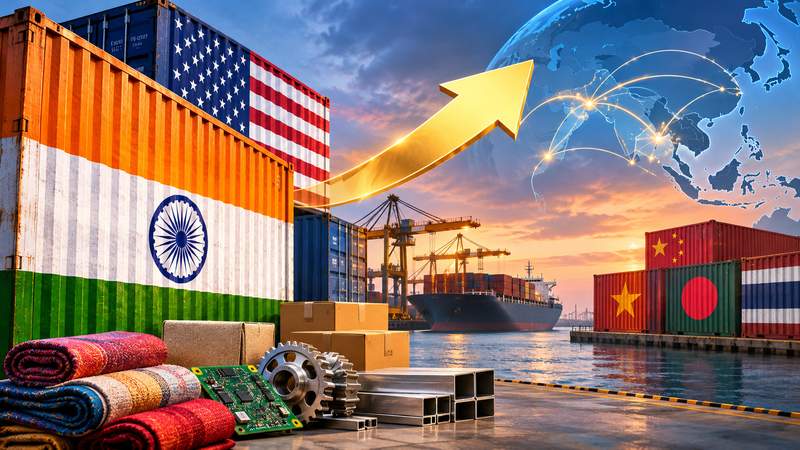
The proposed reduction in US tariffs on Indian goods from 25% to 17%, conditional on a reciprocal trade agreement, could give Indian exporters an advantage over several competing Asian manufacturing economies. The difference may appear relatively small, but in industries operating on tight margins, even a few percentage points can influence where international buyers place their orders. For India, the proposal offers a potential commercial opportunity at a time when Washington is attempting to reorganise global manufacturing and reduce dependence on Chinese production.
The proposed rate is part of a wider American investigation into structural excess manufacturing capacity across 14 economies. India faces a tariff ceiling of 25% under the proposed action, but Washington has indicated that the rate could fall to 17% if New Delhi reaches an agreement addressing the concerns raised in the investigation. The comparison is important because several countries competing with India for export orders face proposed rates of 18% or 20% under similar arrangements.
Bangladesh, Cambodia, Indonesia, Malaysia and Thailand face proposed rates of 18%, while Vietnam’s proposed rate is 20% if a trade agreement is reached. Japan, South Korea, Taiwan and the European Union have proposed rates around 15% under their respective arrangements. China faces a proposed 20% rate on covered goods, in addition to earlier duties.
The advantage for India, therefore, is not simply the possibility of a lower tariff. It is the opportunity to improve its relative position against competing manufacturing destinations in sectors where international buyers are already looking to diversify supply chains.
The Tariff Gap Could Influence Manufacturing Decisions
International companies consider several factors when deciding where to manufacture products for the American market. Labour costs, transport infrastructure, production capacity, delivery schedules and political stability all matter, but import duties can significantly affect the final cost of a product.
A lower tariff rate can improve the competitiveness of Indian exporters against suppliers operating in countries facing higher duties. This could be particularly relevant for textiles, apparel, engineering goods, processed products and other labour-intensive manufacturing sectors.
For example, if Indian exporters face a 17% rate while competitors in Bangladesh, Cambodia or Indonesia face 18%, the difference could influence purchasing decisions when prices and production quality are otherwise comparable. The advantage becomes more meaningful when combined with India’s large domestic industrial base and access to a broad labour market.
However, the tariff difference should not be overstated. A one-percentage-point advantage does not automatically make India more competitive than Bangladesh or Vietnam. Established manufacturers in these countries have long-standing relationships with international brands, specialised production facilities and experience meeting demanding export requirements.
India will need to demonstrate that it can offer consistent quality, predictable delivery and sufficient manufacturing capacity. Tariff advantages can encourage buyers to consider new suppliers, but retaining their business depends on operational performance.
Washington’s Proposal Comes With Significant Trade Concessions
The proposed 17% rate is not an unconditional concession. It is linked to a broader reciprocal trade agreement that requires India to address American concerns over market access and industrial policies.
The proposed framework includes reductions or eliminations of Indian tariffs on several American industrial and agricultural products. It also involves commitments relating to medical devices, information technology goods and the possible acceptance of US standards and testing requirements in selected sectors.
These concessions could create additional opportunities for American exporters, but they also raise questions about the impact on Indian domestic industries. Lower import barriers can increase competition for local manufacturers and agricultural producers, particularly in sectors where American companies have established technological or cost advantages.
The challenge for New Delhi is to negotiate an arrangement that improves access to the American market without weakening its own industrial development priorities. India’s manufacturing programmes are designed to attract investment, expand domestic production and reduce reliance on imported goods in selected sectors. Any agreement will need to balance these objectives against the commercial benefits of a lower tariff rate.
There is also a question of timing. The agreement must address the findings of the American investigation, and the proposed tariff framework remains subject to further consultation and hearings. Until the final terms are settled, Indian exporters cannot treat the 17% rate as a confirmed long-term arrangement.
India’s Manufacturing Ambitions Face a Practical Test
India has been trying to strengthen its position as an alternative manufacturing destination through incentives, infrastructure investment and efforts to attract foreign companies. Its growing electronics production, expanding industrial base and large domestic market provide advantages that several competing economies cannot easily match.
However, manufacturing competitiveness is not determined by incentives alone. Companies require reliable electricity, efficient ports, predictable customs procedures, access to industrial land and a workforce with the necessary technical skills. Delays in logistics or difficulties obtaining components can offset the benefits of lower labour costs or favourable tariffs.
India also needs to improve the depth of its supplier networks. In several industries, domestic manufacturers still depend on imported machinery, electronic components and industrial inputs. This can limit the extent to which production can be expanded quickly and may reduce the benefits of shifting manufacturing from other Asian countries.
The proposed tariff advantage could encourage foreign companies to increase sourcing from India, but the country must be prepared to absorb additional orders. If manufacturers cannot meet delivery deadlines or maintain consistent quality, international buyers may continue using established suppliers elsewhere.
Bangladesh and Vietnam Remain Serious Competitors
India’s potential advantage comes at a time when global brands are reassessing their sourcing strategies. Bangladesh has developed a major position in apparel manufacturing, while Vietnam has attracted investment across electronics, garments and other export-oriented industries.
These economies have established commercial relationships with major international brands. Their manufacturers understand the quality requirements, production schedules and compliance standards expected by global buyers. Such relationships cannot be transferred immediately simply because another country receives a slightly lower tariff rate.
Bangladesh also benefits from an established garment manufacturing ecosystem, although recent labour unrest, energy shortages and political uncertainty have created additional difficulties. Vietnam’s industrial growth has been supported by foreign investment and its integration into regional supply chains.
India’s opportunity is to build on its existing textile, engineering and consumer goods industries while improving its ability to compete for larger international orders. It may also attract companies that want to reduce concentration in a single manufacturing location rather than abandon existing suppliers altogether.
The proposed tariff arrangements cannot be understood separately from Washington’s broader effort to reduce China’s influence over international manufacturing. The United States is concerned that Chinese production capacity, industrial subsidies and investment networks are affecting competition in other markets.
India is strategically important in this context because Washington sees it as a potential alternative manufacturing centre. However, the relationship is not entirely straightforward. India continues to import significant quantities of industrial inputs from China, and its manufacturing expansion is connected to regional supply chains.
A lower tariff rate may improve India’s access to the American market, but it does not remove the need to develop independent production capabilities. If Indian manufacturers remain heavily dependent on Chinese components, the benefits of diversification could be limited.
There is also a wider geopolitical consideration. India is unlikely to align every aspect of its industrial and trade policy with American preferences. It will continue to pursue its own economic priorities, including protecting selected domestic industries and maintaining commercial relationships with multiple partners.
The Real Advantage Will Depend on Execution
The proposed 17% tariff rate could improve India’s position against several Asian competitors, but the opportunity is conditional and should not be confused with an automatic manufacturing advantage. International buyers will continue to evaluate suppliers on price, quality, delivery reliability and the ability to expand production when required.
For India, the immediate task is to secure a workable trade agreement while strengthening the domestic conditions that attract long-term manufacturing investment. A lower tariff rate can open the door, but industrial infrastructure, supplier networks and consistent execution will determine whether companies remain.
The larger opportunity is to move beyond receiving orders diverted from other countries and establish India as a dependable manufacturing centre in its own right. That would provide benefits extending beyond a temporary tariff advantage and help the country secure a more durable position in global trade.
(Source:www.reuters.com)