


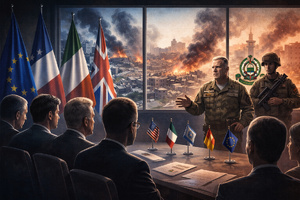
A quiet reassessment is unfolding across European capitals over participation in a U.S.-backed civil-military coordination effort tied to Gaza, reflecting deeper doubts about the direction, effectiveness, and political ownership of the post-ceasefire architecture. What began as a multilateral attempt to stabilize aid flows and shape a post-war pathway has, in the eyes of several European officials, drifted into a holding pattern that neither improves humanitarian conditions nor clarifies the political endgame. The recalibration now under way is less a rupture than a symptom of a broader strategic discomfort with an initiative perceived to be losing coherence at a critical juncture.
This rethink does not amount to a collective withdrawal, nor does it signal a unified European position. Instead, it reveals how allied participation has become conditional—tied to whether the mechanism can deliver tangible outcomes, protect European political equities, and maintain a credible role for non-military actors in Gaza’s future. The question for Europe is no longer whether to engage, but how to avoid being subsumed into a framework whose purpose appears increasingly opaque.
From Coordination Hub to Strategic Ambiguity
The civil-military coordination centre was conceived as a bridge: a place where security oversight, humanitarian facilitation, and policy planning could converge during and after a ceasefire. European governments joined early, sending diplomats, planners, and security officials with the expectation that proximity would translate into influence. The logic was straightforward—presence at the table would allow Europe to shape aid access, protect humanitarian principles, and inject political balance into a U.S.- and Israel-led process.
Over time, however, that premise has weakened. European officials describe a forum heavy on process but light on outcomes, where meetings multiply but decisions rarely translate into changes on the ground. Aid volumes have not risen meaningfully, border arrangements remain constrained, and political timelines are either absent or endlessly deferred. As the centre’s remit expanded on paper, its practical authority appeared to contract.
This erosion of clarity matters because the centre’s legitimacy rests on delivery. Without visible improvements—whether in aid access, civilian protection, or governance planning—participation risks becoming symbolic rather than substantive. For European states, symbolism carries costs: domestic scrutiny, reputational exposure, and association with a policy track that lacks demonstrable impact.
Diverging Expectations Between Washington and Europe
Underlying the reassessment is a divergence in strategic expectations. Washington has framed the coordination effort as a flexible instrument—one component in a phased plan that prioritizes security stabilization before political reconstruction. European governments, by contrast, have tended to view humanitarian access and political inclusion as parallel imperatives rather than sequential ones.
This difference has practical consequences. When security considerations dominate, humanitarian facilitation becomes contingent, subject to restrictions that Europe finds increasingly difficult to justify. The persistence of controls on so-called dual-use items, delays at crossings, and the prioritization of commercial shipments blur the distinction between relief and normal trade. For European officials tasked with defending participation at home, the optics are challenging: presence without leverage risks being read as acquiescence.
The absence of a clear interface between the coordination centre and emerging political bodies compounds the problem. As new supervisory structures are floated, it remains unclear how authority will be distributed, who sets priorities, and where European input fits. In this environment, continued participation begins to look less like influence and more like endorsement without agency.
Humanitarian Outcomes as the Litmus Test
For many European governments, humanitarian impact is the non-negotiable metric. The expectation was that a multilateral coordination mechanism, backed by U.S. leverage, would ease bottlenecks and accelerate aid. Instead, officials report a system in which constraints remain largely intact, and where the centre’s role is often consultative rather than directive.
The distinction between humanitarian and commercial flows has become particularly contentious. While commercial goods can help stabilize markets, they do not substitute for relief in a context of mass displacement and acute need. European officials worry that counting commercial shipments toward overall access figures masks the severity of humanitarian shortfalls and dilutes accountability.
This gap between stated objectives and lived outcomes fuels the reassessment. If participation does not materially improve conditions for civilians, European states must weigh whether their presence serves any practical purpose—or whether it merely provides diplomatic cover for a stalled process.
Political Ownership and the Risk of Marginalization
Another driver of unease is political ownership. The coordination centre is structurally dominated by U.S. and Israeli personnel, with no formal Palestinian representation. European officials initially accepted this imbalance on the assumption that it was temporary and that downstream political processes would broaden participation. That assumption now looks less certain.
Without a clear pathway to inclusive governance discussions, European diplomats fear marginalization—not only of Palestinian voices, but of Europe’s own policy preferences. Staying engaged is seen as a hedge against being sidelined; withdrawing risks ceding even more influence to actors with different priorities. This creates a dilemma: remain and risk irrelevance, or step back and risk exclusion.
The result is a cautious recalibration rather than an overt exit. Some countries are reducing rotations, slowing re-deployments, or downgrading the seniority of personnel. These adjustments send a signal without triggering a rupture, preserving optionality while expressing dissatisfaction.
Alliance Politics and the Cost of Dissent
The reassessment also reflects the realities of alliance politics. European governments are mindful of the diplomatic costs of open dissent, particularly given the broader volatility in transatlantic relations. A formal withdrawal could be interpreted as a political rebuke, with repercussions extending beyond Gaza.
At the same time, passive participation carries its own risks. Domestic audiences are increasingly attuned to foreign policy accountability, and association with a mechanism perceived as ineffective can become politically costly. European leaders must balance alliance solidarity against public expectations that engagement produces results aligned with stated values.
This balancing act explains the incremental nature of the rethink. By avoiding dramatic gestures, European states keep channels open while signaling that continued involvement is conditional, not automatic.
Strategic Uncertainty in the Post-Ceasefire Phase
As discussions shift toward demilitarization, reconstruction, and governance, uncertainty deepens. Timelines remain vague, responsibilities overlapping, and implementation mechanisms undefined. The coordination centre’s role in this next phase is unclear, raising questions about whether it will evolve into a decision-making body or fade into a consultative appendage.
For Europe, the concern is not only efficacy but trajectory. If the post-ceasefire architecture consolidates without meaningful humanitarian or political benchmarks, early participation may be remembered as complicity rather than contribution. The reassessment is therefore as much about future risk as present frustration.
What emerges is not a collapse of cooperation but a calculated pause—a reassessment driven by outcomes, not ideology. European states are signaling that presence must be matched by purpose, and coordination by credibility. The message is understated but firm: engagement is not unconditional, and legitimacy depends on delivery.
Whether this recalibration leads to renewed influence or gradual disengagement will depend on whether the framework adapts. If humanitarian access improves, political pathways clarify, and multilateral input gains weight, European participation could regain momentum. If not, the current unease may harden into a more pronounced distancing.
For now, Europe’s rethink reflects a sober recognition that proximity alone does not confer power. In complex conflicts, coordination mechanisms must do more than convene—they must change realities on the ground. Without that, even well-intentioned engagement risks becoming an exercise in managed frustration rather than meaningful diplomacy.
(Source:www.theprint.in)
This rethink does not amount to a collective withdrawal, nor does it signal a unified European position. Instead, it reveals how allied participation has become conditional—tied to whether the mechanism can deliver tangible outcomes, protect European political equities, and maintain a credible role for non-military actors in Gaza’s future. The question for Europe is no longer whether to engage, but how to avoid being subsumed into a framework whose purpose appears increasingly opaque.
From Coordination Hub to Strategic Ambiguity
The civil-military coordination centre was conceived as a bridge: a place where security oversight, humanitarian facilitation, and policy planning could converge during and after a ceasefire. European governments joined early, sending diplomats, planners, and security officials with the expectation that proximity would translate into influence. The logic was straightforward—presence at the table would allow Europe to shape aid access, protect humanitarian principles, and inject political balance into a U.S.- and Israel-led process.
Over time, however, that premise has weakened. European officials describe a forum heavy on process but light on outcomes, where meetings multiply but decisions rarely translate into changes on the ground. Aid volumes have not risen meaningfully, border arrangements remain constrained, and political timelines are either absent or endlessly deferred. As the centre’s remit expanded on paper, its practical authority appeared to contract.
This erosion of clarity matters because the centre’s legitimacy rests on delivery. Without visible improvements—whether in aid access, civilian protection, or governance planning—participation risks becoming symbolic rather than substantive. For European states, symbolism carries costs: domestic scrutiny, reputational exposure, and association with a policy track that lacks demonstrable impact.
Diverging Expectations Between Washington and Europe
Underlying the reassessment is a divergence in strategic expectations. Washington has framed the coordination effort as a flexible instrument—one component in a phased plan that prioritizes security stabilization before political reconstruction. European governments, by contrast, have tended to view humanitarian access and political inclusion as parallel imperatives rather than sequential ones.
This difference has practical consequences. When security considerations dominate, humanitarian facilitation becomes contingent, subject to restrictions that Europe finds increasingly difficult to justify. The persistence of controls on so-called dual-use items, delays at crossings, and the prioritization of commercial shipments blur the distinction between relief and normal trade. For European officials tasked with defending participation at home, the optics are challenging: presence without leverage risks being read as acquiescence.
The absence of a clear interface between the coordination centre and emerging political bodies compounds the problem. As new supervisory structures are floated, it remains unclear how authority will be distributed, who sets priorities, and where European input fits. In this environment, continued participation begins to look less like influence and more like endorsement without agency.
Humanitarian Outcomes as the Litmus Test
For many European governments, humanitarian impact is the non-negotiable metric. The expectation was that a multilateral coordination mechanism, backed by U.S. leverage, would ease bottlenecks and accelerate aid. Instead, officials report a system in which constraints remain largely intact, and where the centre’s role is often consultative rather than directive.
The distinction between humanitarian and commercial flows has become particularly contentious. While commercial goods can help stabilize markets, they do not substitute for relief in a context of mass displacement and acute need. European officials worry that counting commercial shipments toward overall access figures masks the severity of humanitarian shortfalls and dilutes accountability.
This gap between stated objectives and lived outcomes fuels the reassessment. If participation does not materially improve conditions for civilians, European states must weigh whether their presence serves any practical purpose—or whether it merely provides diplomatic cover for a stalled process.
Political Ownership and the Risk of Marginalization
Another driver of unease is political ownership. The coordination centre is structurally dominated by U.S. and Israeli personnel, with no formal Palestinian representation. European officials initially accepted this imbalance on the assumption that it was temporary and that downstream political processes would broaden participation. That assumption now looks less certain.
Without a clear pathway to inclusive governance discussions, European diplomats fear marginalization—not only of Palestinian voices, but of Europe’s own policy preferences. Staying engaged is seen as a hedge against being sidelined; withdrawing risks ceding even more influence to actors with different priorities. This creates a dilemma: remain and risk irrelevance, or step back and risk exclusion.
The result is a cautious recalibration rather than an overt exit. Some countries are reducing rotations, slowing re-deployments, or downgrading the seniority of personnel. These adjustments send a signal without triggering a rupture, preserving optionality while expressing dissatisfaction.
Alliance Politics and the Cost of Dissent
The reassessment also reflects the realities of alliance politics. European governments are mindful of the diplomatic costs of open dissent, particularly given the broader volatility in transatlantic relations. A formal withdrawal could be interpreted as a political rebuke, with repercussions extending beyond Gaza.
At the same time, passive participation carries its own risks. Domestic audiences are increasingly attuned to foreign policy accountability, and association with a mechanism perceived as ineffective can become politically costly. European leaders must balance alliance solidarity against public expectations that engagement produces results aligned with stated values.
This balancing act explains the incremental nature of the rethink. By avoiding dramatic gestures, European states keep channels open while signaling that continued involvement is conditional, not automatic.
Strategic Uncertainty in the Post-Ceasefire Phase
As discussions shift toward demilitarization, reconstruction, and governance, uncertainty deepens. Timelines remain vague, responsibilities overlapping, and implementation mechanisms undefined. The coordination centre’s role in this next phase is unclear, raising questions about whether it will evolve into a decision-making body or fade into a consultative appendage.
For Europe, the concern is not only efficacy but trajectory. If the post-ceasefire architecture consolidates without meaningful humanitarian or political benchmarks, early participation may be remembered as complicity rather than contribution. The reassessment is therefore as much about future risk as present frustration.
What emerges is not a collapse of cooperation but a calculated pause—a reassessment driven by outcomes, not ideology. European states are signaling that presence must be matched by purpose, and coordination by credibility. The message is understated but firm: engagement is not unconditional, and legitimacy depends on delivery.
Whether this recalibration leads to renewed influence or gradual disengagement will depend on whether the framework adapts. If humanitarian access improves, political pathways clarify, and multilateral input gains weight, European participation could regain momentum. If not, the current unease may harden into a more pronounced distancing.
For now, Europe’s rethink reflects a sober recognition that proximity alone does not confer power. In complex conflicts, coordination mechanisms must do more than convene—they must change realities on the ground. Without that, even well-intentioned engagement risks becoming an exercise in managed frustration rather than meaningful diplomacy.
(Source:www.theprint.in)
