


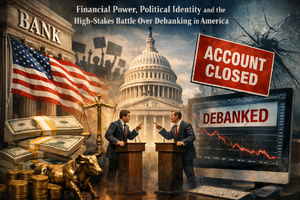
Donald Trump’s decision to file a $5 billion lawsuit against JPMorgan Chase and its longtime chief executive Jamie Dimon marks a pivotal moment in the growing conflict between political power and the modern banking system. At its core, the case is not simply about closed accounts. It is an attempt to challenge how financial institutions assess risk, how political identity intersects with corporate compliance, and who ultimately controls access to the financial infrastructure of the United States.
Trump alleges that JPMorgan deliberately terminated banking relationships with him and affiliated businesses for political reasons, framing the move as an act of ideological exclusion rather than a routine compliance decision. By bringing the case while serving as president, he has elevated a long-simmering conservative grievance into a direct legal confrontation with the country’s largest bank and one of its most influential corporate leaders.
The mechanics of alleged debanking and why they matter
Debanking refers to the closure or denial of banking services to individuals or entities deemed high risk. In theory, such decisions are grounded in regulatory obligations, including anti-money laundering requirements, sanctions compliance, and broader risk management policies. Banks are granted wide discretion to exit relationships that could expose them to legal, regulatory, or reputational harm.
Trump’s lawsuit argues that this discretion was abused. According to the complaint, JPMorgan did not merely reassess risk but allegedly singled him out, violating its own internal standards. The claim goes further by asserting that the bank’s actions were politically motivated and coordinated, designed to marginalize him financially and discourage other institutions from maintaining relationships with him or his businesses.
If proven, such conduct would challenge the long-standing assumption that banks operate as neutral financial intermediaries. The case therefore raises a fundamental question: where does legitimate risk management end, and where does political discrimination begin?
Why JPMorgan and Dimon are central to the dispute
JPMorgan’s prominence makes it a symbolic and strategic target. As the largest U.S. bank by assets, it plays a central role in global finance, corporate lending, and consumer banking. Its policies often influence industry standards, either directly or indirectly.
Jamie Dimon’s role is equally significant. Having led the bank for over two decades, he has become one of the most powerful voices in American finance. Trump’s lawsuit does not treat Dimon as a distant executive but alleges personal responsibility, accusing him of directing or endorsing a so-called “blacklist” that warned other banks against doing business with Trump-related entities.
This allegation is critical because it reframes the dispute from an institutional decision to an intentional strategy. Trump argues that reputational damage followed him beyond JPMorgan, forcing him to disclose account closures to other banks while seeking alternative services. In his telling, the harm was not only financial but systemic, cutting him off from ordinary market participation.
JPMorgan has rejected these claims, maintaining that account closures are based on legal and regulatory considerations rather than political views. The bank argues that such decisions are sometimes unavoidable in a heavily regulated environment, even when they involve prominent clients.
The political economy behind the lawsuit
Trump’s lawsuit cannot be separated from his broader economic agenda. He has repeatedly criticized large banks, accusing them of ideological bias and excessive alignment with progressive causes. At the same time, he has pushed policies that unsettle the financial industry, including calls for strict caps on credit card interest rates and sharp critiques of corporate globalization.
This tension helps explain why the lawsuit is framed as an abuse of financial power rather than a narrow contractual dispute. Trump positions himself as a representative figure, arguing that if a sitting president can be debanked, ordinary citizens and businesses are even more vulnerable.
For the banking industry, the case arrives at an awkward moment. Executives have broadly welcomed deregulation efforts that promise reduced compliance burdens and higher profitability. Yet the same industry now faces intensified scrutiny over whether banks have exercised too much subjective judgment in deciding which customers are acceptable.
Regulatory ambiguity and the rise of discretion
Over the past decade, U.S. banks have operated under overlapping and sometimes vague regulatory expectations. Anti-money laundering rules require heightened scrutiny of politically exposed persons, while supervisory guidance has historically allowed regulators to consider “reputational risk,” a concept critics describe as elastic and subjective.
This environment has encouraged caution. Banks often choose to exit relationships rather than face prolonged regulatory attention or potential enforcement actions. Trump’s lawsuit challenges this logic, suggesting that excessive caution can morph into unlawful exclusion, particularly when applied unevenly.
Regulators themselves have begun reassessing the framework. Moves to scale back reliance on reputational risk standards signal recognition that unclear expectations may have pushed banks toward overly defensive behavior. The lawsuit thus intersects with an ongoing recalibration of how risk is defined and enforced.
Debanking as a cultural and ideological flashpoint
The Trump case sits within a broader cultural debate. Conservative lawmakers and activists have accused banks of discriminating against industries such as firearms, fossil fuels, and cryptocurrency. Banks respond that sector-wide policies reflect risk assessments, investor pressure, and compliance realities rather than ideology.
What distinguishes Trump’s lawsuit is its personalization. Instead of focusing on an industry category, it centers on an individual with extraordinary political visibility. This amplifies concerns about viewpoint discrimination and raises the stakes for judicial interpretation.
If courts accept the argument that political identity can constitute unlawful grounds for account termination, banks may be forced to rethink client exit strategies. Conversely, if JPMorgan prevails, it would reinforce the breadth of discretion currently enjoyed by financial institutions.
Market reactions and institutional confidence
Financial markets have so far treated the lawsuit as a contained legal risk rather than a systemic threat. JPMorgan’s share performance has remained stable, suggesting investor confidence in the bank’s legal position and balance sheet strength.
However, the longer-term implications are harder to price. A ruling that narrows banks’ discretion could increase compliance costs and legal exposure across the sector. It could also embolden other plaintiffs who believe they were unfairly denied financial services.
For corporate leaders, the case underscores the reputational sensitivity of client decisions. Even when legally justified, account closures involving high-profile figures can trigger political backlash and prolonged litigation.
Trump’s lawsuit is ultimately about power: who wields it, how it is constrained, and whether access to financial infrastructure can be conditioned on non-financial considerations. By targeting both JPMorgan and its CEO personally, the case seeks to establish accountability at the highest levels of corporate decision-making.
Regardless of its outcome, the litigation forces a public reckoning with practices that have traditionally occurred behind closed doors. It invites courts to scrutinize the balance between private discretion and public obligation in a sector that underpins the entire economy.
In that sense, the dispute transcends Trump himself. It speaks to a future in which banks, regulators, and courts must more clearly define the boundaries of acceptable risk management in a politically polarized society, where financial access is no longer viewed as merely transactional but as a marker of inclusion in the economic system.
(Source:www.livemint.com)
Trump alleges that JPMorgan deliberately terminated banking relationships with him and affiliated businesses for political reasons, framing the move as an act of ideological exclusion rather than a routine compliance decision. By bringing the case while serving as president, he has elevated a long-simmering conservative grievance into a direct legal confrontation with the country’s largest bank and one of its most influential corporate leaders.
The mechanics of alleged debanking and why they matter
Debanking refers to the closure or denial of banking services to individuals or entities deemed high risk. In theory, such decisions are grounded in regulatory obligations, including anti-money laundering requirements, sanctions compliance, and broader risk management policies. Banks are granted wide discretion to exit relationships that could expose them to legal, regulatory, or reputational harm.
Trump’s lawsuit argues that this discretion was abused. According to the complaint, JPMorgan did not merely reassess risk but allegedly singled him out, violating its own internal standards. The claim goes further by asserting that the bank’s actions were politically motivated and coordinated, designed to marginalize him financially and discourage other institutions from maintaining relationships with him or his businesses.
If proven, such conduct would challenge the long-standing assumption that banks operate as neutral financial intermediaries. The case therefore raises a fundamental question: where does legitimate risk management end, and where does political discrimination begin?
Why JPMorgan and Dimon are central to the dispute
JPMorgan’s prominence makes it a symbolic and strategic target. As the largest U.S. bank by assets, it plays a central role in global finance, corporate lending, and consumer banking. Its policies often influence industry standards, either directly or indirectly.
Jamie Dimon’s role is equally significant. Having led the bank for over two decades, he has become one of the most powerful voices in American finance. Trump’s lawsuit does not treat Dimon as a distant executive but alleges personal responsibility, accusing him of directing or endorsing a so-called “blacklist” that warned other banks against doing business with Trump-related entities.
This allegation is critical because it reframes the dispute from an institutional decision to an intentional strategy. Trump argues that reputational damage followed him beyond JPMorgan, forcing him to disclose account closures to other banks while seeking alternative services. In his telling, the harm was not only financial but systemic, cutting him off from ordinary market participation.
JPMorgan has rejected these claims, maintaining that account closures are based on legal and regulatory considerations rather than political views. The bank argues that such decisions are sometimes unavoidable in a heavily regulated environment, even when they involve prominent clients.
The political economy behind the lawsuit
Trump’s lawsuit cannot be separated from his broader economic agenda. He has repeatedly criticized large banks, accusing them of ideological bias and excessive alignment with progressive causes. At the same time, he has pushed policies that unsettle the financial industry, including calls for strict caps on credit card interest rates and sharp critiques of corporate globalization.
This tension helps explain why the lawsuit is framed as an abuse of financial power rather than a narrow contractual dispute. Trump positions himself as a representative figure, arguing that if a sitting president can be debanked, ordinary citizens and businesses are even more vulnerable.
For the banking industry, the case arrives at an awkward moment. Executives have broadly welcomed deregulation efforts that promise reduced compliance burdens and higher profitability. Yet the same industry now faces intensified scrutiny over whether banks have exercised too much subjective judgment in deciding which customers are acceptable.
Regulatory ambiguity and the rise of discretion
Over the past decade, U.S. banks have operated under overlapping and sometimes vague regulatory expectations. Anti-money laundering rules require heightened scrutiny of politically exposed persons, while supervisory guidance has historically allowed regulators to consider “reputational risk,” a concept critics describe as elastic and subjective.
This environment has encouraged caution. Banks often choose to exit relationships rather than face prolonged regulatory attention or potential enforcement actions. Trump’s lawsuit challenges this logic, suggesting that excessive caution can morph into unlawful exclusion, particularly when applied unevenly.
Regulators themselves have begun reassessing the framework. Moves to scale back reliance on reputational risk standards signal recognition that unclear expectations may have pushed banks toward overly defensive behavior. The lawsuit thus intersects with an ongoing recalibration of how risk is defined and enforced.
Debanking as a cultural and ideological flashpoint
The Trump case sits within a broader cultural debate. Conservative lawmakers and activists have accused banks of discriminating against industries such as firearms, fossil fuels, and cryptocurrency. Banks respond that sector-wide policies reflect risk assessments, investor pressure, and compliance realities rather than ideology.
What distinguishes Trump’s lawsuit is its personalization. Instead of focusing on an industry category, it centers on an individual with extraordinary political visibility. This amplifies concerns about viewpoint discrimination and raises the stakes for judicial interpretation.
If courts accept the argument that political identity can constitute unlawful grounds for account termination, banks may be forced to rethink client exit strategies. Conversely, if JPMorgan prevails, it would reinforce the breadth of discretion currently enjoyed by financial institutions.
Market reactions and institutional confidence
Financial markets have so far treated the lawsuit as a contained legal risk rather than a systemic threat. JPMorgan’s share performance has remained stable, suggesting investor confidence in the bank’s legal position and balance sheet strength.
However, the longer-term implications are harder to price. A ruling that narrows banks’ discretion could increase compliance costs and legal exposure across the sector. It could also embolden other plaintiffs who believe they were unfairly denied financial services.
For corporate leaders, the case underscores the reputational sensitivity of client decisions. Even when legally justified, account closures involving high-profile figures can trigger political backlash and prolonged litigation.
Trump’s lawsuit is ultimately about power: who wields it, how it is constrained, and whether access to financial infrastructure can be conditioned on non-financial considerations. By targeting both JPMorgan and its CEO personally, the case seeks to establish accountability at the highest levels of corporate decision-making.
Regardless of its outcome, the litigation forces a public reckoning with practices that have traditionally occurred behind closed doors. It invites courts to scrutinize the balance between private discretion and public obligation in a sector that underpins the entire economy.
In that sense, the dispute transcends Trump himself. It speaks to a future in which banks, regulators, and courts must more clearly define the boundaries of acceptable risk management in a politically polarized society, where financial access is no longer viewed as merely transactional but as a marker of inclusion in the economic system.
(Source:www.livemint.com)
