


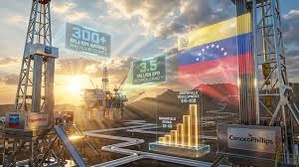
When Donald Trump convened executives from America’s largest oil companies at the White House, the discussion was framed as a commercial opportunity, but the underlying logic was geopolitical. Venezuela’s energy sector, once among the most productive in the world, has deteriorated into a symbol of institutional collapse. Trump’s call for U.S. oil majors to help rebuild the country’s “rotting” infrastructure reflects a deliberate attempt to convert political leverage into long-term economic and strategic control.
Oil sits at the core of this strategy because it remains Venezuela’s only realistic engine for recovery. Despite holding the world’s largest proven crude reserves, the country contributes barely a fraction of global supply. Trump’s administration has signaled that stabilizing Venezuela without restoring oil production is not feasible. The message to energy executives was clear: rebuilding production capacity is not only profitable but essential to reshaping Venezuela’s post-crisis order under U.S. influence.
The emphasis on American firms is also intentional. Washington views U.S. companies as instruments of governance as much as investment, capable of enforcing transparency, operational discipline, and alignment with U.S. interests. By tying Venezuela’s recovery to U.S. capital and technology, Trump is seeking to ensure that any revival of the oil sector strengthens American economic and strategic positioning rather than empowering rival states or unaccountable domestic actors.
Why Venezuela’s Oil Collapse Creates a Rare Opening for U.S. Influence
Venezuela’s oil industry did not decline because of resource exhaustion, but because of structural decay. Years of nationalization, underinvestment, skilled labor flight, and mismanagement hollowed out production capacity. Facilities designed to handle heavy crude fell into disrepair, pipelines corroded, refineries shut down intermittently, and export logistics became unreliable. Output collapsed from historical highs of more than three million barrels per day to levels that barely sustain domestic needs.
For Washington, this collapse represents a rare opening. Venezuela lacks the capital, expertise, and institutional credibility to rebuild its energy sector independently. That dependency creates leverage. Trump’s push for U.S. oil companies to take the lead is rooted in the belief that whoever rebuilds the infrastructure will shape how oil revenues flow, how contracts are enforced, and how political power is exercised.
This is also why the administration has insisted on controlling oil sales and revenues during the transition period. By placing energy exports under frameworks aligned with U.S. oversight, Washington aims to prevent a return to opaque financial practices that previously funded patronage networks and corruption. Oil, in this context, becomes both an economic asset and a governance tool.
Trump’s approach reflects a broader pattern: using market access and security guarantees to redraw economic systems in fragile states. Venezuela’s dependence on oil magnifies the effectiveness of this strategy, making energy reconstruction the fastest route to structural influence.
Corporate Risk, Memory of Expropriation, and Conditional Re-Entry
Despite the scale of opportunity, U.S. oil majors are approaching Venezuela with caution shaped by history. Companies such as Exxon Mobil and ConocoPhillips exited the country nearly two decades ago after assets were nationalized. Those experiences continue to define boardroom risk calculations, particularly for investments that require decades to pay off.
Executives have made clear that Venezuela remains commercially unattractive without sweeping political and legal reforms. High production costs, degraded infrastructure, and uncertainty over property rights all weigh against rapid re-entry. Even with vast reserves, heavy crude projects require sustained capital, stable fiscal terms, and reliable export channels—conditions that cannot be guaranteed by political change alone.
This hesitation explains why Chevron, the only major still operating in Venezuela, occupies a unique position. Its continued presence gives it institutional knowledge and operational footholds that others lack, but also exposes it to concentrated risk. Smaller independents and trading firms, often more flexible and willing to accept political uncertainty, appear more prepared to move quickly under U.S. licensing frameworks.
Trump’s role has been to reassure the industry that the political equation has shifted. His promise of U.S. security guarantees is designed to substitute state backing for institutional trust, reducing perceived risk enough to unlock capital that would otherwise remain sidelined.
Oil Supply, U.S. Refiners, and the Domestic Economic Angle
Trump’s appeal to oil executives is also grounded in domestic economic considerations. Venezuela’s heavy crude is uniquely compatible with many U.S. Gulf Coast refineries that were originally configured to process it. Years of disrupted supply forced refiners to seek alternative blends, often at higher cost. Restoring steady Venezuelan flows would directly benefit U.S. downstream operations.
Lower feedstock costs translate into lower fuel prices, a political advantage Trump has repeatedly emphasized. By linking Venezuelan reconstruction to cheaper energy at home, the administration has reframed foreign intervention as a consumer benefit rather than a geopolitical gamble. This framing helps neutralize criticism that the U.S. is exerting excessive control over another country’s resources.
The agreement to supply crude to the United States on an ongoing basis reflects this logic. Rather than treating Venezuelan oil as a marginal or temporary supplement, Washington appears intent on reintegrating it into U.S. energy planning. That integration strengthens the case for long-term investment while reinforcing U.S. influence over export routes and pricing structures.
In effect, Venezuelan oil becomes part of America’s energy security architecture, tying foreign reconstruction directly to domestic economic stability.
Financing, State Guarantees, and the Push for Rapid Capital Recovery
A critical pillar of Trump’s strategy lies in financing. Rebuilding Venezuela’s oil sector could require investments approaching $100 billion, a scale that private capital is unlikely to commit without state support. The administration’s openness to using U.S. financial institutions to underwrite projects reflects an understanding that risk mitigation is essential.
By signaling potential government-backed financing and guarantees, Trump is attempting to compress timelines. His emphasis on getting investment money back “as quickly as we can” suggests a preference for projects that deliver rapid production gains rather than slow, incremental rehabilitation. Early cash flow would allow companies to recover capital before political uncertainty resurfaces.
This approach prioritizes speed over institutional reform. The underlying assumption is that economic momentum can stabilize governance rather than waiting for governance to stabilize the economy. It is a calculated gamble that oil revenue, once flowing, will anchor political order and reduce incentives for disruption.
Trump’s formula—dividing returns among Venezuela, U.S. companies, and the United States—captures the transactional nature of the plan. Oil is not merely a commodity but the currency through which political alignment, economic recovery, and strategic influence are meant to be secured simultaneously.
(Source:www.energynow.com)
Oil sits at the core of this strategy because it remains Venezuela’s only realistic engine for recovery. Despite holding the world’s largest proven crude reserves, the country contributes barely a fraction of global supply. Trump’s administration has signaled that stabilizing Venezuela without restoring oil production is not feasible. The message to energy executives was clear: rebuilding production capacity is not only profitable but essential to reshaping Venezuela’s post-crisis order under U.S. influence.
The emphasis on American firms is also intentional. Washington views U.S. companies as instruments of governance as much as investment, capable of enforcing transparency, operational discipline, and alignment with U.S. interests. By tying Venezuela’s recovery to U.S. capital and technology, Trump is seeking to ensure that any revival of the oil sector strengthens American economic and strategic positioning rather than empowering rival states or unaccountable domestic actors.
Why Venezuela’s Oil Collapse Creates a Rare Opening for U.S. Influence
Venezuela’s oil industry did not decline because of resource exhaustion, but because of structural decay. Years of nationalization, underinvestment, skilled labor flight, and mismanagement hollowed out production capacity. Facilities designed to handle heavy crude fell into disrepair, pipelines corroded, refineries shut down intermittently, and export logistics became unreliable. Output collapsed from historical highs of more than three million barrels per day to levels that barely sustain domestic needs.
For Washington, this collapse represents a rare opening. Venezuela lacks the capital, expertise, and institutional credibility to rebuild its energy sector independently. That dependency creates leverage. Trump’s push for U.S. oil companies to take the lead is rooted in the belief that whoever rebuilds the infrastructure will shape how oil revenues flow, how contracts are enforced, and how political power is exercised.
This is also why the administration has insisted on controlling oil sales and revenues during the transition period. By placing energy exports under frameworks aligned with U.S. oversight, Washington aims to prevent a return to opaque financial practices that previously funded patronage networks and corruption. Oil, in this context, becomes both an economic asset and a governance tool.
Trump’s approach reflects a broader pattern: using market access and security guarantees to redraw economic systems in fragile states. Venezuela’s dependence on oil magnifies the effectiveness of this strategy, making energy reconstruction the fastest route to structural influence.
Corporate Risk, Memory of Expropriation, and Conditional Re-Entry
Despite the scale of opportunity, U.S. oil majors are approaching Venezuela with caution shaped by history. Companies such as Exxon Mobil and ConocoPhillips exited the country nearly two decades ago after assets were nationalized. Those experiences continue to define boardroom risk calculations, particularly for investments that require decades to pay off.
Executives have made clear that Venezuela remains commercially unattractive without sweeping political and legal reforms. High production costs, degraded infrastructure, and uncertainty over property rights all weigh against rapid re-entry. Even with vast reserves, heavy crude projects require sustained capital, stable fiscal terms, and reliable export channels—conditions that cannot be guaranteed by political change alone.
This hesitation explains why Chevron, the only major still operating in Venezuela, occupies a unique position. Its continued presence gives it institutional knowledge and operational footholds that others lack, but also exposes it to concentrated risk. Smaller independents and trading firms, often more flexible and willing to accept political uncertainty, appear more prepared to move quickly under U.S. licensing frameworks.
Trump’s role has been to reassure the industry that the political equation has shifted. His promise of U.S. security guarantees is designed to substitute state backing for institutional trust, reducing perceived risk enough to unlock capital that would otherwise remain sidelined.
Oil Supply, U.S. Refiners, and the Domestic Economic Angle
Trump’s appeal to oil executives is also grounded in domestic economic considerations. Venezuela’s heavy crude is uniquely compatible with many U.S. Gulf Coast refineries that were originally configured to process it. Years of disrupted supply forced refiners to seek alternative blends, often at higher cost. Restoring steady Venezuelan flows would directly benefit U.S. downstream operations.
Lower feedstock costs translate into lower fuel prices, a political advantage Trump has repeatedly emphasized. By linking Venezuelan reconstruction to cheaper energy at home, the administration has reframed foreign intervention as a consumer benefit rather than a geopolitical gamble. This framing helps neutralize criticism that the U.S. is exerting excessive control over another country’s resources.
The agreement to supply crude to the United States on an ongoing basis reflects this logic. Rather than treating Venezuelan oil as a marginal or temporary supplement, Washington appears intent on reintegrating it into U.S. energy planning. That integration strengthens the case for long-term investment while reinforcing U.S. influence over export routes and pricing structures.
In effect, Venezuelan oil becomes part of America’s energy security architecture, tying foreign reconstruction directly to domestic economic stability.
Financing, State Guarantees, and the Push for Rapid Capital Recovery
A critical pillar of Trump’s strategy lies in financing. Rebuilding Venezuela’s oil sector could require investments approaching $100 billion, a scale that private capital is unlikely to commit without state support. The administration’s openness to using U.S. financial institutions to underwrite projects reflects an understanding that risk mitigation is essential.
By signaling potential government-backed financing and guarantees, Trump is attempting to compress timelines. His emphasis on getting investment money back “as quickly as we can” suggests a preference for projects that deliver rapid production gains rather than slow, incremental rehabilitation. Early cash flow would allow companies to recover capital before political uncertainty resurfaces.
This approach prioritizes speed over institutional reform. The underlying assumption is that economic momentum can stabilize governance rather than waiting for governance to stabilize the economy. It is a calculated gamble that oil revenue, once flowing, will anchor political order and reduce incentives for disruption.
Trump’s formula—dividing returns among Venezuela, U.S. companies, and the United States—captures the transactional nature of the plan. Oil is not merely a commodity but the currency through which political alignment, economic recovery, and strategic influence are meant to be secured simultaneously.
(Source:www.energynow.com)
