


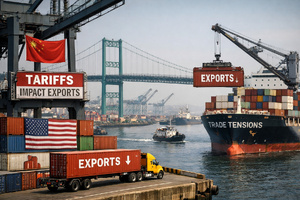
Exports moving through the Port of Los Angeles, the busiest gateway for ocean trade in the United States, have slipped sharply, underscoring how prolonged trade tensions and tariff regimes are redrawing global shipping patterns. January export volumes fell 8% from a year earlier to their lowest monthly level in nearly three years, reflecting a deeper structural slowdown in outbound shipments—particularly to China, once among the port’s most important trading partners.
The contraction highlights a broader shift in U.S. trade dynamics, where policy uncertainty, retaliatory tariffs and geopolitical rivalry have altered supply chains and dampened agricultural and energy exports. While imports remain comparatively resilient, the imbalance between inbound and outbound cargo is widening, raising concerns about long-term competitiveness for American exporters.
Tariffs and the Erosion of Export Demand
The steep drop in shipments to China has become emblematic of the strain. U.S. exports ranging from soybeans and corn to beef, crude oil and coal have faced mounting headwinds as trade disputes triggered retaliatory duties. Agricultural commodities, traditionally a backbone of trans-Pacific trade, have been particularly vulnerable. Soybean shipments through Los Angeles to China plunged dramatically over the past year, reflecting how quickly buyers can pivot to alternative suppliers when tariffs inflate costs.
Trade policy uncertainty compounds the effect. When tariffs are imposed or threatened, foreign buyers hesitate to commit to long-term contracts, preferring to diversify sourcing. Competing exporters in South America and other regions have capitalized on the opening, filling supply gaps created by U.S.-China tensions. Once new supply chains are established, regaining lost market share can be difficult, even if tariffs are eased.
For port operators, these policy-driven shifts translate into lower container throughput on the export side. In January, loaded export containers totaled just over 104,000 twenty-foot equivalent units, a figure that signals diminished outbound activity relative to recent years. The port’s leadership has acknowledged that exports to China, in particular, appear markedly subdued.
Structural Imbalances in Cargo Flow
While exports have faltered, imports have shown greater resilience, though they too are moderating from unusually strong levels seen during earlier tariff anticipation cycles. In January, imports fell 13% from a year earlier, partly reflecting a comparison against a period when U.S. importers rushed to stockpile goods before tariff hikes took effect.
This asymmetry—where imports significantly exceed exports—creates operational challenges. Containers arriving full often leave empty when outbound cargo volumes decline. Shipping lines must reposition equipment, increasing costs and reducing efficiency. For a port that thrives on balanced two-way trade, prolonged export weakness can strain logistics networks and diminish overall competitiveness.
Seasonal factors also play a role. The Lunar New Year in China typically dampens February and March trade as factories close temporarily. However, port officials expect first-quarter volumes to decline by less than 10% compared with the prior year’s quarter, suggesting that while trade is cooling, it is not collapsing. Consumer demand in the United States—responsible for roughly 70% of economic activity—remains a key stabilizing force for inbound shipments, even as export markets weaken.
Broader Economic Implications
The decline in export volumes is not confined to a single commodity or industry. Energy shipments, including crude oil and coal, have softened, while agricultural products face intensified competition. These trends reflect not only tariff impacts but also a reconfiguration of global demand and energy transitions.
For U.S. farmers and energy producers, reduced access to the Chinese market represents a material setback. China has historically been one of the largest buyers of American agricultural goods. When those flows diminish, domestic producers confront lower prices and greater volatility. Some have sought new markets in Southeast Asia, Africa and Europe, but building stable trade relationships takes time.
The ripple effects extend beyond producers. Ports like Los Angeles support thousands of jobs in logistics, warehousing and transportation. Lower export throughput can translate into fewer shifts, reduced trucking demand and diminished ancillary services. Although imports sustain much of the port’s activity, a persistent export slump alters the revenue mix and may constrain long-term infrastructure investment.
Trade Policy and Strategic Realignment
The current export slowdown illustrates how trade policy shapes commercial behavior. Tariffs, while intended to protect domestic industries or address trade imbalances, often prompt reciprocal measures. Retaliatory duties from major trading partners can swiftly erode competitiveness for exporters caught in the crossfire.
Moreover, geopolitical rivalry encourages strategic decoupling in sensitive sectors. Supply chains that once spanned continents are being reconfigured with resilience and political alignment in mind. For exporters relying heavily on a single foreign market, diversification has become a strategic imperative.
At the same time, global trade has not ground to a halt. Instead, it is fragmenting along new lines. Some U.S. exports are finding alternative destinations, while certain imports are being rerouted through different ports or countries. The Port of Los Angeles, given its scale and infrastructure, remains a critical node in this evolving network, but it must adapt to changing cargo compositions and volumes.
Outlook for Maritime Trade
Despite the downturn in exports, port officials have expressed cautious optimism that cargo volumes will not fall precipitously. Consumer spending trends, retail inventory cycles and macroeconomic conditions all influence container flows. A soft holiday retail season may temper import growth, yet underlying demand remains relatively steady.
The challenge lies in restoring export momentum. If trade tensions persist, exporters may continue to struggle in regaining lost market share in China. Conversely, any easing of tariffs or stabilization of bilateral relations could gradually revive shipments, though rebuilding trust and contracts takes time.
In the interim, the port’s strategy focuses on operational efficiency and infrastructure modernization to remain competitive regardless of trade headwinds. Investments in automation, environmental upgrades and supply chain visibility aim to attract carriers and shippers seeking reliability in uncertain times.
The export decline at the Port of Los Angeles thus serves as a barometer of broader economic currents. It reflects the tangible consequences of policy choices, geopolitical friction and shifting demand patterns. While imports provide a buffer, the health of outbound trade remains a critical indicator of the United States’ integration into global markets and the resilience of its producers in an era of evolving trade dynamics.
(Source:www.reuters.com)
The contraction highlights a broader shift in U.S. trade dynamics, where policy uncertainty, retaliatory tariffs and geopolitical rivalry have altered supply chains and dampened agricultural and energy exports. While imports remain comparatively resilient, the imbalance between inbound and outbound cargo is widening, raising concerns about long-term competitiveness for American exporters.
Tariffs and the Erosion of Export Demand
The steep drop in shipments to China has become emblematic of the strain. U.S. exports ranging from soybeans and corn to beef, crude oil and coal have faced mounting headwinds as trade disputes triggered retaliatory duties. Agricultural commodities, traditionally a backbone of trans-Pacific trade, have been particularly vulnerable. Soybean shipments through Los Angeles to China plunged dramatically over the past year, reflecting how quickly buyers can pivot to alternative suppliers when tariffs inflate costs.
Trade policy uncertainty compounds the effect. When tariffs are imposed or threatened, foreign buyers hesitate to commit to long-term contracts, preferring to diversify sourcing. Competing exporters in South America and other regions have capitalized on the opening, filling supply gaps created by U.S.-China tensions. Once new supply chains are established, regaining lost market share can be difficult, even if tariffs are eased.
For port operators, these policy-driven shifts translate into lower container throughput on the export side. In January, loaded export containers totaled just over 104,000 twenty-foot equivalent units, a figure that signals diminished outbound activity relative to recent years. The port’s leadership has acknowledged that exports to China, in particular, appear markedly subdued.
Structural Imbalances in Cargo Flow
While exports have faltered, imports have shown greater resilience, though they too are moderating from unusually strong levels seen during earlier tariff anticipation cycles. In January, imports fell 13% from a year earlier, partly reflecting a comparison against a period when U.S. importers rushed to stockpile goods before tariff hikes took effect.
This asymmetry—where imports significantly exceed exports—creates operational challenges. Containers arriving full often leave empty when outbound cargo volumes decline. Shipping lines must reposition equipment, increasing costs and reducing efficiency. For a port that thrives on balanced two-way trade, prolonged export weakness can strain logistics networks and diminish overall competitiveness.
Seasonal factors also play a role. The Lunar New Year in China typically dampens February and March trade as factories close temporarily. However, port officials expect first-quarter volumes to decline by less than 10% compared with the prior year’s quarter, suggesting that while trade is cooling, it is not collapsing. Consumer demand in the United States—responsible for roughly 70% of economic activity—remains a key stabilizing force for inbound shipments, even as export markets weaken.
Broader Economic Implications
The decline in export volumes is not confined to a single commodity or industry. Energy shipments, including crude oil and coal, have softened, while agricultural products face intensified competition. These trends reflect not only tariff impacts but also a reconfiguration of global demand and energy transitions.
For U.S. farmers and energy producers, reduced access to the Chinese market represents a material setback. China has historically been one of the largest buyers of American agricultural goods. When those flows diminish, domestic producers confront lower prices and greater volatility. Some have sought new markets in Southeast Asia, Africa and Europe, but building stable trade relationships takes time.
The ripple effects extend beyond producers. Ports like Los Angeles support thousands of jobs in logistics, warehousing and transportation. Lower export throughput can translate into fewer shifts, reduced trucking demand and diminished ancillary services. Although imports sustain much of the port’s activity, a persistent export slump alters the revenue mix and may constrain long-term infrastructure investment.
Trade Policy and Strategic Realignment
The current export slowdown illustrates how trade policy shapes commercial behavior. Tariffs, while intended to protect domestic industries or address trade imbalances, often prompt reciprocal measures. Retaliatory duties from major trading partners can swiftly erode competitiveness for exporters caught in the crossfire.
Moreover, geopolitical rivalry encourages strategic decoupling in sensitive sectors. Supply chains that once spanned continents are being reconfigured with resilience and political alignment in mind. For exporters relying heavily on a single foreign market, diversification has become a strategic imperative.
At the same time, global trade has not ground to a halt. Instead, it is fragmenting along new lines. Some U.S. exports are finding alternative destinations, while certain imports are being rerouted through different ports or countries. The Port of Los Angeles, given its scale and infrastructure, remains a critical node in this evolving network, but it must adapt to changing cargo compositions and volumes.
Outlook for Maritime Trade
Despite the downturn in exports, port officials have expressed cautious optimism that cargo volumes will not fall precipitously. Consumer spending trends, retail inventory cycles and macroeconomic conditions all influence container flows. A soft holiday retail season may temper import growth, yet underlying demand remains relatively steady.
The challenge lies in restoring export momentum. If trade tensions persist, exporters may continue to struggle in regaining lost market share in China. Conversely, any easing of tariffs or stabilization of bilateral relations could gradually revive shipments, though rebuilding trust and contracts takes time.
In the interim, the port’s strategy focuses on operational efficiency and infrastructure modernization to remain competitive regardless of trade headwinds. Investments in automation, environmental upgrades and supply chain visibility aim to attract carriers and shippers seeking reliability in uncertain times.
The export decline at the Port of Los Angeles thus serves as a barometer of broader economic currents. It reflects the tangible consequences of policy choices, geopolitical friction and shifting demand patterns. While imports provide a buffer, the health of outbound trade remains a critical indicator of the United States’ integration into global markets and the resilience of its producers in an era of evolving trade dynamics.
(Source:www.reuters.com)
