


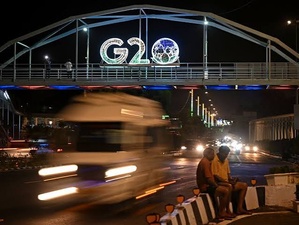
The United States is seeking to turn its increasingly contentious trade relationship with China into a broader campaign of coordinated pressure, with Treasury Secretary Scott Bessent urging G20 economies to reconsider their trade arrangements with Beijing. The objective, according to officials familiar with the discussions, is not simply to reduce individual countries' trade deficits with China but to pressure Beijing into changing an economic model that Washington argues relies excessively on exports, industrial production and foreign demand while domestic consumption remains comparatively weak.
Bessent's proposal comes after the United States imposed extensive tariffs and restrictions on Chinese goods, measures that have reduced direct Chinese exports to the American market but have also encouraged Chinese companies to seek customers elsewhere. Europe and Latin America have become increasingly important destinations, intensifying concerns among other major economies that American trade barriers may be shifting rather than resolving the underlying imbalance.
Washington's argument is that this diversion makes a unilateral US strategy insufficient. If China continues producing large volumes of goods for export while its domestic economy struggles to absorb them, restricting Chinese products in one major market can encourage exporters to redirect those goods into another. The proposed G20 approach is therefore designed to widen the economic pressure on Beijing by making it harder to replace one closed market with another.
Washington wants the pressure on China widened
The scale of China's external surplus is at the centre of the American argument. Bessent has pointed to a Chinese trade surplus of about $1.2 trillion as evidence that the existing pattern cannot continue indefinitely. His criticism is directed at the structure behind the surplus rather than simply at the volume of Chinese exports. Washington believes China's weak domestic demand, extensive industrial capacity and state support for strategic industries are encouraging manufacturers to depend increasingly on overseas markets.
Recent trade figures explain why the issue is becoming more politically sensitive. Chinese exports remained exceptionally strong during 2026, with July exports rising almost 24% from a year earlier. Exports of high-technology products and vehicles have been particularly strong, while shipments to markets outside the United States have continued to increase. This means the reduction in Chinese sales to America does not necessarily translate into a comparable reduction in China's overall export strength.
For Washington, this creates a clear strategic calculation. The United States has already demonstrated that tariffs can reduce Chinese access to the American market. The next step is to persuade other major economies to apply enough pressure that Beijing cannot simply redirect the resulting surplus elsewhere.
That explains the emphasis on G20 cooperation. Bessent wants other industrial economies to recognise that the problem is not confined to the United States. If European, Asian and Latin American markets absorb increasing quantities of Chinese products displaced from America, Washington's tariffs could redistribute the trade pressure without addressing what it sees as the underlying economic distortion.
The proposed approach would therefore use access to foreign markets as leverage on China. The objective is to make continued dependence on exports increasingly costly and encourage Beijing to expand domestic consumption instead.
Chinese exports are becoming the target of wider trade pressure
The pressure is particularly significant for industries where China has developed enormous production capacity. Electric vehicles, batteries, solar equipment, electronics, machinery, steel and other manufactured products have allowed Chinese companies to build strong positions in overseas markets. When domestic demand is insufficient to absorb production, international markets provide an alternative outlet.
Washington argues that this is not simply the result of Chinese companies becoming more competitive. It points to industrial subsidies and other government policies that it believes distort competition and encourage production beyond what domestic demand can support.
Beijing rejects that interpretation. Chinese authorities have argued that claims of widespread excess capacity caused by inadequate domestic demand are misleading and that the country's export strength reflects improvements in productivity, technology and economies of scale. That disagreement is fundamental because it means Washington and Beijing do not share the same diagnosis of the problem.
The difference matters for the pressure strategy. If the United States and its partners believe Chinese overcapacity is primarily the product of state support and weak domestic demand, trade barriers are being proposed as leverage to force policy changes inside China. If Beijing instead sees export growth as the natural result of industrial competitiveness and overseas demand, it has less reason to accept foreign restrictions as justification for changing its economic model.
That makes the G20 debate more consequential than a discussion about tariffs alone. Washington is effectively asking other countries to use their own markets as bargaining power in an attempt to influence Chinese domestic economic policy.
Europe faces pressure to join the US strategy
Europe is likely to be one of the most important tests of Washington's proposal. European industries are increasingly concerned about competition from Chinese manufacturers, particularly in automobiles and other advanced manufacturing sectors. At the same time, European economies remain deeply connected to Chinese supply chains and continue to depend on Chinese products and components.
That leaves European governments with a difficult choice. Joining a coordinated US-led effort could increase pressure on Beijing and protect vulnerable European industries. But broad trade restrictions could also increase costs for European consumers and manufacturers that rely on Chinese imports.
The issue is already moving higher on Europe's economic agenda. France and Germany are preparing a joint approach to China's large trade surplus, although their emphasis has included encouraging a stronger Chinese currency and greater Chinese domestic demand rather than simply reproducing Washington's tariff strategy.
This creates an important distinction between shared concerns and shared policy. Europe may agree with Washington that China's trade surplus is becoming difficult to absorb, while disagreeing over how much pressure should be applied and what form it should take.
Bessent's proposal is therefore also an attempt to shape that debate before individual governments adopt separate responses. A coordinated G20 position would give Washington considerably greater leverage over Beijing than unilateral American tariffs.
The pressure strategy has economic limits
There is, however, no guarantee that additional trade barriers would force China to rebalance its economy. Tariffs can reduce exports to particular markets, but they cannot directly make Chinese households spend more, restore confidence in the property sector or alter domestic savings patterns.
If G20 economies collectively restrict Chinese imports, Chinese manufacturers could instead seek markets outside the participating countries, reduce prices to remain competitive or move production into third countries. Some Chinese companies could also accelerate investment in overseas manufacturing to avoid trade barriers. The result could be a more fragmented global trading system without necessarily producing the domestic economic transformation Washington seeks.
There is another complication. The United States itself contributes to global trade imbalances through its large fiscal deficits and substantial demand for imported goods. Some economists argue that reducing America's fiscal imbalance would also be necessary for addressing global current-account disparities. Pressure directed exclusively at China therefore cannot resolve every source of the global imbalance.
That does not invalidate Washington's argument about Chinese industrial capacity. It does, however, show why trade barriers alone are unlikely to deliver the structural changes the United States wants.
Washington is combining pressure with selective negotiation
The Trump administration's strategy toward China is consequently becoming a combination of economic pressure and selective engagement. While Bessent is asking G20 countries to consider stronger barriers, American and Chinese officials are also discussing possible tariff reductions on non-strategic goods. Bessent has suggested that there could be scope to remove tariffs on substantial volumes of goods on both sides.
This dual approach indicates that Washington is not necessarily seeking an across-the-board shutdown of trade with China. Instead, it appears to be distinguishing between sectors that are considered strategically important and areas where tariff reductions could benefit both economies.
The planned meeting between President Donald Trump and Chinese President Xi Jinping later in September will provide an important test of whether the pressure strategy can produce concessions from Beijing. Washington wants China to alter the balance between domestic consumption and exports, while Beijing has shown limited willingness to accept the American description of its industrial model as the central cause of global trade imbalances.
The G20 initiative therefore represents an effort to increase the cost of resisting that American position. If major economies coordinate their trade policies, China's access to overseas markets could become more restricted at the same time that Washington is maintaining its own barriers. That would create stronger incentives for Beijing to negotiate.
But the success of the strategy will ultimately depend on whether G20 countries are prepared to accept the economic costs of applying pressure on China. Their willingness to act collectively will determine whether Bessent's proposal becomes a genuine multilateral effort to force economic rebalancing in Beijing or remains primarily an American attempt to persuade other economies to join its increasingly assertive trade policy.
(Source:www.firstpost.com)
Bessent's proposal comes after the United States imposed extensive tariffs and restrictions on Chinese goods, measures that have reduced direct Chinese exports to the American market but have also encouraged Chinese companies to seek customers elsewhere. Europe and Latin America have become increasingly important destinations, intensifying concerns among other major economies that American trade barriers may be shifting rather than resolving the underlying imbalance.
Washington's argument is that this diversion makes a unilateral US strategy insufficient. If China continues producing large volumes of goods for export while its domestic economy struggles to absorb them, restricting Chinese products in one major market can encourage exporters to redirect those goods into another. The proposed G20 approach is therefore designed to widen the economic pressure on Beijing by making it harder to replace one closed market with another.
Washington wants the pressure on China widened
The scale of China's external surplus is at the centre of the American argument. Bessent has pointed to a Chinese trade surplus of about $1.2 trillion as evidence that the existing pattern cannot continue indefinitely. His criticism is directed at the structure behind the surplus rather than simply at the volume of Chinese exports. Washington believes China's weak domestic demand, extensive industrial capacity and state support for strategic industries are encouraging manufacturers to depend increasingly on overseas markets.
Recent trade figures explain why the issue is becoming more politically sensitive. Chinese exports remained exceptionally strong during 2026, with July exports rising almost 24% from a year earlier. Exports of high-technology products and vehicles have been particularly strong, while shipments to markets outside the United States have continued to increase. This means the reduction in Chinese sales to America does not necessarily translate into a comparable reduction in China's overall export strength.
For Washington, this creates a clear strategic calculation. The United States has already demonstrated that tariffs can reduce Chinese access to the American market. The next step is to persuade other major economies to apply enough pressure that Beijing cannot simply redirect the resulting surplus elsewhere.
That explains the emphasis on G20 cooperation. Bessent wants other industrial economies to recognise that the problem is not confined to the United States. If European, Asian and Latin American markets absorb increasing quantities of Chinese products displaced from America, Washington's tariffs could redistribute the trade pressure without addressing what it sees as the underlying economic distortion.
The proposed approach would therefore use access to foreign markets as leverage on China. The objective is to make continued dependence on exports increasingly costly and encourage Beijing to expand domestic consumption instead.
Chinese exports are becoming the target of wider trade pressure
The pressure is particularly significant for industries where China has developed enormous production capacity. Electric vehicles, batteries, solar equipment, electronics, machinery, steel and other manufactured products have allowed Chinese companies to build strong positions in overseas markets. When domestic demand is insufficient to absorb production, international markets provide an alternative outlet.
Washington argues that this is not simply the result of Chinese companies becoming more competitive. It points to industrial subsidies and other government policies that it believes distort competition and encourage production beyond what domestic demand can support.
Beijing rejects that interpretation. Chinese authorities have argued that claims of widespread excess capacity caused by inadequate domestic demand are misleading and that the country's export strength reflects improvements in productivity, technology and economies of scale. That disagreement is fundamental because it means Washington and Beijing do not share the same diagnosis of the problem.
The difference matters for the pressure strategy. If the United States and its partners believe Chinese overcapacity is primarily the product of state support and weak domestic demand, trade barriers are being proposed as leverage to force policy changes inside China. If Beijing instead sees export growth as the natural result of industrial competitiveness and overseas demand, it has less reason to accept foreign restrictions as justification for changing its economic model.
That makes the G20 debate more consequential than a discussion about tariffs alone. Washington is effectively asking other countries to use their own markets as bargaining power in an attempt to influence Chinese domestic economic policy.
Europe faces pressure to join the US strategy
Europe is likely to be one of the most important tests of Washington's proposal. European industries are increasingly concerned about competition from Chinese manufacturers, particularly in automobiles and other advanced manufacturing sectors. At the same time, European economies remain deeply connected to Chinese supply chains and continue to depend on Chinese products and components.
That leaves European governments with a difficult choice. Joining a coordinated US-led effort could increase pressure on Beijing and protect vulnerable European industries. But broad trade restrictions could also increase costs for European consumers and manufacturers that rely on Chinese imports.
The issue is already moving higher on Europe's economic agenda. France and Germany are preparing a joint approach to China's large trade surplus, although their emphasis has included encouraging a stronger Chinese currency and greater Chinese domestic demand rather than simply reproducing Washington's tariff strategy.
This creates an important distinction between shared concerns and shared policy. Europe may agree with Washington that China's trade surplus is becoming difficult to absorb, while disagreeing over how much pressure should be applied and what form it should take.
Bessent's proposal is therefore also an attempt to shape that debate before individual governments adopt separate responses. A coordinated G20 position would give Washington considerably greater leverage over Beijing than unilateral American tariffs.
The pressure strategy has economic limits
There is, however, no guarantee that additional trade barriers would force China to rebalance its economy. Tariffs can reduce exports to particular markets, but they cannot directly make Chinese households spend more, restore confidence in the property sector or alter domestic savings patterns.
If G20 economies collectively restrict Chinese imports, Chinese manufacturers could instead seek markets outside the participating countries, reduce prices to remain competitive or move production into third countries. Some Chinese companies could also accelerate investment in overseas manufacturing to avoid trade barriers. The result could be a more fragmented global trading system without necessarily producing the domestic economic transformation Washington seeks.
There is another complication. The United States itself contributes to global trade imbalances through its large fiscal deficits and substantial demand for imported goods. Some economists argue that reducing America's fiscal imbalance would also be necessary for addressing global current-account disparities. Pressure directed exclusively at China therefore cannot resolve every source of the global imbalance.
That does not invalidate Washington's argument about Chinese industrial capacity. It does, however, show why trade barriers alone are unlikely to deliver the structural changes the United States wants.
Washington is combining pressure with selective negotiation
The Trump administration's strategy toward China is consequently becoming a combination of economic pressure and selective engagement. While Bessent is asking G20 countries to consider stronger barriers, American and Chinese officials are also discussing possible tariff reductions on non-strategic goods. Bessent has suggested that there could be scope to remove tariffs on substantial volumes of goods on both sides.
This dual approach indicates that Washington is not necessarily seeking an across-the-board shutdown of trade with China. Instead, it appears to be distinguishing between sectors that are considered strategically important and areas where tariff reductions could benefit both economies.
The planned meeting between President Donald Trump and Chinese President Xi Jinping later in September will provide an important test of whether the pressure strategy can produce concessions from Beijing. Washington wants China to alter the balance between domestic consumption and exports, while Beijing has shown limited willingness to accept the American description of its industrial model as the central cause of global trade imbalances.
The G20 initiative therefore represents an effort to increase the cost of resisting that American position. If major economies coordinate their trade policies, China's access to overseas markets could become more restricted at the same time that Washington is maintaining its own barriers. That would create stronger incentives for Beijing to negotiate.
But the success of the strategy will ultimately depend on whether G20 countries are prepared to accept the economic costs of applying pressure on China. Their willingness to act collectively will determine whether Bessent's proposal becomes a genuine multilateral effort to force economic rebalancing in Beijing or remains primarily an American attempt to persuade other economies to join its increasingly assertive trade policy.
(Source:www.firstpost.com)
