

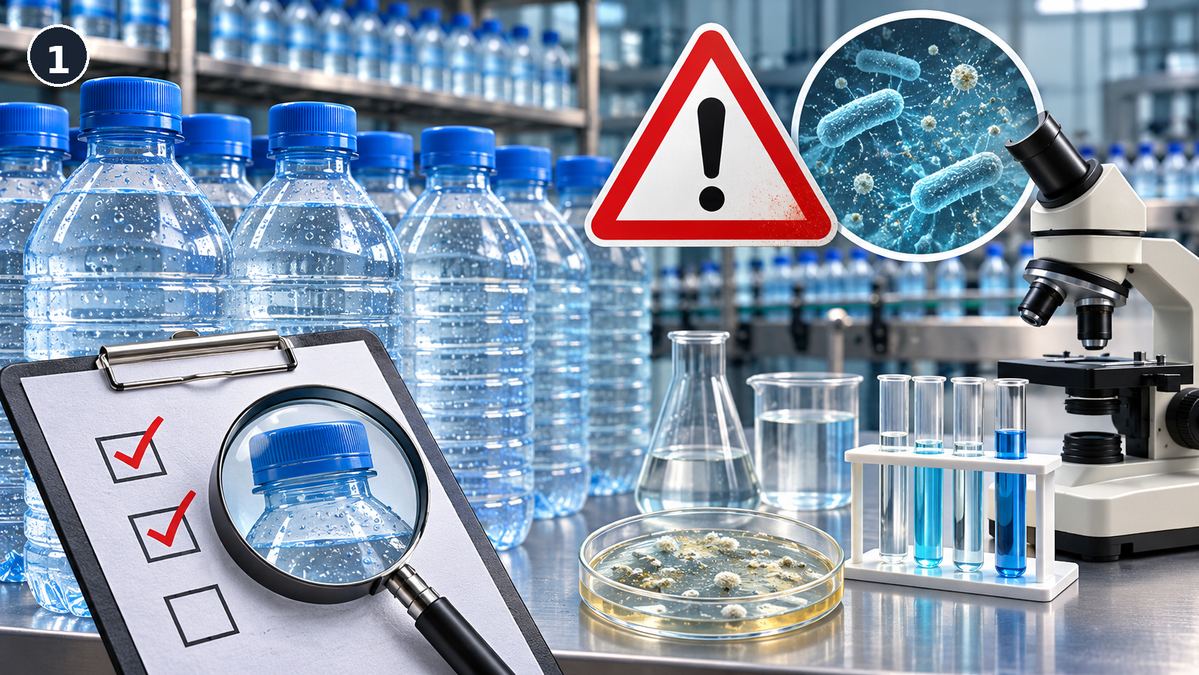
India’s packaged drinking water market faces a growing credibility challenge as repeated safety findings involving Bisleri, one of the country’s most established bottled-water brands, raise questions about manufacturing controls, regulatory supervision and the reliability of quality assurance across the industry. The latest detection of coliform bacteria in a second Bisleri sample adds another dimension to an already serious regulatory dispute, shifting attention from an isolated product failure towards the effectiveness of the systems responsible for ensuring drinking water safety.
The latest finding concerns a batch manufactured in July 2026. The Food Safety and Standards Authority of India had informed Bisleri through an August 12 notice that the sample was unsafe and directed the company to stop selling the affected batch. A subsequent confirmatory examination reportedly produced the same result. Bisleri acknowledged that regulatory laboratories had detected coliform bacteria but maintained that independent tests of samples from the same batch had met the applicable safety standards.
The disagreement between the company’s testing and the regulatory findings makes the case particularly significant. It raises questions about laboratory procedures, sampling methods and the consistency of quality-control systems. More importantly, consumers have little practical ability to independently establish whether a sealed bottle meets the prescribed standards. They depend almost entirely on manufacturers and regulators to ensure that the water they purchase is safe.
When Brand Reputation Meets Regulatory Evidence
Bisleri’s position in the Indian market makes the latest development more consequential than an ordinary quality-control dispute involving a smaller manufacturer. Packaged drinking water has become an everyday necessity in many Indian cities, where unreliable municipal supplies, concerns about contamination and changing consumption patterns have increased dependence on bottled water. The company has built considerable recognition through its distribution network and long-standing presence in the market.
That reputation, however, cannot substitute for demonstrable compliance. The latest bacterial finding comes days after another regulatory case involving Bisleri, in which a packaged drinking water sample collected from the company’s premises was declared unsafe because it failed the prescribed bromate limit. Following an appeal, a referral laboratory also reported the presence of polynuclear aromatic hydrocarbons, commonly known as PAHs. The regulator subsequently sanctioned prosecution against the company under the Food Safety and Standards Act.
Bisleri has disputed aspects of the earlier testing process as well. The company has maintained that its own examinations produced different results and questioned the differences between laboratory findings. These disagreements need to be examined through transparent scientific procedures rather than treated as a contest between corporate assurances and regulatory authority. Equally, the existence of a prosecution sanction should not be confused with a judicial conviction.
The two cases also involve different safety concerns. Bromate and certain PAHs are chemical contaminants, while coliform bacteria are indicators of possible contamination during water treatment, handling or distribution. Their detection does not automatically establish that every product manufactured by the company is unsafe. However, repeated findings involving different categories of contamination make a stronger case for examining manufacturing processes, source water, treatment facilities and batch-level testing.
The Weaknesses Behind India’s Packaged Water Market
The Indian bottled-water industry operates in a market where consumer demand has expanded considerably, but the ability to maintain consistent quality across thousands of production and distribution points remains a challenge. Packaged water manufacturers depend on several stages of processing, including source-water selection, filtration, disinfection, treatment, bottling, sealing and storage. A failure at any stage can compromise the finished product.
Contamination does not necessarily originate from the same point in every case. Poorly maintained treatment equipment, inadequate disinfection, contaminated storage tanks, unhygienic bottling environments and improper handling can create different risks. Even when the production facility follows established procedures, transportation and storage conditions can affect product quality. These possibilities underline why testing should cover the complete production and distribution chain rather than focus exclusively on the final product.
India’s regulatory framework requires packaged drinking water to comply with prescribed microbiological and chemical safety standards. The mandatory Bureau of Indian Standards certification requirement was removed in October 2024, with the food safety regulator introducing a separate testing framework that became effective in January 2026. This places greater importance on the implementation of regular testing, documentation and regulatory inspections.
The removal of mandatory certification does not mean manufacturers have been given greater freedom to compromise on safety. Rather, it makes the effectiveness of the food safety regulator’s testing and enforcement arrangements particularly important. A system based on periodic inspections and risk-based sampling can work only if authorities have adequate laboratory capacity, trained personnel and the ability to act quickly when a sample fails.
Why the Regulator Needs to Look Beyond Individual Brands
The latest findings should not be interpreted as evidence that the entire bottled-water industry is unsafe. However, the regulator’s decision to expand inspections and testing across packaged-water manufacturers is justified by the potential public health implications. Major competitors, including PepsiCo, Coca-Cola, Tata Consumer Products and Reliance Consumer Products, operate in a market where consumer confidence is closely linked to the perception that sealed drinking water is subject to reliable government oversight.
The challenge is to ensure that inspections are consistent rather than driven by the visibility of particular brands. Smaller manufacturers and local bottling units deserve the same scrutiny as nationally recognised companies. A market dominated by familiar labels can create a false sense of security if the actual quality of individual batches is not independently verified.
Regulators should also consider publishing more detailed testing information, including the nature of contamination, affected production batches, sampling dates and the subsequent corrective action taken by manufacturers. Such disclosure would allow consumers and distributors to distinguish between an isolated production failure and a problem involving repeated non-compliance.
For manufacturers, the commercial consequences of weak quality assurance could extend beyond regulatory penalties. Packaged water is a product where trust is central to purchasing decisions. Unlike many consumer goods, customers cannot assess its safety through appearance, smell or taste. A manufacturer therefore depends on credibility built through consistent compliance and transparent handling of problems.
The Bisleri cases have brought this issue into sharper focus. The immediate question concerns the safety of the specific batches identified by regulators and the company’s response to those findings. The wider issue, however, concerns whether India’s packaged-water industry has developed quality-control systems capable of keeping pace with its expanding market. Unless testing, accountability and public disclosure improve together, even established brands may find it increasingly difficult to maintain consumer confidence.
(Source:www.moneycontrol.com)