
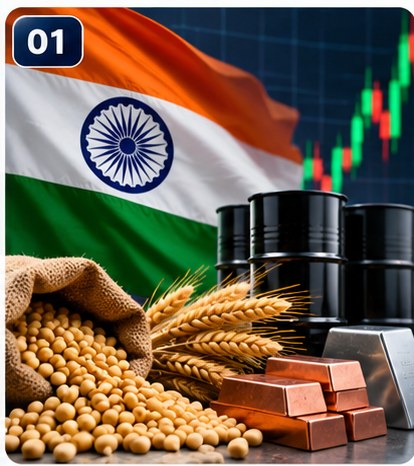
India’s decision to widen foreign investor participation in its commodity derivatives markets from June 2027 marks an important step in the country’s efforts to deepen its financial markets and attract international capital. The proposed opening is not simply about allowing overseas investors to trade more freely. It reflects a broader recognition that Indian commodity exchanges need greater international participation if they are to develop into credible pricing centres for agricultural products, metals and energy-related commodities. However, attracting foreign capital will also require regulators to address questions surrounding market transparency, price volatility and the protection of domestic participants.
The reform comes at a time when global commodity markets are increasingly influenced by geopolitical tensions, supply-chain disruptions, currency movements and changing patterns of industrial demand. International investors routinely use derivatives to manage exposure to these developments, while producers and consumers depend on futures markets to protect themselves against unpredictable price movements. India’s relatively restricted foreign participation has limited the extent to which its commodity exchanges can integrate with these international trading networks.
International Participation and the Search for Better Price Discovery
Commodity derivatives markets perform a function that extends beyond speculative trading. They provide mechanisms through which farmers, manufacturers, importers, exporters and industrial consumers can manage future price risks. A more internationally connected Indian market could improve liquidity, encourage wider participation and make domestic commodity prices more responsive to developments in global markets. This would be particularly relevant for commodities where India has substantial production or consumption interests but remains influenced by international benchmark prices.
Greater foreign participation could also strengthen the position of Indian exchanges against established commodity trading centres in London, New York and Singapore. International funds and institutional investors bring different trading strategies, market information and risk-management practices. Their participation could increase trading volumes and improve the availability of counterparties for domestic businesses seeking to hedge their exposure. However, higher trading activity alone does not guarantee better price discovery. The quality of market regulation, settlement systems and underlying physical-market participation will remain equally important.
For India, the opportunity is significant because its position in global commodity consumption is much larger than its influence over international benchmark pricing. The country is a major consumer of crude oil, gold, copper and several agricultural commodities. Yet domestic producers and businesses frequently remain exposed to prices determined in overseas markets. Developing deeper domestic derivatives markets could help Indian participants manage this exposure more efficiently, although international pricing influence will take considerably longer to establish.
Why Regulators Must Balance Openness With Market Stability
Opening commodity markets to overseas investors introduces risks that cannot be addressed simply by increasing regulatory supervision after the reform takes effect. Foreign institutional capital can improve liquidity, but it can also move rapidly between markets in response to interest-rate decisions, currency fluctuations and geopolitical developments. In periods of uncertainty, large positions can amplify price movements, particularly in contracts where trading volumes and available physical supplies are relatively limited.
This concern becomes particularly important in agricultural commodities. India has millions of farmers whose incomes are influenced by crop prices, while food inflation remains a politically and economically sensitive issue. A derivatives market that becomes excessively dominated by financial trading could create perceptions that prices are being driven by speculative activity rather than underlying supply and demand. Even when such perceptions are not supported by actual market conditions, they can undermine confidence in the exchanges and complicate policy decisions.
Regulators will therefore need to establish clear position limits, reporting requirements, surveillance mechanisms and safeguards against market manipulation. The ability to identify beneficial ownership and monitor the movement of large trading positions will become more important as overseas participation increases. Consistent enforcement will also matter because international investors are unlikely to commit substantial capital to a market where trading rules are unpredictable or where regulatory decisions appear inconsistent.
Domestic Businesses Could Gain From Deeper Markets
The potential benefits extend beyond financial institutions. Indian manufacturers, jewellery businesses, commodity processors and agricultural enterprises could gain access to more liquid instruments for managing price fluctuations. Smaller businesses often lack the financial resources and specialist expertise required to manage commodity risks effectively. A deeper market could encourage the development of additional hedging services and improve access to organised risk-management products.
However, the benefits will not automatically reach smaller producers. Farmers and small industrial enterprises generally depend on intermediaries, cooperatives and financial institutions to access organised derivatives markets. Unless these channels become more accessible, the expansion could primarily benefit large trading companies and international investment funds. The government and exchanges will need to ensure that the reform strengthens the connection between financial contracts and the physical commodity economy.
The success of the opening will ultimately depend on whether India can attract international participation without weakening confidence in domestic price formation. Foreign capital may increase trading activity, but sustainable market development requires reliable regulation, stronger physical-market integration and transparent settlement mechanisms. The June 2027 change could provide an important foundation, although India’s ability to become a more influential international commodity trading centre will depend on how effectively these structural challenges are addressed.
(Source:www.marketscreener.com)