


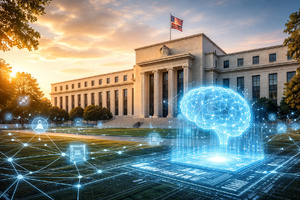
The latest Federal Reserve meeting minutes reveal a central bank navigating two powerful crosscurrents: a widening internal divide over the future path of interest rates and an emerging debate over how artificial intelligence may reshape productivity, inflation and financial stability. While policymakers were largely united in holding rates steady at their most recent meeting, the unanimity masked a deeper disagreement about what comes next—and about how to interpret the structural transformation unfolding beneath the surface of the U.S. economy.
The Federal Open Market Committee’s decision to maintain its benchmark rate within the 3.50%–3.75% range signaled caution after a period of monetary easing. Yet the minutes expose a policy conversation far from settled. Some officials remain prepared to tighten policy again if inflation proves stubborn. Others anticipate renewed rate cuts should price pressures recede as expected. Layered atop that traditional debate is a more novel and consequential discussion: whether the accelerating adoption of AI will generate a productivity boom capable of easing inflationary constraints—or instead create asset bubbles and financial imbalances that complicate monetary management.
A Policy Split Rooted in Competing Inflation Narratives
At the heart of the Federal Reserve’s internal divide lies a fundamental disagreement about the trajectory of inflation. Although headline price pressures have moderated from peak levels, inflation remains above the Fed’s long-standing 2% target. For some policymakers, that fact alone argues for patience or even renewed vigilance. The memory of the 1970s, when premature easing reignited price surges, continues to shape the institution’s collective psyche.
Several officials have indicated openness to rate hikes should inflation fail to resume its downward trend. Their reasoning rests on concerns that labor markets remain tight and that demand could outpace the economy’s productive capacity. From this perspective, the risk is not merely elevated inflation but inflation becoming embedded in expectations. Wage growth, while moderating, remains robust enough to sustain service-sector price pressures.
Others, however, argue that monetary policy is already sufficiently restrictive. They see signs of cooling in housing markets, credit growth and consumer spending. For this group, further tightening could unnecessarily damage employment and investment at a moment when structural change is already underway. Their baseline scenario assumes that inflation will continue to ease gradually, allowing room for measured rate cuts later in the year.
What complicates the debate is the uncertainty surrounding the neutral rate—the level at which monetary policy neither stimulates nor restrains the economy. Policymakers do not agree on whether current rates remain restrictive or have moved closer to neutral territory. This ambiguity makes forward guidance difficult and consensus elusive.
Artificial Intelligence as a Productivity Catalyst
Beyond cyclical inflation dynamics, the minutes reveal a growing focus on AI’s potential to alter the economic landscape. Some policymakers express cautious optimism that rapid technological advancement could lift productivity growth, thereby expanding the economy’s potential output. If AI enables firms to produce more with fewer inputs, upward pressure on wages and prices could diminish even amid strong demand.
Historically, productivity surges have reshaped monetary policy calculations. The late 1990s technology boom allowed the economy to grow at a faster pace without igniting inflation, as digital innovation improved efficiency across sectors. Today, proponents of the AI-driven productivity thesis argue that automation, machine learning and advanced data analytics may trigger a comparable transformation.
Generative AI systems are already influencing industries ranging from finance to healthcare, logistics to legal services. Businesses are investing heavily in data centers, semiconductor capacity and AI-integrated software. If these investments yield widespread efficiency gains, the Fed may find itself confronting a structurally higher growth rate with contained inflation—a combination that could justify looser monetary conditions over time.
Yet optimism remains tempered by uncertainty. Productivity gains often take years to diffuse across the economy. Early stages of technological revolutions can instead generate cost pressures as firms invest heavily before reaping returns. Policymakers acknowledge that AI’s ultimate macroeconomic impact may unfold unevenly, complicating near-term decisions.
Financial Stability Concerns in an AI Investment Boom
While some officials focus on AI’s deflationary potential, others highlight financial risks associated with surging valuations in technology sectors. Investment in AI infrastructure—particularly in semiconductor manufacturing, cloud computing and advanced hardware—has propelled asset prices upward. Equity markets have concentrated gains among firms perceived as AI leaders, raising questions about valuation sustainability.
The Fed minutes reference concerns about “opaque private markets,” where venture capital and private equity flows have poured into AI startups. Limited transparency in these markets can obscure leverage and risk concentration. If expectations of rapid AI-driven returns prove overly optimistic, financial imbalances could emerge.
History offers cautionary examples. The dot-com bubble of the late 1990s saw exuberant investment in internet companies before profitability was established. When valuations corrected, the resulting downturn affected broader economic activity. Policymakers today are wary of similar dynamics, particularly given the scale of current capital flows.
Monetary policy cannot directly regulate asset valuations, but it influences financial conditions. A premature easing cycle could amplify speculative behavior, while excessive tightening might stifle productive investment. The Fed’s challenge is to distinguish between sustainable innovation and unsustainable exuberance—an inherently difficult task when technological frontiers are shifting rapidly.
Leadership Transition and the Challenge of Consensus
The internal policy split comes at a delicate institutional moment. Chair Jerome Powell’s term is approaching its end, and leadership transition inevitably shapes expectations. Building consensus within a committee of diverse economic philosophies becomes more challenging during periods of uncertainty.
Some officials advocate a “two-sided” approach to forward guidance, signaling readiness to adjust rates upward or downward depending on incoming data. This reflects a recognition that the economic outlook is unusually fluid. Inflation trends, labor market conditions and AI-driven productivity shifts may all evolve in ways that defy conventional forecasting models.
Market participants have interpreted the minutes as leaning slightly hawkish, given the explicit acknowledgment that rate hikes remain conceivable. Yet pricing in futures markets continues to anticipate eventual rate cuts, reflecting confidence that inflation will moderate. This divergence between internal debate and external expectations underscores the communication challenge facing the Fed.
In past cycles, policy disagreements have often coalesced once data clarified the direction of travel. The current environment is more complex because structural forces—technological change, demographic shifts, global supply chain realignment—interact with cyclical dynamics. AI, in particular, introduces a layer of unpredictability rarely confronted in previous monetary cycles.
Balancing Growth, Employment and Technological Disruption
The Fed’s dual mandate—to promote maximum employment and stable prices—remains the guiding framework. Yet AI’s transformative potential forces policymakers to reinterpret what those goals entail. Automation may displace certain jobs while creating new ones, altering labor market dynamics. Skill mismatches and wage dispersion could intensify during transitional phases.
Some policymakers worry that rapid automation might dampen wage growth in certain sectors, reducing inflationary pressure but also affecting household income distribution. Others argue that AI-driven productivity could enhance profitability and spur investment, ultimately supporting employment in complementary roles.
The minutes suggest that officials are attempting to integrate these considerations into their models, though empirical data remains limited. Traditional indicators such as unemployment rates and core inflation may not fully capture the pace of structural change. Monetary policy, inherently reactive, must operate amid incomplete information.
At the same time, fiscal policy and regulatory frameworks influence how AI’s benefits and risks are distributed. While the Fed does not set technology policy, its decisions interact with broader economic conditions shaped by innovation incentives and workforce adaptation programs.
In this environment, the decision to pause rate adjustments reflects prudence. After multiple cuts in the prior year, policymakers appear intent on assessing whether inflation continues its downward trajectory without jeopardizing growth. The pause allows time to evaluate both cyclical data and the unfolding technological shift.
The Federal Reserve has historically navigated turning points with a mix of caution and adaptability. The minutes reveal an institution aware that the ground beneath it is shifting—not only due to inflation dynamics but also because artificial intelligence may redefine economic potential. The debate unfolding within the committee is less about immediate disagreement and more about calibrating policy for a future whose contours remain uncertain.
(Source:www.investing.com)
The Federal Open Market Committee’s decision to maintain its benchmark rate within the 3.50%–3.75% range signaled caution after a period of monetary easing. Yet the minutes expose a policy conversation far from settled. Some officials remain prepared to tighten policy again if inflation proves stubborn. Others anticipate renewed rate cuts should price pressures recede as expected. Layered atop that traditional debate is a more novel and consequential discussion: whether the accelerating adoption of AI will generate a productivity boom capable of easing inflationary constraints—or instead create asset bubbles and financial imbalances that complicate monetary management.
A Policy Split Rooted in Competing Inflation Narratives
At the heart of the Federal Reserve’s internal divide lies a fundamental disagreement about the trajectory of inflation. Although headline price pressures have moderated from peak levels, inflation remains above the Fed’s long-standing 2% target. For some policymakers, that fact alone argues for patience or even renewed vigilance. The memory of the 1970s, when premature easing reignited price surges, continues to shape the institution’s collective psyche.
Several officials have indicated openness to rate hikes should inflation fail to resume its downward trend. Their reasoning rests on concerns that labor markets remain tight and that demand could outpace the economy’s productive capacity. From this perspective, the risk is not merely elevated inflation but inflation becoming embedded in expectations. Wage growth, while moderating, remains robust enough to sustain service-sector price pressures.
Others, however, argue that monetary policy is already sufficiently restrictive. They see signs of cooling in housing markets, credit growth and consumer spending. For this group, further tightening could unnecessarily damage employment and investment at a moment when structural change is already underway. Their baseline scenario assumes that inflation will continue to ease gradually, allowing room for measured rate cuts later in the year.
What complicates the debate is the uncertainty surrounding the neutral rate—the level at which monetary policy neither stimulates nor restrains the economy. Policymakers do not agree on whether current rates remain restrictive or have moved closer to neutral territory. This ambiguity makes forward guidance difficult and consensus elusive.
Artificial Intelligence as a Productivity Catalyst
Beyond cyclical inflation dynamics, the minutes reveal a growing focus on AI’s potential to alter the economic landscape. Some policymakers express cautious optimism that rapid technological advancement could lift productivity growth, thereby expanding the economy’s potential output. If AI enables firms to produce more with fewer inputs, upward pressure on wages and prices could diminish even amid strong demand.
Historically, productivity surges have reshaped monetary policy calculations. The late 1990s technology boom allowed the economy to grow at a faster pace without igniting inflation, as digital innovation improved efficiency across sectors. Today, proponents of the AI-driven productivity thesis argue that automation, machine learning and advanced data analytics may trigger a comparable transformation.
Generative AI systems are already influencing industries ranging from finance to healthcare, logistics to legal services. Businesses are investing heavily in data centers, semiconductor capacity and AI-integrated software. If these investments yield widespread efficiency gains, the Fed may find itself confronting a structurally higher growth rate with contained inflation—a combination that could justify looser monetary conditions over time.
Yet optimism remains tempered by uncertainty. Productivity gains often take years to diffuse across the economy. Early stages of technological revolutions can instead generate cost pressures as firms invest heavily before reaping returns. Policymakers acknowledge that AI’s ultimate macroeconomic impact may unfold unevenly, complicating near-term decisions.
Financial Stability Concerns in an AI Investment Boom
While some officials focus on AI’s deflationary potential, others highlight financial risks associated with surging valuations in technology sectors. Investment in AI infrastructure—particularly in semiconductor manufacturing, cloud computing and advanced hardware—has propelled asset prices upward. Equity markets have concentrated gains among firms perceived as AI leaders, raising questions about valuation sustainability.
The Fed minutes reference concerns about “opaque private markets,” where venture capital and private equity flows have poured into AI startups. Limited transparency in these markets can obscure leverage and risk concentration. If expectations of rapid AI-driven returns prove overly optimistic, financial imbalances could emerge.
History offers cautionary examples. The dot-com bubble of the late 1990s saw exuberant investment in internet companies before profitability was established. When valuations corrected, the resulting downturn affected broader economic activity. Policymakers today are wary of similar dynamics, particularly given the scale of current capital flows.
Monetary policy cannot directly regulate asset valuations, but it influences financial conditions. A premature easing cycle could amplify speculative behavior, while excessive tightening might stifle productive investment. The Fed’s challenge is to distinguish between sustainable innovation and unsustainable exuberance—an inherently difficult task when technological frontiers are shifting rapidly.
Leadership Transition and the Challenge of Consensus
The internal policy split comes at a delicate institutional moment. Chair Jerome Powell’s term is approaching its end, and leadership transition inevitably shapes expectations. Building consensus within a committee of diverse economic philosophies becomes more challenging during periods of uncertainty.
Some officials advocate a “two-sided” approach to forward guidance, signaling readiness to adjust rates upward or downward depending on incoming data. This reflects a recognition that the economic outlook is unusually fluid. Inflation trends, labor market conditions and AI-driven productivity shifts may all evolve in ways that defy conventional forecasting models.
Market participants have interpreted the minutes as leaning slightly hawkish, given the explicit acknowledgment that rate hikes remain conceivable. Yet pricing in futures markets continues to anticipate eventual rate cuts, reflecting confidence that inflation will moderate. This divergence between internal debate and external expectations underscores the communication challenge facing the Fed.
In past cycles, policy disagreements have often coalesced once data clarified the direction of travel. The current environment is more complex because structural forces—technological change, demographic shifts, global supply chain realignment—interact with cyclical dynamics. AI, in particular, introduces a layer of unpredictability rarely confronted in previous monetary cycles.
Balancing Growth, Employment and Technological Disruption
The Fed’s dual mandate—to promote maximum employment and stable prices—remains the guiding framework. Yet AI’s transformative potential forces policymakers to reinterpret what those goals entail. Automation may displace certain jobs while creating new ones, altering labor market dynamics. Skill mismatches and wage dispersion could intensify during transitional phases.
Some policymakers worry that rapid automation might dampen wage growth in certain sectors, reducing inflationary pressure but also affecting household income distribution. Others argue that AI-driven productivity could enhance profitability and spur investment, ultimately supporting employment in complementary roles.
The minutes suggest that officials are attempting to integrate these considerations into their models, though empirical data remains limited. Traditional indicators such as unemployment rates and core inflation may not fully capture the pace of structural change. Monetary policy, inherently reactive, must operate amid incomplete information.
At the same time, fiscal policy and regulatory frameworks influence how AI’s benefits and risks are distributed. While the Fed does not set technology policy, its decisions interact with broader economic conditions shaped by innovation incentives and workforce adaptation programs.
In this environment, the decision to pause rate adjustments reflects prudence. After multiple cuts in the prior year, policymakers appear intent on assessing whether inflation continues its downward trajectory without jeopardizing growth. The pause allows time to evaluate both cyclical data and the unfolding technological shift.
The Federal Reserve has historically navigated turning points with a mix of caution and adaptability. The minutes reveal an institution aware that the ground beneath it is shifting—not only due to inflation dynamics but also because artificial intelligence may redefine economic potential. The debate unfolding within the committee is less about immediate disagreement and more about calibrating policy for a future whose contours remain uncertain.
(Source:www.investing.com)
