


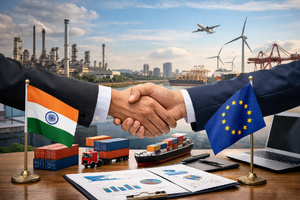
India and the European Union are moving toward a comprehensive trade and partnership framework that goes far beyond tariff adjustments, reshaping how both sides think about market access, industrial policy, and long-term strategic alignment. While early attention has focused on proposed reductions in India’s steep import duties on European automobiles, the broader architecture of the agreement reveals a carefully sequenced opening of sensitive sectors, a recalibration of supply chains, and a parallel deepening of geopolitical cooperation. The deal reflects a convergence of economic necessity and strategic intent at a moment when both sides are seeking diversification away from concentrated dependencies and greater resilience in trade and security ties.
Tariff liberalisation as a signal, not a concession
At the heart of the negotiations is India’s willingness to sharply reduce tariffs on imported passenger vehicles from the EU, cutting rates that have long stood among the highest globally. The proposed move to lower duties to 40% from levels as high as 110% marks a symbolic shift in India’s trade posture, signalling openness without abandoning its long-standing emphasis on domestic manufacturing. Crucially, the reductions are designed with thresholds and quotas that allow New Delhi to test demand, manage political sensitivities, and preserve leverage over the pace of liberalisation.
By focusing initial cuts on higher-value vehicles above a defined price point, India is opening space for European manufacturers to expand their footprint while limiting direct pressure on mass-market domestic producers. The staged approach—where duties are set to fall further over time—creates predictability for investors while retaining policy flexibility. For Brussels, the move demonstrates tangible progress after years of stalled talks, offering its automakers improved access to one of the world’s fastest-growing consumer markets without requiring India to dismantle its protective framework overnight.
Automobiles, investment logic, and the manufacturing calculus
For European carmakers, the tariff changes are less about immediate volume gains and more about strategic optionality. Brands such as Volkswagen, Mercedes-Benz, and BMW already manufacture locally in India, but high import barriers have constrained their ability to introduce broader model ranges or test premium segments at scale. Lower duties on a defined quota of imports allow these firms to assess consumer response, refine product mixes, and build brand equity before committing additional capital to local assembly or component sourcing.
From India’s perspective, the sequencing matters. By excluding battery electric vehicles from immediate tariff cuts and deferring their inclusion, policymakers are protecting nascent domestic investments while buying time to develop supply chains, charging infrastructure, and regulatory standards. This approach aligns with India’s broader industrial strategy, which seeks to attract foreign capital and technology without undermining local champions. It also reflects lessons learned from earlier trade openings, where abrupt liberalisation created political backlash without delivering commensurate investment gains.
India’s passenger vehicle market remains dominated by a handful of domestic and Asian manufacturers, with European brands holding a marginal share despite the country’s scale. The proposed trade framework aims to correct this imbalance gradually, using tariff reductions as a lever to increase competition while avoiding market disruption. As India’s annual car sales are projected to expand significantly over the next decade, policymakers see an opportunity to use controlled openness to deepen technological capabilities, improve quality standards, and integrate more tightly into global value chains.
For the EU, improved access to India helps offset structural pressures closer to home. European automakers face slowing demand, regulatory costs linked to decarbonisation, and intensifying competition from Chinese producers. India offers growth potential, demographic momentum, and a policy environment increasingly receptive to foreign participation—provided it aligns with national development priorities. The trade deal thus functions as a hedge, allowing European firms to diversify revenue streams while contributing to India’s industrial upgrading.
Beyond goods: services, standards, and supply chains
Although automobiles have become the emblem of the negotiations, the agreement’s scope extends well beyond a single sector. Talks have encompassed services liberalisation, regulatory cooperation, and standards alignment—areas that often determine the real economic impact of trade deals. For India, expanded access to European markets for textiles, jewellery, and professional services carries particular weight, especially as exporters navigate shifting global trade dynamics and protectionist pressures elsewhere.
Standards cooperation is equally significant. Mutual recognition in areas such as technical regulations, data governance, and sustainability reporting can reduce non-tariff barriers that quietly constrain trade flows. By embedding such provisions into the framework, both sides are attempting to future-proof the agreement against technological change and regulatory divergence. This is especially relevant for emerging sectors such as digital services, advanced manufacturing, and clean technologies, where rules are still evolving.
The trade negotiations are unfolding alongside a parallel effort to deepen security and defence cooperation, underscoring the strategic logic underpinning the economic pact. The EU’s interest in closer ties with India reflects a broader recalibration of its external relations, driven by geopolitical uncertainty and a desire to reduce over-reliance on a narrow set of partners. India, for its part, sees value in engaging Europe as a complementary pole to its existing partnerships, enhancing strategic autonomy while accessing advanced technologies and industrial collaboration.
Proposals to institutionalise regular dialogue on defence initiatives, maritime security, cyber resilience, and counterterrorism point to a relationship that is becoming more multidimensional. While such cooperation remains bounded by legal frameworks and political sensitivities, its inclusion alongside trade negotiations signals a recognition that economic and security interests are increasingly intertwined. For investors and policymakers alike, this broader alignment enhances the credibility and durability of the economic commitments being discussed.
Political economy and timing considerations
The momentum behind the deal is shaped as much by timing as by substance. Both sides face external pressures that make compromise more attractive: Europe is seeking new growth avenues amid internal transitions, while India is positioning itself as a reliable alternative manufacturing and investment destination in a fragmented global economy. The framing of the agreement as a landmark partnership reflects an understanding that incremental gains, taken together, can redefine the trajectory of bilateral relations.
Domestically, the calibrated nature of India’s concessions helps manage political risk. By emphasising phased implementation, sectoral safeguards, and reciprocal benefits, policymakers can present the deal as a strategic choice rather than a capitulation. In Europe, the agreement offers a narrative of engagement with a major emerging economy that shares an interest in rules-based trade, even as global consensus frays.
What ultimately distinguishes the India–EU framework is its emphasis on evolution rather than finality. The agreement is structured to allow for periodic review, adjustment, and expansion as economic conditions change and trust deepens. This flexibility is critical in a world where technological shifts, geopolitical shocks, and domestic politics can quickly render static trade rules obsolete.
By anchoring tariff liberalisation within a wider matrix of investment, standards, and strategic cooperation, the deal aspires to move beyond transactional exchange toward a more integrated partnership. Its success will depend less on headline tariff numbers than on how effectively both sides implement commitments, manage frictions, and align incentives over time. In that sense, the proposed reductions on car imports are best understood not as an end point, but as an opening move in a longer process of economic and strategic convergence between India and the European Union.
(Source:www.reuters.com)
Tariff liberalisation as a signal, not a concession
At the heart of the negotiations is India’s willingness to sharply reduce tariffs on imported passenger vehicles from the EU, cutting rates that have long stood among the highest globally. The proposed move to lower duties to 40% from levels as high as 110% marks a symbolic shift in India’s trade posture, signalling openness without abandoning its long-standing emphasis on domestic manufacturing. Crucially, the reductions are designed with thresholds and quotas that allow New Delhi to test demand, manage political sensitivities, and preserve leverage over the pace of liberalisation.
By focusing initial cuts on higher-value vehicles above a defined price point, India is opening space for European manufacturers to expand their footprint while limiting direct pressure on mass-market domestic producers. The staged approach—where duties are set to fall further over time—creates predictability for investors while retaining policy flexibility. For Brussels, the move demonstrates tangible progress after years of stalled talks, offering its automakers improved access to one of the world’s fastest-growing consumer markets without requiring India to dismantle its protective framework overnight.
Automobiles, investment logic, and the manufacturing calculus
For European carmakers, the tariff changes are less about immediate volume gains and more about strategic optionality. Brands such as Volkswagen, Mercedes-Benz, and BMW already manufacture locally in India, but high import barriers have constrained their ability to introduce broader model ranges or test premium segments at scale. Lower duties on a defined quota of imports allow these firms to assess consumer response, refine product mixes, and build brand equity before committing additional capital to local assembly or component sourcing.
From India’s perspective, the sequencing matters. By excluding battery electric vehicles from immediate tariff cuts and deferring their inclusion, policymakers are protecting nascent domestic investments while buying time to develop supply chains, charging infrastructure, and regulatory standards. This approach aligns with India’s broader industrial strategy, which seeks to attract foreign capital and technology without undermining local champions. It also reflects lessons learned from earlier trade openings, where abrupt liberalisation created political backlash without delivering commensurate investment gains.
India’s passenger vehicle market remains dominated by a handful of domestic and Asian manufacturers, with European brands holding a marginal share despite the country’s scale. The proposed trade framework aims to correct this imbalance gradually, using tariff reductions as a lever to increase competition while avoiding market disruption. As India’s annual car sales are projected to expand significantly over the next decade, policymakers see an opportunity to use controlled openness to deepen technological capabilities, improve quality standards, and integrate more tightly into global value chains.
For the EU, improved access to India helps offset structural pressures closer to home. European automakers face slowing demand, regulatory costs linked to decarbonisation, and intensifying competition from Chinese producers. India offers growth potential, demographic momentum, and a policy environment increasingly receptive to foreign participation—provided it aligns with national development priorities. The trade deal thus functions as a hedge, allowing European firms to diversify revenue streams while contributing to India’s industrial upgrading.
Beyond goods: services, standards, and supply chains
Although automobiles have become the emblem of the negotiations, the agreement’s scope extends well beyond a single sector. Talks have encompassed services liberalisation, regulatory cooperation, and standards alignment—areas that often determine the real economic impact of trade deals. For India, expanded access to European markets for textiles, jewellery, and professional services carries particular weight, especially as exporters navigate shifting global trade dynamics and protectionist pressures elsewhere.
Standards cooperation is equally significant. Mutual recognition in areas such as technical regulations, data governance, and sustainability reporting can reduce non-tariff barriers that quietly constrain trade flows. By embedding such provisions into the framework, both sides are attempting to future-proof the agreement against technological change and regulatory divergence. This is especially relevant for emerging sectors such as digital services, advanced manufacturing, and clean technologies, where rules are still evolving.
The trade negotiations are unfolding alongside a parallel effort to deepen security and defence cooperation, underscoring the strategic logic underpinning the economic pact. The EU’s interest in closer ties with India reflects a broader recalibration of its external relations, driven by geopolitical uncertainty and a desire to reduce over-reliance on a narrow set of partners. India, for its part, sees value in engaging Europe as a complementary pole to its existing partnerships, enhancing strategic autonomy while accessing advanced technologies and industrial collaboration.
Proposals to institutionalise regular dialogue on defence initiatives, maritime security, cyber resilience, and counterterrorism point to a relationship that is becoming more multidimensional. While such cooperation remains bounded by legal frameworks and political sensitivities, its inclusion alongside trade negotiations signals a recognition that economic and security interests are increasingly intertwined. For investors and policymakers alike, this broader alignment enhances the credibility and durability of the economic commitments being discussed.
Political economy and timing considerations
The momentum behind the deal is shaped as much by timing as by substance. Both sides face external pressures that make compromise more attractive: Europe is seeking new growth avenues amid internal transitions, while India is positioning itself as a reliable alternative manufacturing and investment destination in a fragmented global economy. The framing of the agreement as a landmark partnership reflects an understanding that incremental gains, taken together, can redefine the trajectory of bilateral relations.
Domestically, the calibrated nature of India’s concessions helps manage political risk. By emphasising phased implementation, sectoral safeguards, and reciprocal benefits, policymakers can present the deal as a strategic choice rather than a capitulation. In Europe, the agreement offers a narrative of engagement with a major emerging economy that shares an interest in rules-based trade, even as global consensus frays.
What ultimately distinguishes the India–EU framework is its emphasis on evolution rather than finality. The agreement is structured to allow for periodic review, adjustment, and expansion as economic conditions change and trust deepens. This flexibility is critical in a world where technological shifts, geopolitical shocks, and domestic politics can quickly render static trade rules obsolete.
By anchoring tariff liberalisation within a wider matrix of investment, standards, and strategic cooperation, the deal aspires to move beyond transactional exchange toward a more integrated partnership. Its success will depend less on headline tariff numbers than on how effectively both sides implement commitments, manage frictions, and align incentives over time. In that sense, the proposed reductions on car imports are best understood not as an end point, but as an opening move in a longer process of economic and strategic convergence between India and the European Union.
(Source:www.reuters.com)
