


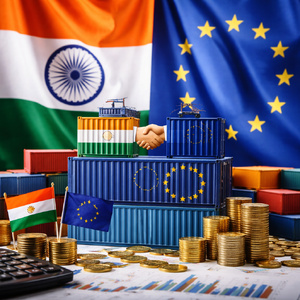
The agreement between India and the European Union to slash tariffs on most traded goods marks a decisive shift in global trade alignments. After nearly two decades of intermittent negotiations, both sides have converged on a framework that prioritises market access, supply-chain resilience, and strategic diversification. The timing reflects more than commercial ambition. It captures a moment when rising trade friction elsewhere, policy unpredictability, and the need for stable growth partners have pushed New Delhi and Brussels toward pragmatic economic cooperation.
At its core, the deal restructures tariff regimes across the bulk of bilateral trade. Europe will remove or sharply reduce duties on almost all goods imported from India over a phased period, while India will significantly lower long-standing protective barriers across industrial sectors. The objective is not simply to boost trade volumes but to re-anchor economic ties in manufacturing, technology, and value-added exports, positioning the partnership as a counterweight to volatility in other major trade relationships.
Strategic Drivers Behind a Long-Delayed Breakthrough
The breakthrough reflects a convergence of strategic interests that matured over time. For India, the agreement aligns with its broader ambition to integrate more deeply into global manufacturing networks while preserving policy space in sensitive areas. For Europe, access to one of the world’s fastest-growing large markets has become increasingly important as firms seek alternatives to concentrated supply chains and rising geopolitical risk.
External pressures accelerated this convergence. Escalating tariff disputes involving the United States injected urgency into trade diplomacy, prompting middle powers to hedge against unilateral trade actions. As Donald Trump pursued aggressive tariff strategies, both India and the EU reassessed their exposure and sought to diversify trade partnerships. The result was renewed momentum in talks that had previously stalled over market access, regulatory standards, and sectoral protections.
Political signalling also mattered. Leaders in New Delhi and Brussels framed the deal as a forward-looking economic partnership rather than a transactional tariff swap. Public endorsements from Narendra Modi and Ursula von der Leyen underscored the agreement’s strategic intent: to anchor long-term cooperation in a fragmented global economy where predictability has become a competitive advantage.
Market Access, Tariff Phasing, and Industrial Trade-Offs
The most consequential changes lie in market access. India has agreed to reduce tariffs across a wide range of European exports, including machinery, electrical equipment, chemicals, iron and steel, and automobiles. The auto sector illustrates the calibrated nature of the concessions. Tariffs that once exceeded 100% will fall in stages, initially to intermediate levels before settling at a much lower rate over several years, subject to quotas and value thresholds. This design protects domestic producers while giving European manufacturers a clear pathway into the Indian market.
On the European side, near-total tariff elimination on Indian exports opens opportunities for sectors where India holds competitive strength. Marine products, textiles, leather goods, gems and jewellery, chemicals, and base metals stand to gain from duty-free or near-zero access over time. The exclusion of agriculture-related items such as dairy, beef, rice, and sugar reflects political sensitivities on both sides, preserving domestic support structures while keeping the focus on industrial and manufactured trade.
The phased structure of tariff cuts is central to the agreement’s durability. By spreading adjustments over several years, both economies can absorb competitive pressures, adjust supply chains, and attract investment aligned with the new trade regime. This gradualism reduces the risk of domestic backlash while reinforcing credibility among businesses planning long-term capacity and sourcing decisions.
Investment, Supply Chains, and Trade Diversification
Beyond tariffs, the agreement reshapes investment incentives and supply-chain strategies. European firms gain greater predictability in a market that has often been characterised by regulatory complexity and high entry costs. Lower duties and clearer rules enhance the case for local manufacturing, joint ventures, and technology transfer, particularly in capital-intensive sectors such as automobiles, renewable energy equipment, and advanced machinery.
For India, the deal complements domestic initiatives aimed at expanding manufacturing capacity and export sophistication. Preferential access to the European market strengthens incentives for Indian firms to move up the value chain, meet higher standards, and integrate into cross-border production networks. As trade volumes expand, ancillary benefits are expected in logistics, services, and skilled employment.
The broader significance lies in diversification. With trade between India and the EU already rivaling India’s commerce with other major partners, the agreement reduces over-reliance on any single market. It embeds India more firmly within European supply chains at a time when firms are reassessing geographic concentration. For Europe, deeper engagement with India offers demographic scale and growth potential that few markets can match, reinforcing resilience amid slowing demand elsewhere.
Climate Rules, Carbon Costs, and the Boundaries of Cooperation
While expansive, the agreement also highlights unresolved tensions, particularly around climate policy. Indian exporters remain exposed to Europe’s carbon-related levies on emissions-intensive goods, which apply to sectors such as steel, cement, fertilisers, and electricity. These measures reflect Europe’s climate priorities but introduce new cost considerations for developing-country exporters.
India has sought assurances of flexibility, arguing that equal treatment should apply if exemptions or adjustments are granted to other partners. The deal stops short of providing immediate relief, underscoring the complexity of reconciling trade liberalisation with climate regulation. Instead, cooperation has taken a different form, with Europe committing financial support to assist India’s emissions-reduction efforts over the coming years.
This parallel track illustrates the evolving nature of trade agreements, where market access increasingly intersects with environmental standards, industrial policy, and development objectives. The India-EU pact does not resolve these frictions, but it establishes a framework within which they can be negotiated without derailing broader economic integration.
Taken together, the agreement represents a recalibration rather than a rupture with past policy. It reflects a shared recognition that in an era of tariff volatility and geopolitical strain, stable and diversified partnerships are essential. By lowering barriers across most goods while managing sensitivities through phased implementation and exclusions, India and Europe have laid the groundwork for a more balanced and resilient trade relationship that extends beyond immediate tariff gains.
(Source:www.bbc.com)
At its core, the deal restructures tariff regimes across the bulk of bilateral trade. Europe will remove or sharply reduce duties on almost all goods imported from India over a phased period, while India will significantly lower long-standing protective barriers across industrial sectors. The objective is not simply to boost trade volumes but to re-anchor economic ties in manufacturing, technology, and value-added exports, positioning the partnership as a counterweight to volatility in other major trade relationships.
Strategic Drivers Behind a Long-Delayed Breakthrough
The breakthrough reflects a convergence of strategic interests that matured over time. For India, the agreement aligns with its broader ambition to integrate more deeply into global manufacturing networks while preserving policy space in sensitive areas. For Europe, access to one of the world’s fastest-growing large markets has become increasingly important as firms seek alternatives to concentrated supply chains and rising geopolitical risk.
External pressures accelerated this convergence. Escalating tariff disputes involving the United States injected urgency into trade diplomacy, prompting middle powers to hedge against unilateral trade actions. As Donald Trump pursued aggressive tariff strategies, both India and the EU reassessed their exposure and sought to diversify trade partnerships. The result was renewed momentum in talks that had previously stalled over market access, regulatory standards, and sectoral protections.
Political signalling also mattered. Leaders in New Delhi and Brussels framed the deal as a forward-looking economic partnership rather than a transactional tariff swap. Public endorsements from Narendra Modi and Ursula von der Leyen underscored the agreement’s strategic intent: to anchor long-term cooperation in a fragmented global economy where predictability has become a competitive advantage.
Market Access, Tariff Phasing, and Industrial Trade-Offs
The most consequential changes lie in market access. India has agreed to reduce tariffs across a wide range of European exports, including machinery, electrical equipment, chemicals, iron and steel, and automobiles. The auto sector illustrates the calibrated nature of the concessions. Tariffs that once exceeded 100% will fall in stages, initially to intermediate levels before settling at a much lower rate over several years, subject to quotas and value thresholds. This design protects domestic producers while giving European manufacturers a clear pathway into the Indian market.
On the European side, near-total tariff elimination on Indian exports opens opportunities for sectors where India holds competitive strength. Marine products, textiles, leather goods, gems and jewellery, chemicals, and base metals stand to gain from duty-free or near-zero access over time. The exclusion of agriculture-related items such as dairy, beef, rice, and sugar reflects political sensitivities on both sides, preserving domestic support structures while keeping the focus on industrial and manufactured trade.
The phased structure of tariff cuts is central to the agreement’s durability. By spreading adjustments over several years, both economies can absorb competitive pressures, adjust supply chains, and attract investment aligned with the new trade regime. This gradualism reduces the risk of domestic backlash while reinforcing credibility among businesses planning long-term capacity and sourcing decisions.
Investment, Supply Chains, and Trade Diversification
Beyond tariffs, the agreement reshapes investment incentives and supply-chain strategies. European firms gain greater predictability in a market that has often been characterised by regulatory complexity and high entry costs. Lower duties and clearer rules enhance the case for local manufacturing, joint ventures, and technology transfer, particularly in capital-intensive sectors such as automobiles, renewable energy equipment, and advanced machinery.
For India, the deal complements domestic initiatives aimed at expanding manufacturing capacity and export sophistication. Preferential access to the European market strengthens incentives for Indian firms to move up the value chain, meet higher standards, and integrate into cross-border production networks. As trade volumes expand, ancillary benefits are expected in logistics, services, and skilled employment.
The broader significance lies in diversification. With trade between India and the EU already rivaling India’s commerce with other major partners, the agreement reduces over-reliance on any single market. It embeds India more firmly within European supply chains at a time when firms are reassessing geographic concentration. For Europe, deeper engagement with India offers demographic scale and growth potential that few markets can match, reinforcing resilience amid slowing demand elsewhere.
Climate Rules, Carbon Costs, and the Boundaries of Cooperation
While expansive, the agreement also highlights unresolved tensions, particularly around climate policy. Indian exporters remain exposed to Europe’s carbon-related levies on emissions-intensive goods, which apply to sectors such as steel, cement, fertilisers, and electricity. These measures reflect Europe’s climate priorities but introduce new cost considerations for developing-country exporters.
India has sought assurances of flexibility, arguing that equal treatment should apply if exemptions or adjustments are granted to other partners. The deal stops short of providing immediate relief, underscoring the complexity of reconciling trade liberalisation with climate regulation. Instead, cooperation has taken a different form, with Europe committing financial support to assist India’s emissions-reduction efforts over the coming years.
This parallel track illustrates the evolving nature of trade agreements, where market access increasingly intersects with environmental standards, industrial policy, and development objectives. The India-EU pact does not resolve these frictions, but it establishes a framework within which they can be negotiated without derailing broader economic integration.
Taken together, the agreement represents a recalibration rather than a rupture with past policy. It reflects a shared recognition that in an era of tariff volatility and geopolitical strain, stable and diversified partnerships are essential. By lowering barriers across most goods while managing sensitivities through phased implementation and exclusions, India and Europe have laid the groundwork for a more balanced and resilient trade relationship that extends beyond immediate tariff gains.
(Source:www.bbc.com)
