


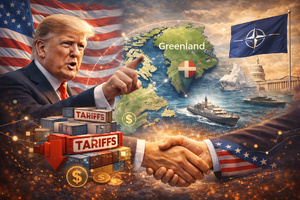
President Donald Trump’s renewed threat to impose escalating tariffs on eight European nations marked a sharp intensification of a dispute that goes far beyond trade balances or customs duties. At its core, the pledge to penalize Denmark, Norway, Sweden, France, Germany, the Netherlands, Finland, and Great Britain until the United States is allowed to acquire Greenland reflects a broader strategy: using economic coercion to pursue geopolitical objectives that allies consider non-negotiable. The episode illustrates how tariffs, once framed as tools to protect domestic industry, have become instruments of foreign policy leverage, reshaping transatlantic relations in the process.
The dispute centers on Greenland, an autonomous territory within the Kingdom of Denmark, whose strategic value has risen steadily as Arctic ice retreats and global competition intensifies. Trump has repeatedly stated that ownership of the island is vital to U.S. security and economic interests, citing its location between North America and Europe and its vast, largely untapped mineral resources. By tying tariffs directly to Greenland’s sale, Trump has blurred the line between trade policy and territorial ambition, creating a precedent that has unsettled European capitals and raised questions about the durability of long-standing alliances.
Economic Pressure as a Diplomatic Weapon
Trump’s tariff threat follows a familiar pattern from his earlier presidency: applying economic pressure to force political concessions. The proposed measures begin with an additional 10% levy on imports from the eight European countries, rising to 25% within months if no agreement is reached. Unlike traditional trade disputes, which are typically justified by unfair practices or national security exemptions, these tariffs are explicitly conditional on a geopolitical outcome—the transfer of sovereignty over Greenland.
This approach reflects Trump’s transactional worldview, where economic tools are used to extract strategic gains. Tariffs, in this context, are not merely punitive but symbolic, signaling Washington’s willingness to disrupt established economic relationships to achieve broader aims. By targeting multiple European economies simultaneously, the threat amplifies uncertainty for businesses and investors, while also testing the cohesion of Europe’s collective response.
The choice of countries is telling. All eight have publicly backed Denmark’s position that Greenland is not for sale and that its future must be determined by its own population. By extending tariffs beyond Denmark itself, Trump has widened the dispute to include allies whose direct involvement in Greenland is limited but whose political support has strengthened Copenhagen’s stance. The message is clear: solidarity carries a cost.
Greenland’s Strategic Weight in a Changing Arctic
Greenland’s importance has grown as climate change accelerates Arctic accessibility. Melting ice is opening new shipping routes and exposing deposits of rare earth elements, uranium, and other critical minerals essential to modern technologies and defense systems. For Washington, securing reliable access to these resources has become a strategic priority amid intensifying competition with China and Russia.
Trump has argued that U.S. ownership of Greenland would provide a decisive advantage in this emerging geopolitical theater. Yet European officials counter that the United States already enjoys extensive military access through long-standing agreements. The Pituffik Space Base, operated by the U.S. military, has for decades served as a key node in missile warning and space surveillance, and existing treaties allow Washington to expand its presence as needed.
This reality has fueled skepticism in Europe about Trump’s stated motivations. Many officials view the push to purchase Greenland less as a security necessity and more as an expression of territorial ambition, one that clashes with post-war norms against altering borders through coercion. The deployment of additional European military personnel to the island, at Denmark’s request, underscores the seriousness with which allies are treating the situation.
Alliance Strain and the Risk to NATO Unity
The tariff threat has reverberated through NATO, an alliance built on collective defense and mutual trust. Several European leaders have warned that using economic punishment against allies for defending shared security principles undermines the alliance’s credibility. The prospect of tariffs linked to a territorial dispute within NATO territory has raised fears of a precedent that could weaken the bloc’s cohesion at a time of heightened external pressure.
European Union leaders have responded with coordinated statements of solidarity with Denmark and Greenland, emphasizing that sovereignty and self-determination are non-negotiable. The call for emergency consultations among EU ambassadors reflects concern that the dispute could escalate quickly, drawing in trade policy, defense planning, and diplomatic strategy simultaneously.
From a European perspective, the danger lies not only in the immediate economic impact of tariffs but in the erosion of predictability. Trade agreements painstakingly negotiated over years could be rendered meaningless if they can be overridden by unilateral demands. This uncertainty complicates long-term planning for industries ranging from automotive manufacturing to aerospace, sectors deeply integrated across the Atlantic.
Domestic and International Calculations in Washington
Within the United States, public support for acquiring Greenland remains limited, suggesting that the issue resonates more as a symbol of strength than as a popular policy goal. Nevertheless, Trump’s stance aligns with a broader narrative of reclaiming American dominance and challenging established diplomatic norms. By framing Greenland as essential to national security, he has sought to legitimize extraordinary measures, including the use of tariffs without clear legislative backing.
Legal questions loom over the tariff strategy. Challenges to the scope of presidential authority on trade have already reached the Supreme Court, and any ruling could have far-reaching implications for the balance of power between the executive branch and Congress. The Greenland-linked tariffs add another layer of complexity, as they are tied not to trade practices but to foreign policy objectives traditionally handled through diplomacy.
Internationally, rivals such as China and Russia have watched the dispute closely. European officials have warned that divisions among Western allies serve the interests of competing powers, particularly in the Arctic, where influence is still being contested. A prolonged rift could weaken coordinated responses to external challenges, from security threats to supply chain vulnerabilities.
Trade Policy at a Crossroads
The Greenland episode highlights a broader transformation in global trade policy. Tariffs are no longer confined to disputes over subsidies or market access; they are increasingly deployed as tools of strategic coercion. For allies accustomed to resolving disagreements through negotiation and multilateral institutions, this shift represents a fundamental challenge.
By linking economic penalties to territorial demands, Trump has raised the stakes of the transatlantic relationship. Even if the tariffs are never fully implemented, the threat itself has already altered perceptions, injecting uncertainty into trade relations and testing the resilience of alliances built over decades.
As European governments weigh their responses, the situation underscores the limits of economic pressure when it collides with issues of sovereignty and identity. Greenland’s leaders have been unequivocal in rejecting any sale, reinforcing the principle that the island’s future cannot be decided by external bargaining. In this sense, the dispute has become a case study in the risks of conflating trade leverage with geopolitical ambition—an approach that may yield short-term attention but carries long-term costs for trust, stability, and cooperation.
(Source:www.theprint.in)
The dispute centers on Greenland, an autonomous territory within the Kingdom of Denmark, whose strategic value has risen steadily as Arctic ice retreats and global competition intensifies. Trump has repeatedly stated that ownership of the island is vital to U.S. security and economic interests, citing its location between North America and Europe and its vast, largely untapped mineral resources. By tying tariffs directly to Greenland’s sale, Trump has blurred the line between trade policy and territorial ambition, creating a precedent that has unsettled European capitals and raised questions about the durability of long-standing alliances.
Economic Pressure as a Diplomatic Weapon
Trump’s tariff threat follows a familiar pattern from his earlier presidency: applying economic pressure to force political concessions. The proposed measures begin with an additional 10% levy on imports from the eight European countries, rising to 25% within months if no agreement is reached. Unlike traditional trade disputes, which are typically justified by unfair practices or national security exemptions, these tariffs are explicitly conditional on a geopolitical outcome—the transfer of sovereignty over Greenland.
This approach reflects Trump’s transactional worldview, where economic tools are used to extract strategic gains. Tariffs, in this context, are not merely punitive but symbolic, signaling Washington’s willingness to disrupt established economic relationships to achieve broader aims. By targeting multiple European economies simultaneously, the threat amplifies uncertainty for businesses and investors, while also testing the cohesion of Europe’s collective response.
The choice of countries is telling. All eight have publicly backed Denmark’s position that Greenland is not for sale and that its future must be determined by its own population. By extending tariffs beyond Denmark itself, Trump has widened the dispute to include allies whose direct involvement in Greenland is limited but whose political support has strengthened Copenhagen’s stance. The message is clear: solidarity carries a cost.
Greenland’s Strategic Weight in a Changing Arctic
Greenland’s importance has grown as climate change accelerates Arctic accessibility. Melting ice is opening new shipping routes and exposing deposits of rare earth elements, uranium, and other critical minerals essential to modern technologies and defense systems. For Washington, securing reliable access to these resources has become a strategic priority amid intensifying competition with China and Russia.
Trump has argued that U.S. ownership of Greenland would provide a decisive advantage in this emerging geopolitical theater. Yet European officials counter that the United States already enjoys extensive military access through long-standing agreements. The Pituffik Space Base, operated by the U.S. military, has for decades served as a key node in missile warning and space surveillance, and existing treaties allow Washington to expand its presence as needed.
This reality has fueled skepticism in Europe about Trump’s stated motivations. Many officials view the push to purchase Greenland less as a security necessity and more as an expression of territorial ambition, one that clashes with post-war norms against altering borders through coercion. The deployment of additional European military personnel to the island, at Denmark’s request, underscores the seriousness with which allies are treating the situation.
Alliance Strain and the Risk to NATO Unity
The tariff threat has reverberated through NATO, an alliance built on collective defense and mutual trust. Several European leaders have warned that using economic punishment against allies for defending shared security principles undermines the alliance’s credibility. The prospect of tariffs linked to a territorial dispute within NATO territory has raised fears of a precedent that could weaken the bloc’s cohesion at a time of heightened external pressure.
European Union leaders have responded with coordinated statements of solidarity with Denmark and Greenland, emphasizing that sovereignty and self-determination are non-negotiable. The call for emergency consultations among EU ambassadors reflects concern that the dispute could escalate quickly, drawing in trade policy, defense planning, and diplomatic strategy simultaneously.
From a European perspective, the danger lies not only in the immediate economic impact of tariffs but in the erosion of predictability. Trade agreements painstakingly negotiated over years could be rendered meaningless if they can be overridden by unilateral demands. This uncertainty complicates long-term planning for industries ranging from automotive manufacturing to aerospace, sectors deeply integrated across the Atlantic.
Domestic and International Calculations in Washington
Within the United States, public support for acquiring Greenland remains limited, suggesting that the issue resonates more as a symbol of strength than as a popular policy goal. Nevertheless, Trump’s stance aligns with a broader narrative of reclaiming American dominance and challenging established diplomatic norms. By framing Greenland as essential to national security, he has sought to legitimize extraordinary measures, including the use of tariffs without clear legislative backing.
Legal questions loom over the tariff strategy. Challenges to the scope of presidential authority on trade have already reached the Supreme Court, and any ruling could have far-reaching implications for the balance of power between the executive branch and Congress. The Greenland-linked tariffs add another layer of complexity, as they are tied not to trade practices but to foreign policy objectives traditionally handled through diplomacy.
Internationally, rivals such as China and Russia have watched the dispute closely. European officials have warned that divisions among Western allies serve the interests of competing powers, particularly in the Arctic, where influence is still being contested. A prolonged rift could weaken coordinated responses to external challenges, from security threats to supply chain vulnerabilities.
Trade Policy at a Crossroads
The Greenland episode highlights a broader transformation in global trade policy. Tariffs are no longer confined to disputes over subsidies or market access; they are increasingly deployed as tools of strategic coercion. For allies accustomed to resolving disagreements through negotiation and multilateral institutions, this shift represents a fundamental challenge.
By linking economic penalties to territorial demands, Trump has raised the stakes of the transatlantic relationship. Even if the tariffs are never fully implemented, the threat itself has already altered perceptions, injecting uncertainty into trade relations and testing the resilience of alliances built over decades.
As European governments weigh their responses, the situation underscores the limits of economic pressure when it collides with issues of sovereignty and identity. Greenland’s leaders have been unequivocal in rejecting any sale, reinforcing the principle that the island’s future cannot be decided by external bargaining. In this sense, the dispute has become a case study in the risks of conflating trade leverage with geopolitical ambition—an approach that may yield short-term attention but carries long-term costs for trust, stability, and cooperation.
(Source:www.theprint.in)
