


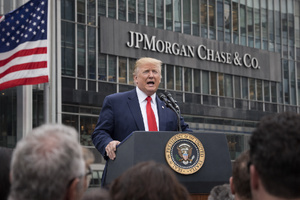
The lawsuit filed by Donald Trump against JPMorgan Chase and its chief executive Jamie Dimon is more than a personal grievance elevated into court. It represents a crystallisation of a deeper and increasingly adversarial relationship between Trump’s political project and the institutions that dominate American finance. While large banks were widely expected to benefit from deregulation, lighter supervision, and capital relief under Trump-aligned regulators, the lawsuit highlights a parallel dynamic: Wall Street is also being recast as a political foil, useful both as a symbol of elite power and as a lever for pressure when it resists presidential priorities.
At the centre of the dispute is Trump’s allegation that JPMorgan closed accounts linked to him and his businesses for political reasons. The bank denies this, insisting that it does not discriminate on ideological grounds. But the legal merits, while important, are almost secondary to the political signal. By framing the dispute as “debanking” motivated by politics, Trump is tapping into a broader narrative that financial institutions have become unelected arbiters of economic participation. This framing resonates with a base already sceptical of corporate power and cultural gatekeeping, and it allows Trump to position himself simultaneously as a victim of elite exclusion and as a champion of those who feel marginalised by institutional finance.
The case also underscores a shift in how conflict with Wall Street is being conducted. Rather than relying solely on regulatory threats or rhetorical attacks, the use of high-profile litigation introduces legal risk, reputational exposure, and prolonged uncertainty. For banks accustomed to navigating predictable regulatory cycles, this personalised and confrontational approach adds a new layer of complexity to their relationship with political power.
Populism meets finance in an era of selective hostility
Trump’s clash with JPMorgan fits into a broader pattern of selective hostility toward major lenders. On one hand, his administration’s regulators have signalled strong support for loosening capital requirements, streamlining supervision, and approving large mergers—policies long sought by the banking industry. On the other, Trump has repeatedly singled out individual banks and executives for criticism, accusing them of ideological bias, unfair treatment, or resistance to his economic agenda.
This duality reflects the internal tension within Trump’s political coalition. Deregulation appeals to market-oriented conservatives and investors, while attacks on Wall Street energise populist supporters who associate big banks with bailouts, globalization, and cultural liberalism. By oscillating between these positions, Trump maintains leverage over both constituencies. The JPMorgan lawsuit exemplifies this strategy: it does not challenge the structural power of large banks through sweeping regulation, but it does place them on notice that political alignment—or perceived opposition—can carry consequences.
The lawsuit also follows Trump’s public clashes with other financial institutions, reinforcing the sense that no bank is entirely insulated from political scrutiny. Accusations of politically motivated account closures, criticism of executives’ policy positions, and threats of intervention in consumer finance markets all contribute to an environment in which banks must weigh not only regulatory compliance but also political optics. This marks a departure from the more technocratic relationship that has traditionally governed interactions between Wall Street and Washington.
Policy pressure beyond the courtroom
The legal action against JPMorgan cannot be separated from Trump’s broader policy posture toward the financial sector. Alongside the lawsuit, Trump has floated proposals such as capping credit card interest rates, a move that directly challenges a core profit centre for large banks. Although framed as consumer protection, such proposals introduce uncertainty into business models built on risk-based pricing and could compress margins across the industry.
At the same time, Trump-aligned regulators have pursued policies that lower capital buffers and reduce compliance burdens, potentially freeing up hundreds of billions of dollars for lending, dividends, or share buybacks. This juxtaposition creates a paradoxical operating environment: banks are being offered structural benefits even as they face episodic political attacks that can damage trust and brand value.
For Wall Street, this unpredictability complicates strategic planning. Lobbying efforts have intensified, with banks expanding their presence in Washington and aligning with advocacy groups designed to shape policy debates. Yet the JPMorgan lawsuit suggests that access and influence offer limited protection against personalised confrontation. Litigation introduces a different risk calculus, one that cannot be easily managed through traditional channels of engagement.
The case also raises questions about precedent. If political leaders increasingly frame disputes with banks as ideological or discriminatory conflicts, financial institutions may become more cautious in how they manage client relationships, compliance decisions, and public messaging. This could lead to more conservative risk management, but it could also heighten tensions around the role banks play in enforcing legal and regulatory standards.
Market confidence amid political turbulence
Despite the intensity of the rhetoric and the size of the lawsuit, market reaction has been relatively muted. Investors largely appear to view the case as a contained political episode rather than a systemic threat to JPMorgan or the banking sector more broadly. Bank stocks have continued to track broader market trends, buoyed by expectations of capital relief, improved profitability, and a more permissive supervisory regime.
This investor confidence reflects a belief that, while politically noisy, the conflict does not fundamentally alter the structural advantages enjoyed by large banks. JPMorgan, in particular, is seen as well-capitalised, diversified, and resilient enough to absorb legal challenges without material damage to its core operations. From this perspective, the lawsuit is a reputational and governance issue rather than a financial one.
Yet the longer-term implications may be subtler. Repeated confrontations with political leadership can erode the perception of neutrality that underpins trust in financial institutions. If banks are increasingly portrayed as political actors—whether fairly or not—their role as intermediaries may be scrutinised more closely by both regulators and the public. Over time, this could influence how financial power is perceived and contested in the United States.
Trump’s lawsuit against JPMorgan thus operates on multiple levels. It is a legal dispute, a political statement, and a signal to Wall Street that alignment with power is no longer assumed. In redefining his relationship with the financial elite, Trump is not seeking to dismantle the system, but to assert dominance over it—using confrontation as a tool to remind even the largest institutions that, in his worldview, no centre of power stands above political will.
(Source:www.businesstimes.com.sg)
At the centre of the dispute is Trump’s allegation that JPMorgan closed accounts linked to him and his businesses for political reasons. The bank denies this, insisting that it does not discriminate on ideological grounds. But the legal merits, while important, are almost secondary to the political signal. By framing the dispute as “debanking” motivated by politics, Trump is tapping into a broader narrative that financial institutions have become unelected arbiters of economic participation. This framing resonates with a base already sceptical of corporate power and cultural gatekeeping, and it allows Trump to position himself simultaneously as a victim of elite exclusion and as a champion of those who feel marginalised by institutional finance.
The case also underscores a shift in how conflict with Wall Street is being conducted. Rather than relying solely on regulatory threats or rhetorical attacks, the use of high-profile litigation introduces legal risk, reputational exposure, and prolonged uncertainty. For banks accustomed to navigating predictable regulatory cycles, this personalised and confrontational approach adds a new layer of complexity to their relationship with political power.
Populism meets finance in an era of selective hostility
Trump’s clash with JPMorgan fits into a broader pattern of selective hostility toward major lenders. On one hand, his administration’s regulators have signalled strong support for loosening capital requirements, streamlining supervision, and approving large mergers—policies long sought by the banking industry. On the other, Trump has repeatedly singled out individual banks and executives for criticism, accusing them of ideological bias, unfair treatment, or resistance to his economic agenda.
This duality reflects the internal tension within Trump’s political coalition. Deregulation appeals to market-oriented conservatives and investors, while attacks on Wall Street energise populist supporters who associate big banks with bailouts, globalization, and cultural liberalism. By oscillating between these positions, Trump maintains leverage over both constituencies. The JPMorgan lawsuit exemplifies this strategy: it does not challenge the structural power of large banks through sweeping regulation, but it does place them on notice that political alignment—or perceived opposition—can carry consequences.
The lawsuit also follows Trump’s public clashes with other financial institutions, reinforcing the sense that no bank is entirely insulated from political scrutiny. Accusations of politically motivated account closures, criticism of executives’ policy positions, and threats of intervention in consumer finance markets all contribute to an environment in which banks must weigh not only regulatory compliance but also political optics. This marks a departure from the more technocratic relationship that has traditionally governed interactions between Wall Street and Washington.
Policy pressure beyond the courtroom
The legal action against JPMorgan cannot be separated from Trump’s broader policy posture toward the financial sector. Alongside the lawsuit, Trump has floated proposals such as capping credit card interest rates, a move that directly challenges a core profit centre for large banks. Although framed as consumer protection, such proposals introduce uncertainty into business models built on risk-based pricing and could compress margins across the industry.
At the same time, Trump-aligned regulators have pursued policies that lower capital buffers and reduce compliance burdens, potentially freeing up hundreds of billions of dollars for lending, dividends, or share buybacks. This juxtaposition creates a paradoxical operating environment: banks are being offered structural benefits even as they face episodic political attacks that can damage trust and brand value.
For Wall Street, this unpredictability complicates strategic planning. Lobbying efforts have intensified, with banks expanding their presence in Washington and aligning with advocacy groups designed to shape policy debates. Yet the JPMorgan lawsuit suggests that access and influence offer limited protection against personalised confrontation. Litigation introduces a different risk calculus, one that cannot be easily managed through traditional channels of engagement.
The case also raises questions about precedent. If political leaders increasingly frame disputes with banks as ideological or discriminatory conflicts, financial institutions may become more cautious in how they manage client relationships, compliance decisions, and public messaging. This could lead to more conservative risk management, but it could also heighten tensions around the role banks play in enforcing legal and regulatory standards.
Market confidence amid political turbulence
Despite the intensity of the rhetoric and the size of the lawsuit, market reaction has been relatively muted. Investors largely appear to view the case as a contained political episode rather than a systemic threat to JPMorgan or the banking sector more broadly. Bank stocks have continued to track broader market trends, buoyed by expectations of capital relief, improved profitability, and a more permissive supervisory regime.
This investor confidence reflects a belief that, while politically noisy, the conflict does not fundamentally alter the structural advantages enjoyed by large banks. JPMorgan, in particular, is seen as well-capitalised, diversified, and resilient enough to absorb legal challenges without material damage to its core operations. From this perspective, the lawsuit is a reputational and governance issue rather than a financial one.
Yet the longer-term implications may be subtler. Repeated confrontations with political leadership can erode the perception of neutrality that underpins trust in financial institutions. If banks are increasingly portrayed as political actors—whether fairly or not—their role as intermediaries may be scrutinised more closely by both regulators and the public. Over time, this could influence how financial power is perceived and contested in the United States.
Trump’s lawsuit against JPMorgan thus operates on multiple levels. It is a legal dispute, a political statement, and a signal to Wall Street that alignment with power is no longer assumed. In redefining his relationship with the financial elite, Trump is not seeking to dismantle the system, but to assert dominance over it—using confrontation as a tool to remind even the largest institutions that, in his worldview, no centre of power stands above political will.
(Source:www.businesstimes.com.sg)
