


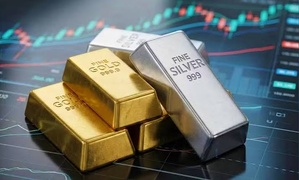
The sharp decline in gold and silver prices has highlighted a recurring reality in global financial markets: precious metals may be viewed as safe-haven assets during periods of uncertainty, but their performance remains heavily influenced by monetary policy expectations. Recent weakness in both metals reflects growing investor concerns that higher interest rates could persist for longer than previously anticipated, reducing the appeal of assets that do not generate income.
The selloff came as investors reassessed the outlook for U.S. monetary policy following signals that inflationary pressures may remain more persistent than markets had hoped. Gold, which has enjoyed a powerful rally over recent years amid geopolitical tensions, central bank buying and economic uncertainty, suddenly found itself facing a different challenge. Instead of focusing primarily on global risks, investors began concentrating on the possibility that interest rates could remain elevated or even move higher.
Silver, which often experiences larger price swings because of its dual role as both a precious and industrial metal, suffered an even steeper decline. The move reflected not only changing expectations regarding monetary policy but also a broader reduction in risk appetite across financial markets as investors adjusted portfolios in response to shifting economic conditions.
The development illustrates how precious metals can be influenced by forces that extend far beyond traditional safe-haven demand. While geopolitical tensions and economic uncertainty often support gold and silver prices, central bank policy frequently determines whether those supportive factors can sustain long-term rallies.
Why Interest Rates Matter So Much for Gold
Gold occupies a unique position within financial markets because it does not generate income. Unlike bonds, which provide interest payments, or dividend-paying stocks, which distribute earnings to shareholders, gold offers no regular return to investors. Its appeal is primarily derived from its role as a store of value and a hedge against economic or political uncertainty.
This characteristic makes interest rates particularly important.
When interest rates are low, the opportunity cost of holding gold is relatively limited. Investors are not giving up significant income by allocating money to precious metals. During such periods, gold often becomes more attractive because its defensive qualities can outweigh the absence of yield.
The situation changes when interest rates rise.
Higher rates increase the returns available from government bonds, savings instruments and other income-producing assets. Investors then face a greater opportunity cost when holding gold because alternative investments become more attractive. As a result, demand for precious metals can weaken even if broader economic uncertainty remains elevated.
This relationship has shaped gold markets for decades. Major rallies in the metal have frequently coincided with periods of low interest rates, aggressive monetary easing or expectations that central banks would eventually reduce borrowing costs. Conversely, expectations of tighter policy have often created headwinds for prices.
Recent market movements reflect this dynamic. Investors increasingly believe that inflation concerns could limit the ability of policymakers to ease monetary conditions in the near future. The prospect of prolonged higher rates has therefore emerged as a significant challenge for precious metals.
Inflation Creates a Complicated Environment
One of the most interesting aspects of the current market environment is that inflation is simultaneously supporting and undermining gold prices.
Traditionally, gold has been viewed as a hedge against inflation. When the purchasing power of currencies declines, investors often turn to tangible assets that may retain value over time. This perception has helped support demand for gold during periods of rising prices.
However, inflation also influences central bank behaviour. When inflation remains elevated, policymakers often respond by maintaining higher interest rates or tightening monetary policy. Such actions can strengthen currencies and increase bond yields, creating conditions that are typically unfavourable for gold.
This creates a complex balancing act for investors. On one hand, persistent inflation can reinforce the case for owning precious metals as a store of value. On the other hand, the policy response to inflation may weaken demand by increasing the attractiveness of competing assets.
The recent decline in gold prices suggests that many investors are currently placing greater emphasis on the second factor. Rather than focusing exclusively on inflation itself, markets are increasingly concentrating on how central banks may respond to it.
This shift in emphasis helps explain why precious metals can sometimes struggle even when inflation remains a concern. Investors are not merely assessing current economic conditions; they are attempting to anticipate future policy decisions and their impact on financial markets.
Silver Faces Additional Pressures
While gold is primarily viewed as a monetary and defensive asset, silver occupies a more complex position within global markets.
In addition to its role as a precious metal, silver is widely used in industrial applications including electronics, renewable energy technologies, medical equipment and manufacturing processes. This dual identity means silver prices are influenced by a broader range of factors than gold.
During periods of economic optimism, industrial demand can provide substantial support. Growing investment in clean energy technologies, solar panels and advanced electronics has strengthened the long-term outlook for silver consumption in recent years.
However, silver's industrial exposure can also increase volatility. When investors become concerned about economic growth, demand expectations for industrial commodities often weaken. Combined with concerns regarding monetary policy, this can create significant downward pressure on prices.
The recent decline illustrates this vulnerability. As financial markets reassessed growth prospects, technology-sector valuations and interest-rate expectations, silver experienced sharper losses than gold. Investors not only questioned the outlook for precious metals but also reconsidered broader assumptions regarding economic momentum and industrial demand.
This pattern is common during periods of market stress. Silver often amplifies moves occurring in gold because it is exposed to both monetary and industrial influences simultaneously.
Central Banks Remain a Key Market Driver
Another important factor influencing precious metals markets is the behaviour of central banks.
Over the past several years, central bank purchases have become a major source of support for gold prices. Many monetary authorities have increased gold holdings as part of broader efforts to diversify reserves and reduce dependence on traditional reserve assets.
These purchases have contributed to a structural increase in demand that helped support prices even during periods of market volatility.
However, central bank buying does not operate in isolation. Financial markets remain heavily influenced by expectations regarding the policies of major institutions such as the Federal Reserve. Changes in interest-rate expectations can often have a more immediate impact on investor behaviour than longer-term structural demand trends.
This explains why gold prices can decline even when central banks continue accumulating reserves. Short-term market movements are often driven by shifts in expectations regarding monetary policy, bond yields and currency markets.
Investors therefore monitor not only the physical demand for precious metals but also the broader economic environment in which those assets trade.
The interaction between central bank reserve management and monetary policy expectations has become one of the defining characteristics of modern gold markets.
A Stronger Dollar Adds Pressure
Currency movements represent another important element influencing precious metals.
Gold and silver are generally priced in U.S. dollars. As a result, changes in the value of the dollar can significantly affect demand from international investors.
When the dollar strengthens, precious metals become more expensive for buyers using other currencies. This can reduce demand and place downward pressure on prices.
A stronger dollar is often associated with higher interest rates because investors seek the improved returns available in dollar-denominated assets. Consequently, rising rates and a stronger currency frequently reinforce each other, creating a challenging environment for precious metals.
The recent market reaction reflects this relationship.
As expectations for tighter monetary policy increased, investors also adjusted views regarding the outlook for the dollar. The combination of higher potential yields and currency strength contributed to reduced enthusiasm for gold and silver.
This interconnected nature of financial markets means that precious-metal investors must consider multiple variables simultaneously. Prices are influenced not only by supply and demand fundamentals but also by currencies, interest rates, inflation expectations and broader economic sentiment.
Markets Shift From Geopolitics to Monetary Policy
One of the most notable developments in recent months has been the changing focus of financial markets.
Periods of geopolitical uncertainty often generate strong demand for safe-haven assets. Gold historically benefits when investors seek protection from political instability, military conflicts or economic disruptions. Such conditions helped support precious metals during various episodes of global uncertainty.
More recently, however, investor attention has increasingly shifted toward monetary policy and inflation.
The change reflects a belief that central-bank decisions may exert a greater influence on asset prices than geopolitical developments in the near term. Even though global uncertainties remain, markets appear increasingly focused on the direction of interest rates and the implications for investment portfolios.
This transition demonstrates the adaptability of financial markets. Investor priorities can change rapidly depending on which risks are perceived as most significant. At times, geopolitical concerns dominate decision-making. At other times, monetary policy becomes the primary driver.
The latest decline in gold and silver suggests that concerns regarding future interest rates have moved to the forefront of investor thinking. Precious metals remain important components of many portfolios, but their near-term direction increasingly depends on whether policymakers can bring inflation under control without requiring a prolonged period of restrictive monetary conditions.
As markets continue evaluating economic data, inflation trends and central-bank signals, the relationship between interest rates and precious metals is likely to remain one of the most important forces shaping investor sentiment. The recent selloff serves as a reminder that even assets with strong long-term support can face significant pressure when monetary policy expectations move against them.
(Source:www.moneycontrol.com)
The selloff came as investors reassessed the outlook for U.S. monetary policy following signals that inflationary pressures may remain more persistent than markets had hoped. Gold, which has enjoyed a powerful rally over recent years amid geopolitical tensions, central bank buying and economic uncertainty, suddenly found itself facing a different challenge. Instead of focusing primarily on global risks, investors began concentrating on the possibility that interest rates could remain elevated or even move higher.
Silver, which often experiences larger price swings because of its dual role as both a precious and industrial metal, suffered an even steeper decline. The move reflected not only changing expectations regarding monetary policy but also a broader reduction in risk appetite across financial markets as investors adjusted portfolios in response to shifting economic conditions.
The development illustrates how precious metals can be influenced by forces that extend far beyond traditional safe-haven demand. While geopolitical tensions and economic uncertainty often support gold and silver prices, central bank policy frequently determines whether those supportive factors can sustain long-term rallies.
Why Interest Rates Matter So Much for Gold
Gold occupies a unique position within financial markets because it does not generate income. Unlike bonds, which provide interest payments, or dividend-paying stocks, which distribute earnings to shareholders, gold offers no regular return to investors. Its appeal is primarily derived from its role as a store of value and a hedge against economic or political uncertainty.
This characteristic makes interest rates particularly important.
When interest rates are low, the opportunity cost of holding gold is relatively limited. Investors are not giving up significant income by allocating money to precious metals. During such periods, gold often becomes more attractive because its defensive qualities can outweigh the absence of yield.
The situation changes when interest rates rise.
Higher rates increase the returns available from government bonds, savings instruments and other income-producing assets. Investors then face a greater opportunity cost when holding gold because alternative investments become more attractive. As a result, demand for precious metals can weaken even if broader economic uncertainty remains elevated.
This relationship has shaped gold markets for decades. Major rallies in the metal have frequently coincided with periods of low interest rates, aggressive monetary easing or expectations that central banks would eventually reduce borrowing costs. Conversely, expectations of tighter policy have often created headwinds for prices.
Recent market movements reflect this dynamic. Investors increasingly believe that inflation concerns could limit the ability of policymakers to ease monetary conditions in the near future. The prospect of prolonged higher rates has therefore emerged as a significant challenge for precious metals.
Inflation Creates a Complicated Environment
One of the most interesting aspects of the current market environment is that inflation is simultaneously supporting and undermining gold prices.
Traditionally, gold has been viewed as a hedge against inflation. When the purchasing power of currencies declines, investors often turn to tangible assets that may retain value over time. This perception has helped support demand for gold during periods of rising prices.
However, inflation also influences central bank behaviour. When inflation remains elevated, policymakers often respond by maintaining higher interest rates or tightening monetary policy. Such actions can strengthen currencies and increase bond yields, creating conditions that are typically unfavourable for gold.
This creates a complex balancing act for investors. On one hand, persistent inflation can reinforce the case for owning precious metals as a store of value. On the other hand, the policy response to inflation may weaken demand by increasing the attractiveness of competing assets.
The recent decline in gold prices suggests that many investors are currently placing greater emphasis on the second factor. Rather than focusing exclusively on inflation itself, markets are increasingly concentrating on how central banks may respond to it.
This shift in emphasis helps explain why precious metals can sometimes struggle even when inflation remains a concern. Investors are not merely assessing current economic conditions; they are attempting to anticipate future policy decisions and their impact on financial markets.
Silver Faces Additional Pressures
While gold is primarily viewed as a monetary and defensive asset, silver occupies a more complex position within global markets.
In addition to its role as a precious metal, silver is widely used in industrial applications including electronics, renewable energy technologies, medical equipment and manufacturing processes. This dual identity means silver prices are influenced by a broader range of factors than gold.
During periods of economic optimism, industrial demand can provide substantial support. Growing investment in clean energy technologies, solar panels and advanced electronics has strengthened the long-term outlook for silver consumption in recent years.
However, silver's industrial exposure can also increase volatility. When investors become concerned about economic growth, demand expectations for industrial commodities often weaken. Combined with concerns regarding monetary policy, this can create significant downward pressure on prices.
The recent decline illustrates this vulnerability. As financial markets reassessed growth prospects, technology-sector valuations and interest-rate expectations, silver experienced sharper losses than gold. Investors not only questioned the outlook for precious metals but also reconsidered broader assumptions regarding economic momentum and industrial demand.
This pattern is common during periods of market stress. Silver often amplifies moves occurring in gold because it is exposed to both monetary and industrial influences simultaneously.
Central Banks Remain a Key Market Driver
Another important factor influencing precious metals markets is the behaviour of central banks.
Over the past several years, central bank purchases have become a major source of support for gold prices. Many monetary authorities have increased gold holdings as part of broader efforts to diversify reserves and reduce dependence on traditional reserve assets.
These purchases have contributed to a structural increase in demand that helped support prices even during periods of market volatility.
However, central bank buying does not operate in isolation. Financial markets remain heavily influenced by expectations regarding the policies of major institutions such as the Federal Reserve. Changes in interest-rate expectations can often have a more immediate impact on investor behaviour than longer-term structural demand trends.
This explains why gold prices can decline even when central banks continue accumulating reserves. Short-term market movements are often driven by shifts in expectations regarding monetary policy, bond yields and currency markets.
Investors therefore monitor not only the physical demand for precious metals but also the broader economic environment in which those assets trade.
The interaction between central bank reserve management and monetary policy expectations has become one of the defining characteristics of modern gold markets.
A Stronger Dollar Adds Pressure
Currency movements represent another important element influencing precious metals.
Gold and silver are generally priced in U.S. dollars. As a result, changes in the value of the dollar can significantly affect demand from international investors.
When the dollar strengthens, precious metals become more expensive for buyers using other currencies. This can reduce demand and place downward pressure on prices.
A stronger dollar is often associated with higher interest rates because investors seek the improved returns available in dollar-denominated assets. Consequently, rising rates and a stronger currency frequently reinforce each other, creating a challenging environment for precious metals.
The recent market reaction reflects this relationship.
As expectations for tighter monetary policy increased, investors also adjusted views regarding the outlook for the dollar. The combination of higher potential yields and currency strength contributed to reduced enthusiasm for gold and silver.
This interconnected nature of financial markets means that precious-metal investors must consider multiple variables simultaneously. Prices are influenced not only by supply and demand fundamentals but also by currencies, interest rates, inflation expectations and broader economic sentiment.
Markets Shift From Geopolitics to Monetary Policy
One of the most notable developments in recent months has been the changing focus of financial markets.
Periods of geopolitical uncertainty often generate strong demand for safe-haven assets. Gold historically benefits when investors seek protection from political instability, military conflicts or economic disruptions. Such conditions helped support precious metals during various episodes of global uncertainty.
More recently, however, investor attention has increasingly shifted toward monetary policy and inflation.
The change reflects a belief that central-bank decisions may exert a greater influence on asset prices than geopolitical developments in the near term. Even though global uncertainties remain, markets appear increasingly focused on the direction of interest rates and the implications for investment portfolios.
This transition demonstrates the adaptability of financial markets. Investor priorities can change rapidly depending on which risks are perceived as most significant. At times, geopolitical concerns dominate decision-making. At other times, monetary policy becomes the primary driver.
The latest decline in gold and silver suggests that concerns regarding future interest rates have moved to the forefront of investor thinking. Precious metals remain important components of many portfolios, but their near-term direction increasingly depends on whether policymakers can bring inflation under control without requiring a prolonged period of restrictive monetary conditions.
As markets continue evaluating economic data, inflation trends and central-bank signals, the relationship between interest rates and precious metals is likely to remain one of the most important forces shaping investor sentiment. The recent selloff serves as a reminder that even assets with strong long-term support can face significant pressure when monetary policy expectations move against them.
(Source:www.moneycontrol.com)
