


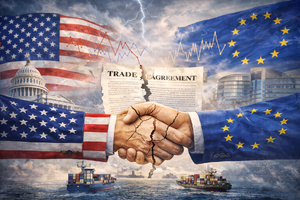
Europe has moved swiftly to counter what officials describe as escalating tariff instability emanating from Washington, warning that recently negotiated trade arrangements could unravel if legal and policy clarity is not restored. The latest flashpoint emerged after the United States introduced a new global 15% import tariff following a Supreme Court ruling that struck down an earlier tariff framework. Although the headline rate for many European exports remains nominally unchanged, the abrupt legal pivot has unsettled policymakers in Brussels, Berlin, Paris and London.
At stake is not merely the level of tariffs but the credibility of negotiated commitments. European leaders argue that repeated shifts in U.S. tariff policy undermine the predictability that trade agreements are designed to secure. In a rules-based trading system, stability often matters as much as market access itself.
The reaction from European institutions reflects a deeper anxiety: that tariff volatility erodes the foundation of transatlantic economic cooperation at a moment when geopolitical coordination is increasingly vital.
Legal Shockwaves and Policy Recalibration
The U.S. Supreme Court’s invalidation of the previous tariff regime triggered a rapid executive response, with new duties imposed under an alternative legal authority. The revised framework allows temporary tariffs of up to 15% for a limited period before congressional approval is required. While technically compliant with domestic law, the shift has generated confusion abroad.
European officials have emphasized that agreements reached under earlier understandings were premised on a stable tariff environment. If the legal architecture underpinning those tariffs changes abruptly, the enforceability and interpretation of existing trade deals come into question.
The European Commission has reiterated that negotiated commitments must be honored in spirit as well as letter. European Parliament figures have publicly characterized the evolving U.S. stance as destabilizing, calling for legal assessments before implementing or continuing concessions tied to transatlantic arrangements.
This insistence on clarity is not rhetorical. Trade agreements often contain detailed provisions regarding tariff ceilings, exemptions and dispute resolution mechanisms. When baseline assumptions shift, the entire matrix of concessions can be reopened.
Risk to Existing Trade Arrangements
The European Union and the United Kingdom had previously negotiated differentiated tariff outcomes with Washington. For EU exporters, the prevailing rate aligned with the new 15% level in many categories, accompanied by specific exclusions. The U.K., by contrast, had secured a lower baseline rate, creating a competitive advantage for certain goods.
Under the new framework, countries that had negotiated preferential treatment could find themselves disadvantaged if uniform rates are applied. European policymakers warn that this dynamic effectively penalizes early engagement and undermines incentives to strike tailored agreements.
Trade-weighted impacts vary across partners, but even modest percentage changes can influence competitiveness in sectors such as automotive manufacturing, machinery, chemicals and agriculture. European capitals are therefore scrutinizing whether the new U.S. approach alters the practical benefits embedded in prior deals.
For Brussels, the issue transcends individual tariff lines. It concerns the integrity of the negotiation process. If commitments appear contingent on domestic litigation outcomes or executive reinterpretation, the reliability of future accords may be questioned.
Economic and Political Stakes
The transatlantic economy remains one of the largest bilateral trade relationships in the world, encompassing goods, services, investment and technology flows. Disruptions in tariff policy reverberate across supply chains that integrate American and European production networks.
European industries reliant on U.S. demand face renewed uncertainty about pricing, margins and market access. At the same time, U.S. firms operating in Europe could encounter reciprocal measures if Brussels opts for retaliatory steps. French officials have signaled that countermeasures remain on the table should the U.S. fail to provide satisfactory assurances.
Financial markets have responded cautiously, with European equities showing sensitivity to renewed trade friction. The European Central Bank has underscored the importance of predictability for business planning, likening trade rules to traffic laws that must be understood before economic actors proceed.
Politically, European leaders face domestic pressure to defend commercial interests while avoiding escalation. A fragmented response could weaken the bloc’s negotiating leverage, prompting calls for unity among member states.
Strategic Autonomy and Long-Term Realignment
Beyond immediate tariff rates, the episode feeds into a broader European debate over strategic autonomy. The European Union has in recent years sought to diversify supply chains, strengthen internal market resilience and reduce overreliance on external partners in critical sectors.
Repeated tariff turbulence from Washington may accelerate these efforts. Policymakers could prioritize regional industrial policies, deepen trade ties with alternative partners and reinforce World Trade Organization mechanisms where possible.
At the same time, transatlantic alignment remains strategically significant, particularly in areas such as technology standards, climate policy and geopolitical coordination. European officials have signaled that they prefer de-escalation and legal clarity over confrontation.
The United States has indicated that its underlying trade objectives remain unchanged and that previously negotiated agreements are intended to stand. However, European counterparts argue that assurances must be accompanied by transparent legal frameworks and durable commitments.
The current impasse illustrates the delicate balance between domestic legal processes and international economic diplomacy. As Washington recalibrates its tariff authority within constitutional boundaries, Europe is asserting that predictability is a non-negotiable component of modern trade relations.
In this environment, the phrase “pure tariff chaos” captures not only frustration but strategic concern. For Europe, the stability of trade rules underpins investment decisions, supply-chain integration and political trust. Without clarity, even unchanged tariff rates can feel uncertain, and uncertainty itself becomes the most disruptive tariff of all.
(Source:www.ft.com)
At stake is not merely the level of tariffs but the credibility of negotiated commitments. European leaders argue that repeated shifts in U.S. tariff policy undermine the predictability that trade agreements are designed to secure. In a rules-based trading system, stability often matters as much as market access itself.
The reaction from European institutions reflects a deeper anxiety: that tariff volatility erodes the foundation of transatlantic economic cooperation at a moment when geopolitical coordination is increasingly vital.
Legal Shockwaves and Policy Recalibration
The U.S. Supreme Court’s invalidation of the previous tariff regime triggered a rapid executive response, with new duties imposed under an alternative legal authority. The revised framework allows temporary tariffs of up to 15% for a limited period before congressional approval is required. While technically compliant with domestic law, the shift has generated confusion abroad.
European officials have emphasized that agreements reached under earlier understandings were premised on a stable tariff environment. If the legal architecture underpinning those tariffs changes abruptly, the enforceability and interpretation of existing trade deals come into question.
The European Commission has reiterated that negotiated commitments must be honored in spirit as well as letter. European Parliament figures have publicly characterized the evolving U.S. stance as destabilizing, calling for legal assessments before implementing or continuing concessions tied to transatlantic arrangements.
This insistence on clarity is not rhetorical. Trade agreements often contain detailed provisions regarding tariff ceilings, exemptions and dispute resolution mechanisms. When baseline assumptions shift, the entire matrix of concessions can be reopened.
Risk to Existing Trade Arrangements
The European Union and the United Kingdom had previously negotiated differentiated tariff outcomes with Washington. For EU exporters, the prevailing rate aligned with the new 15% level in many categories, accompanied by specific exclusions. The U.K., by contrast, had secured a lower baseline rate, creating a competitive advantage for certain goods.
Under the new framework, countries that had negotiated preferential treatment could find themselves disadvantaged if uniform rates are applied. European policymakers warn that this dynamic effectively penalizes early engagement and undermines incentives to strike tailored agreements.
Trade-weighted impacts vary across partners, but even modest percentage changes can influence competitiveness in sectors such as automotive manufacturing, machinery, chemicals and agriculture. European capitals are therefore scrutinizing whether the new U.S. approach alters the practical benefits embedded in prior deals.
For Brussels, the issue transcends individual tariff lines. It concerns the integrity of the negotiation process. If commitments appear contingent on domestic litigation outcomes or executive reinterpretation, the reliability of future accords may be questioned.
Economic and Political Stakes
The transatlantic economy remains one of the largest bilateral trade relationships in the world, encompassing goods, services, investment and technology flows. Disruptions in tariff policy reverberate across supply chains that integrate American and European production networks.
European industries reliant on U.S. demand face renewed uncertainty about pricing, margins and market access. At the same time, U.S. firms operating in Europe could encounter reciprocal measures if Brussels opts for retaliatory steps. French officials have signaled that countermeasures remain on the table should the U.S. fail to provide satisfactory assurances.
Financial markets have responded cautiously, with European equities showing sensitivity to renewed trade friction. The European Central Bank has underscored the importance of predictability for business planning, likening trade rules to traffic laws that must be understood before economic actors proceed.
Politically, European leaders face domestic pressure to defend commercial interests while avoiding escalation. A fragmented response could weaken the bloc’s negotiating leverage, prompting calls for unity among member states.
Strategic Autonomy and Long-Term Realignment
Beyond immediate tariff rates, the episode feeds into a broader European debate over strategic autonomy. The European Union has in recent years sought to diversify supply chains, strengthen internal market resilience and reduce overreliance on external partners in critical sectors.
Repeated tariff turbulence from Washington may accelerate these efforts. Policymakers could prioritize regional industrial policies, deepen trade ties with alternative partners and reinforce World Trade Organization mechanisms where possible.
At the same time, transatlantic alignment remains strategically significant, particularly in areas such as technology standards, climate policy and geopolitical coordination. European officials have signaled that they prefer de-escalation and legal clarity over confrontation.
The United States has indicated that its underlying trade objectives remain unchanged and that previously negotiated agreements are intended to stand. However, European counterparts argue that assurances must be accompanied by transparent legal frameworks and durable commitments.
The current impasse illustrates the delicate balance between domestic legal processes and international economic diplomacy. As Washington recalibrates its tariff authority within constitutional boundaries, Europe is asserting that predictability is a non-negotiable component of modern trade relations.
In this environment, the phrase “pure tariff chaos” captures not only frustration but strategic concern. For Europe, the stability of trade rules underpins investment decisions, supply-chain integration and political trust. Without clarity, even unchanged tariff rates can feel uncertain, and uncertainty itself becomes the most disruptive tariff of all.
(Source:www.ft.com)
