


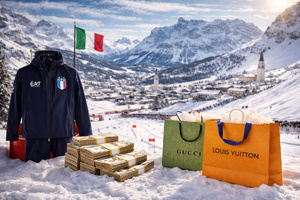
The Winter Games in Italy are emerging as more than a sporting event. They are becoming a carefully choreographed global stage for luxury brands seeking visibility, legitimacy, and emotional connection at a moment when traditional marketing channels feel increasingly saturated. With Milan and Cortina d’Ampezzo sharing the spotlight, the Games offer a rare convergence of fashion credibility, elite leisure culture, and worldwide broadcast reach—an alignment that explains why luxury houses are investing heavily in presence rather than merely sponsorship.
Unlike summer sporting spectacles that often prioritize scale and mass participation, winter competitions are associated with exclusivity, technical precision, and affluent audiences. For luxury brands, this association is not incidental. It reinforces narratives of craftsmanship, performance, and lifestyle aspiration, all while delivering exposure to a global audience tuned in not only for medals but for atmosphere and identity.
Italy’s dual appeal: metropolitan fashion and alpine heritage
The geographic structure of the Italian Winter Games is central to their appeal. Milan represents modern luxury—global, creative, and commercially powerful—while Cortina d’Ampezzo embodies heritage, discretion, and old-world glamour. Together, they mirror the dual identity many luxury brands seek to project: innovative yet rooted, contemporary yet timeless.
Milan’s status as a fashion capital gives the Games immediate cultural legitimacy. For brands, this transforms sponsorship from a logo-placement exercise into a form of cultural participation. Meanwhile, Cortina’s alpine setting provides a natural backdrop for outerwear, technical apparel, and winter accessories, allowing products to be shown in environments that feel authentic rather than staged.
This “city and mountains” dynamic enables brands to tell layered stories—about urban sophistication and performance under extreme conditions—without fragmenting their message.
Why luxury brands are turning to sport as a narrative platform
Luxury’s growing interest in elite sport reflects a broader shift in consumer behavior. High-net-worth consumers are increasingly prioritizing experiences, identity, and values over conspicuous consumption. Sporting events, particularly global ones, offer a way to embed products within narratives of excellence, resilience, and national pride.
The Winter Games amplify this effect. They emphasize individual mastery, technological edge, and physical endurance—qualities that translate seamlessly into luxury storytelling. When brands dress athletes, outfit national teams, or design capsule collections inspired by winter sports, they are not simply selling products; they are aligning themselves with performance at the highest level.
This strategy also broadens reach. While luxury traditionally speaks to a narrow audience, the Olympics gather viewers across demographics and geographies. The challenge for brands is to maintain exclusivity while embracing scale, and winter sports—with their inherently premium associations—help resolve that tension.
Heritage brands and the logic of “coming home”
For several Italian luxury houses, the Winter Games represent a return to origins rather than a departure into new territory. Outerwear specialists and alpine-inspired brands can trace their DNA directly to mountain culture, making participation feel organic rather than opportunistic.
This is particularly evident in the renewed engagement of brands that historically supplied technical gear before evolving into global luxury names. Re-entering the Olympic sphere allows them to reconnect with their functional roots while showcasing how far their craftsmanship has evolved. The result is a narrative arc that resonates with consumers seeking authenticity over novelty.
Italy’s role as host intensifies this effect. When brand heritage aligns with national identity and geography, the Games become a form of cultural validation rather than a marketing expense.
Dressing teams as soft power and global advertising
Outfitting national teams has become one of the most effective luxury strategies around the Games. Uniforms function as moving billboards, but with far greater emotional impact. They are worn during medal ceremonies, opening parades, and moments of national celebration, embedding brand imagery into collective memory.
For brands like Giorgio Armani, whose EA7 line has deep ties to Italian winter sports, this role reinforces national prestige while highlighting technical capability. Similarly, Ralph Lauren’s long-standing association with the U.S. Olympic team demonstrates how continuity builds trust and recognition over time.
These partnerships are not short-term sales drivers. They are reputation investments, positioning brands as custodians of national image and sporting excellence.
Away from stadiums and broadcast cameras, Cortina d’Ampezzo has become a focal point for physical brand presence. With a permanent population of just over 5,000, the Alpine town punches far above its weight during peak seasons, drawing affluent travelers who value discretion as much as luxury.
In anticipation of the Games, brands have rushed to open or renovate boutiques along Corso Italia, Cortina’s main shopping artery. Prada and Loro Piana have launched new stores, while Dior, Louis Vuitton, and Swatch have upgraded existing spaces.
These investments reflect confidence that Olympic-driven visibility will translate into long-term destination appeal. Even after the Games conclude, Cortina’s enhanced retail landscape is expected to benefit from increased international awareness.
Capsules, collaborations, and controlled scarcity
Another defining feature of luxury engagement with the Winter Games is the rise of limited-edition capsule collections. Inspired by winter sports aesthetics—technical fabrics, alpine color palettes, and performance silhouettes—these collections allow brands to experiment without diluting core lines.
Capsules also exploit scarcity, a cornerstone of luxury value. Tied to a specific event and moment in time, they encourage immediate purchase while reinforcing the sense that the Games are a cultural milestone. For consumers, owning such items becomes a way of participating in the event, even from afar.
This approach mirrors strategies seen at other global events but gains particular traction in winter sports, where functional design and luxury craftsmanship naturally intersect.
The Olympics as a cultural mega-platform
What distinguishes the Winter Games in Italy is how seamlessly they integrate into the broader cultural ecosystem. Luxury brands increasingly view the Olympics not merely as a sporting event, but as a global cultural platform where fashion, design, and national identity converge.
This perspective was reinforced when LVMH partnered with the Paris Summer Games, setting a precedent for deep luxury involvement. Italy’s Winter Games extend this logic, benefiting from the country’s long-standing association with design excellence and artisanal skill.
For brands, the appeal lies in staging “savoir-faire” on a scale that few other events allow—without sacrificing the aura of exclusivity that defines luxury.
The strategic importance of the Winter Games extends beyond their duration. Infrastructure upgrades, increased tourism, and sustained media exposure reshape perceptions of host locations. For luxury brands, early and visible involvement positions them to benefit from this halo effect long after medals are awarded.
Italy’s Winter Games offer a case study in how global sport, place branding, and luxury marketing increasingly intersect. By aligning with an event that embodies performance, elegance, and heritage, luxury brands are not just seeking attention—they are reinforcing narratives that underpin their value in an increasingly experience-driven economy.
In doing so, they turn the Winter Games into more than a competition. They become a living showroom, a cultural statement, and a reminder that in luxury, context matters as much as product.
(Source:www.devdiscourse.com)
Unlike summer sporting spectacles that often prioritize scale and mass participation, winter competitions are associated with exclusivity, technical precision, and affluent audiences. For luxury brands, this association is not incidental. It reinforces narratives of craftsmanship, performance, and lifestyle aspiration, all while delivering exposure to a global audience tuned in not only for medals but for atmosphere and identity.
Italy’s dual appeal: metropolitan fashion and alpine heritage
The geographic structure of the Italian Winter Games is central to their appeal. Milan represents modern luxury—global, creative, and commercially powerful—while Cortina d’Ampezzo embodies heritage, discretion, and old-world glamour. Together, they mirror the dual identity many luxury brands seek to project: innovative yet rooted, contemporary yet timeless.
Milan’s status as a fashion capital gives the Games immediate cultural legitimacy. For brands, this transforms sponsorship from a logo-placement exercise into a form of cultural participation. Meanwhile, Cortina’s alpine setting provides a natural backdrop for outerwear, technical apparel, and winter accessories, allowing products to be shown in environments that feel authentic rather than staged.
This “city and mountains” dynamic enables brands to tell layered stories—about urban sophistication and performance under extreme conditions—without fragmenting their message.
Why luxury brands are turning to sport as a narrative platform
Luxury’s growing interest in elite sport reflects a broader shift in consumer behavior. High-net-worth consumers are increasingly prioritizing experiences, identity, and values over conspicuous consumption. Sporting events, particularly global ones, offer a way to embed products within narratives of excellence, resilience, and national pride.
The Winter Games amplify this effect. They emphasize individual mastery, technological edge, and physical endurance—qualities that translate seamlessly into luxury storytelling. When brands dress athletes, outfit national teams, or design capsule collections inspired by winter sports, they are not simply selling products; they are aligning themselves with performance at the highest level.
This strategy also broadens reach. While luxury traditionally speaks to a narrow audience, the Olympics gather viewers across demographics and geographies. The challenge for brands is to maintain exclusivity while embracing scale, and winter sports—with their inherently premium associations—help resolve that tension.
Heritage brands and the logic of “coming home”
For several Italian luxury houses, the Winter Games represent a return to origins rather than a departure into new territory. Outerwear specialists and alpine-inspired brands can trace their DNA directly to mountain culture, making participation feel organic rather than opportunistic.
This is particularly evident in the renewed engagement of brands that historically supplied technical gear before evolving into global luxury names. Re-entering the Olympic sphere allows them to reconnect with their functional roots while showcasing how far their craftsmanship has evolved. The result is a narrative arc that resonates with consumers seeking authenticity over novelty.
Italy’s role as host intensifies this effect. When brand heritage aligns with national identity and geography, the Games become a form of cultural validation rather than a marketing expense.
Dressing teams as soft power and global advertising
Outfitting national teams has become one of the most effective luxury strategies around the Games. Uniforms function as moving billboards, but with far greater emotional impact. They are worn during medal ceremonies, opening parades, and moments of national celebration, embedding brand imagery into collective memory.
For brands like Giorgio Armani, whose EA7 line has deep ties to Italian winter sports, this role reinforces national prestige while highlighting technical capability. Similarly, Ralph Lauren’s long-standing association with the U.S. Olympic team demonstrates how continuity builds trust and recognition over time.
These partnerships are not short-term sales drivers. They are reputation investments, positioning brands as custodians of national image and sporting excellence.
Away from stadiums and broadcast cameras, Cortina d’Ampezzo has become a focal point for physical brand presence. With a permanent population of just over 5,000, the Alpine town punches far above its weight during peak seasons, drawing affluent travelers who value discretion as much as luxury.
In anticipation of the Games, brands have rushed to open or renovate boutiques along Corso Italia, Cortina’s main shopping artery. Prada and Loro Piana have launched new stores, while Dior, Louis Vuitton, and Swatch have upgraded existing spaces.
These investments reflect confidence that Olympic-driven visibility will translate into long-term destination appeal. Even after the Games conclude, Cortina’s enhanced retail landscape is expected to benefit from increased international awareness.
Capsules, collaborations, and controlled scarcity
Another defining feature of luxury engagement with the Winter Games is the rise of limited-edition capsule collections. Inspired by winter sports aesthetics—technical fabrics, alpine color palettes, and performance silhouettes—these collections allow brands to experiment without diluting core lines.
Capsules also exploit scarcity, a cornerstone of luxury value. Tied to a specific event and moment in time, they encourage immediate purchase while reinforcing the sense that the Games are a cultural milestone. For consumers, owning such items becomes a way of participating in the event, even from afar.
This approach mirrors strategies seen at other global events but gains particular traction in winter sports, where functional design and luxury craftsmanship naturally intersect.
The Olympics as a cultural mega-platform
What distinguishes the Winter Games in Italy is how seamlessly they integrate into the broader cultural ecosystem. Luxury brands increasingly view the Olympics not merely as a sporting event, but as a global cultural platform where fashion, design, and national identity converge.
This perspective was reinforced when LVMH partnered with the Paris Summer Games, setting a precedent for deep luxury involvement. Italy’s Winter Games extend this logic, benefiting from the country’s long-standing association with design excellence and artisanal skill.
For brands, the appeal lies in staging “savoir-faire” on a scale that few other events allow—without sacrificing the aura of exclusivity that defines luxury.
The strategic importance of the Winter Games extends beyond their duration. Infrastructure upgrades, increased tourism, and sustained media exposure reshape perceptions of host locations. For luxury brands, early and visible involvement positions them to benefit from this halo effect long after medals are awarded.
Italy’s Winter Games offer a case study in how global sport, place branding, and luxury marketing increasingly intersect. By aligning with an event that embodies performance, elegance, and heritage, luxury brands are not just seeking attention—they are reinforcing narratives that underpin their value in an increasingly experience-driven economy.
In doing so, they turn the Winter Games into more than a competition. They become a living showroom, a cultural statement, and a reminder that in luxury, context matters as much as product.
(Source:www.devdiscourse.com)
