


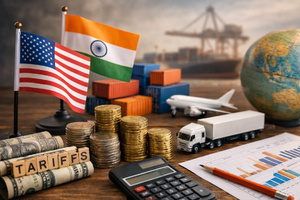
Markets in India reacted swiftly to the announcement that U.S. tariffs on Indian goods would be sharply reduced, even as the absence of formal documentation left policymakers parsing intent rather than text. The signal, delivered directly by Donald Trump, was enough to reverse weeks of anxiety that had followed the imposition of punitive duties and to restore a measure of confidence among exporters, investors, and officials in New Delhi. The relief stemmed less from the precise number cited than from what the move implied: a recalibration of trade relations that places India back within the competitive range of its Asian peers.
For an export-dependent economy navigating slowing global demand, high interest rates, and geopolitical fragmentation, even partial clarity on access to the U.S. market carries outsized importance. The tariff cut, though short on detail, reshaped expectations around growth, currency stability, and supply-chain positioning.
Why tariff relief matters more than formal fine print
Trade policy signals often work through anticipation rather than implementation. In this case, the prospect of tariffs falling from prohibitive levels to a mid-range band immediately altered pricing assumptions for Indian exporters. Under the higher duties, many Indian goods had become uncompetitive relative to shipments from Southeast Asia, forcing firms to either absorb losses or cede market share.
The revised tariff level effectively restores parity. Exporters of labour-intensive goods—such as gems and jewellery, leather products, plastics, ceramics, and auto components—stand to benefit disproportionately because margins in these sectors are thin and highly sensitive to duties. Even without a signed agreement, buyers and suppliers adjust contracts based on expected policy direction. That alone can revive stalled orders and reopen negotiations that had been frozen by uncertainty.
For policymakers, the relief also lies in avoided damage. A prolonged period of elevated tariffs would have undercut India’s manufacturing push and complicated efforts to position the country as an alternative supply base amid global diversification away from China.
Market response reflects confidence in direction, not detail
Financial markets offered a clear verdict on the announcement. Indian equities rallied sharply, led by export-oriented stocks, while the rupee strengthened against the dollar. The reaction suggested investors were less concerned about the absence of technical clauses and more focused on the strategic intent behind the move.
The U.S. remains India’s single largest export destination, accounting for a significant share of outbound goods and services. Any improvement in access to that market feeds directly into earnings visibility and capital flows. The surge in the Nifty 50 and the appreciation of the currency reflected expectations that export revenues would stabilize and that foreign portfolio investors would face fewer downside risks.
This confidence is partly rooted in precedent. Past trade announcements between the two countries have often been followed by phased implementation rather than immediate, sweeping changes. Markets have learned to price the trajectory rather than the timetable.
Strategic trade-offs behind India’s acceptance
While the tariff cut was framed as a concession by Washington, it also implied commitments from New Delhi that carry long-term implications. India’s willingness to expand purchases of U.S. goods—ranging from energy and defence equipment to aircraft and agricultural products—aligns with an ongoing effort to diversify suppliers and strengthen strategic ties.
Energy is a particularly sensitive area. India is one of the world’s largest oil importers, and any rebalancing of sourcing affects inflation, fiscal balances, and industrial costs. A gradual shift toward U.S. energy supplies, rather than an abrupt halt to existing arrangements, allows India to manage price risks while signaling alignment with U.S. strategic preferences.
Similarly, limited openings in agriculture reflect a calibrated approach. India has historically shielded its farm sector due to political sensitivities and the livelihoods of millions of small farmers. Incremental access for select products enables trade progress without destabilizing domestic constituencies.
Relative advantage in an Asian context
The relief in India is magnified by comparison. U.S. tariffs on other Asian exporters remain clustered around similar levels, meaning India no longer faces a structural disadvantage. During the period of higher duties, Indian exporters had been undercut by rivals in Vietnam, Bangladesh, and Indonesia, who could offer comparable products at lower landed costs.
Restoring tariff parity improves India’s negotiating position within global supply chains. Multinational firms assessing where to locate production weigh not only labour costs and infrastructure but also trade predictability. A stable tariff environment with the U.S. strengthens India’s pitch as a long-term manufacturing base, particularly in sectors aligned with global demand for diversification.
The absence of formal statements from either government might normally raise red flags. In this case, however, both sides have incentives to maintain momentum. For Washington, easing tariffs fits a broader narrative of recalibrating trade relationships to secure strategic cooperation. For New Delhi, signaling openness without overcommitting preserves policy flexibility.
Officials in India have emphasized that immediate, disruptive changes—such as a sudden overhaul of energy imports—are unlikely. This gradualism reassures domestic industries and limits inflationary spillovers. Ratings agencies and economists have echoed this view, noting that abrupt shifts could tighten global supply and push up prices.
In effect, the lack of rigid detail leaves room for phased adjustment. That flexibility is valuable in a global environment marked by volatile commodity prices and uneven growth.
Political signaling and bilateral momentum
The parallel messaging from Narendra Modi and Trump underscored the political dimension of the move. Trade agreements between India and the U.S. have often advanced through executive signaling before being translated into technical frameworks. Public affirmation helps anchor expectations and reduces the likelihood of sudden reversals.
For India, the optics of securing tariff relief from its largest export market bolster domestic confidence at a time when external headwinds are mounting. For the U.S., the announcement reinforces a narrative of leveraging trade to achieve broader strategic goals.
Data from recent months had already shown how sensitive Indian exports were to tariff changes, with shipments to the U.S. slowing after higher duties were imposed. The prospect of lower tariffs reverses that trajectory. Exporters can now plan capacity utilization, pricing strategies, and investment with greater certainty.
Beyond immediate trade flows, the announcement feeds into India’s medium-term growth outlook. Stronger exports support manufacturing employment, stabilize the current account, and provide a buffer against global shocks. They also reinforce the government’s ambition to integrate India more deeply into global value chains.
Ultimately, the relief sparked by Trump’s tariff cut reflects a broader reality: in a fragmented global trade system, signals of stability carry immense value. India’s gains stem not from exhaustive documentation but from restored confidence that its access to the U.S. market will not be abruptly curtailed.
The episode highlights how modern trade policy operates as much through messaging as through treaties. For India, the announcement buys time and space—time to recalibrate supply chains, and space to negotiate details without the pressure of punitive tariffs. In an era of frequent shocks, that breathing room itself is a meaningful economic asset.
(Source:www.marketscreener.com)
For an export-dependent economy navigating slowing global demand, high interest rates, and geopolitical fragmentation, even partial clarity on access to the U.S. market carries outsized importance. The tariff cut, though short on detail, reshaped expectations around growth, currency stability, and supply-chain positioning.
Why tariff relief matters more than formal fine print
Trade policy signals often work through anticipation rather than implementation. In this case, the prospect of tariffs falling from prohibitive levels to a mid-range band immediately altered pricing assumptions for Indian exporters. Under the higher duties, many Indian goods had become uncompetitive relative to shipments from Southeast Asia, forcing firms to either absorb losses or cede market share.
The revised tariff level effectively restores parity. Exporters of labour-intensive goods—such as gems and jewellery, leather products, plastics, ceramics, and auto components—stand to benefit disproportionately because margins in these sectors are thin and highly sensitive to duties. Even without a signed agreement, buyers and suppliers adjust contracts based on expected policy direction. That alone can revive stalled orders and reopen negotiations that had been frozen by uncertainty.
For policymakers, the relief also lies in avoided damage. A prolonged period of elevated tariffs would have undercut India’s manufacturing push and complicated efforts to position the country as an alternative supply base amid global diversification away from China.
Market response reflects confidence in direction, not detail
Financial markets offered a clear verdict on the announcement. Indian equities rallied sharply, led by export-oriented stocks, while the rupee strengthened against the dollar. The reaction suggested investors were less concerned about the absence of technical clauses and more focused on the strategic intent behind the move.
The U.S. remains India’s single largest export destination, accounting for a significant share of outbound goods and services. Any improvement in access to that market feeds directly into earnings visibility and capital flows. The surge in the Nifty 50 and the appreciation of the currency reflected expectations that export revenues would stabilize and that foreign portfolio investors would face fewer downside risks.
This confidence is partly rooted in precedent. Past trade announcements between the two countries have often been followed by phased implementation rather than immediate, sweeping changes. Markets have learned to price the trajectory rather than the timetable.
Strategic trade-offs behind India’s acceptance
While the tariff cut was framed as a concession by Washington, it also implied commitments from New Delhi that carry long-term implications. India’s willingness to expand purchases of U.S. goods—ranging from energy and defence equipment to aircraft and agricultural products—aligns with an ongoing effort to diversify suppliers and strengthen strategic ties.
Energy is a particularly sensitive area. India is one of the world’s largest oil importers, and any rebalancing of sourcing affects inflation, fiscal balances, and industrial costs. A gradual shift toward U.S. energy supplies, rather than an abrupt halt to existing arrangements, allows India to manage price risks while signaling alignment with U.S. strategic preferences.
Similarly, limited openings in agriculture reflect a calibrated approach. India has historically shielded its farm sector due to political sensitivities and the livelihoods of millions of small farmers. Incremental access for select products enables trade progress without destabilizing domestic constituencies.
Relative advantage in an Asian context
The relief in India is magnified by comparison. U.S. tariffs on other Asian exporters remain clustered around similar levels, meaning India no longer faces a structural disadvantage. During the period of higher duties, Indian exporters had been undercut by rivals in Vietnam, Bangladesh, and Indonesia, who could offer comparable products at lower landed costs.
Restoring tariff parity improves India’s negotiating position within global supply chains. Multinational firms assessing where to locate production weigh not only labour costs and infrastructure but also trade predictability. A stable tariff environment with the U.S. strengthens India’s pitch as a long-term manufacturing base, particularly in sectors aligned with global demand for diversification.
The absence of formal statements from either government might normally raise red flags. In this case, however, both sides have incentives to maintain momentum. For Washington, easing tariffs fits a broader narrative of recalibrating trade relationships to secure strategic cooperation. For New Delhi, signaling openness without overcommitting preserves policy flexibility.
Officials in India have emphasized that immediate, disruptive changes—such as a sudden overhaul of energy imports—are unlikely. This gradualism reassures domestic industries and limits inflationary spillovers. Ratings agencies and economists have echoed this view, noting that abrupt shifts could tighten global supply and push up prices.
In effect, the lack of rigid detail leaves room for phased adjustment. That flexibility is valuable in a global environment marked by volatile commodity prices and uneven growth.
Political signaling and bilateral momentum
The parallel messaging from Narendra Modi and Trump underscored the political dimension of the move. Trade agreements between India and the U.S. have often advanced through executive signaling before being translated into technical frameworks. Public affirmation helps anchor expectations and reduces the likelihood of sudden reversals.
For India, the optics of securing tariff relief from its largest export market bolster domestic confidence at a time when external headwinds are mounting. For the U.S., the announcement reinforces a narrative of leveraging trade to achieve broader strategic goals.
Data from recent months had already shown how sensitive Indian exports were to tariff changes, with shipments to the U.S. slowing after higher duties were imposed. The prospect of lower tariffs reverses that trajectory. Exporters can now plan capacity utilization, pricing strategies, and investment with greater certainty.
Beyond immediate trade flows, the announcement feeds into India’s medium-term growth outlook. Stronger exports support manufacturing employment, stabilize the current account, and provide a buffer against global shocks. They also reinforce the government’s ambition to integrate India more deeply into global value chains.
Ultimately, the relief sparked by Trump’s tariff cut reflects a broader reality: in a fragmented global trade system, signals of stability carry immense value. India’s gains stem not from exhaustive documentation but from restored confidence that its access to the U.S. market will not be abruptly curtailed.
The episode highlights how modern trade policy operates as much through messaging as through treaties. For India, the announcement buys time and space—time to recalibrate supply chains, and space to negotiate details without the pressure of punitive tariffs. In an era of frequent shocks, that breathing room itself is a meaningful economic asset.
(Source:www.marketscreener.com)
